The surge in interest in electric cars continues, with EVs grabbing a 24.2 per cent share of the Australian new car market in September, just short of August’s record of 24.8 per cent, but the second consecutive month when EVs accounted for nearly one in four new car sales.
Data released on Tuesday by the Federal Chamber of Automotive Industries show the overall new car market is growing – albeit at less than one per cent up from the previous year, but the big surge is in electric cars which outsold petrol cars for the second month in a row.
FCAI acting chief executive Dianne O’Hara said in a statement the result showed that the shift towards electrified vehicles was being sustained. So far in 2026, full battery electric vehicles represent 18.9 per cent of the entire market, compared with 8.1 per cent at the same time in 2025.
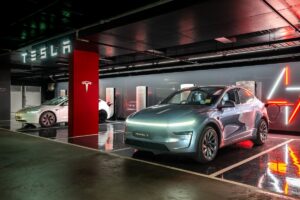
The Model Y remained the best selling EV in September, with 4,476 sales, but lost its place at the top of the overall new car market to the Ford Ranger, and was also overtaken by the Toyota Rav4.
The next best-selling EV was the BYD Sealion 7, with 2,687 sales, and the Geely EX 5 with 2,008. Geely also performed strongly with its new EX2, which generated 1,211 sales. And as we reported last week, the Tesla Model 3 had another strong month with 1,178 sales after performing poorly earlier in the year.
Last week the Electric Vehicle Council revealed that Tesla sold a total of 5,654 EVs in September. They made clear it was not the usual end-of-quarter burst in sales that characterise Tesla data, largely due to different delivery schedules in a rapidly changing market.
Still that took total EV sales to 26,087 for the month, ahead of petrol cars (26,018) and diesels (25,173). A further 10,072 sales came from plug in hybrids, and another 17,843 from mild hybrids, giving “electrified” vehicles a narrow margin over petrol and diesel only cars.
The industry says that continued progress for the EV market will depend on ongoing support through federal government policies such as the NVES – national vehicle emissions standards – which has results in a huge increase in the availability of new models, and a cut in prices.
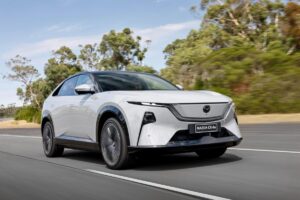
There have been fears that Japanese car makers led by Toyota are pushing for the NVES to be diluted, but Mazda said this week the unexpected success of its new EV models, and more to come, left them feeling comfortable with the settings.
Australia’s best-selling EVs in September
| Rank | Model | Sales |
|---|---|---|
| 1 | Tesla Model Y | 4,476 |
| 2 | BYD Sealion 7 | 2,687 |
| 3 | Geely EX5 | 2,008 |
| 4 | Omoda Jaecoo J5 | 1,754 |
| 5 | Zeekr 7X | 1,628 |
| 6 | Geely EX2 | 1,211 |
| 7 | Tesla Model 3 | 1,178 |
| 8 | BYD Atto 2 | 936 |
| 9 | MG4 Urban | 735 |
| 10 | BYD Atto 1 | 633 |
| 11 | GWM Ora 5 | 609 |
| 12 | Kia EV3 | 564 |
| 13 | Xpeng G6 | 560 |
| 14 | Kia EV5 | 509 |
| 15 | BYD Atto 3 | 460 |
| 16 | Zeekr X | 417 |
| 17 | Toyota bZ4X | 410 |
You can find the full breakdown of EV sales at The Driven’s Australian electric vehicle sales by month in 2026 – by model and by brand
The National Automotive Leasing and Salary Packaging Association (NALSPA) said the Electric Car Discount – the FBT exemption for electric cars up to a certain price point -continued to help working Australians afford vehicles that cost less to run and can be powered by Australian-generated electricity.
“An EV can deliver substantial savings on running costs, but households first need to be able to afford the switch. That is where the Electric Car Discount continues to make a real difference,” said NALSPA chief executive Rohan Martin
“Our members regularly hear from working Australians who would not have been able to consider an EV without the Electric Car Discount. It is helping families access lower running costs while making the vehicle payments more affordable.
“For households with rooftop solar, an EV also offers the opportunity to power their driving with electricity generated at home.
“A home battery can extend that opportunity by storing solar energy for charging later and we note that Australian households installed a record number of rooftop solar systems and home batteries in the first half of 2026.
Martin said the savings were already delivering substantial benefits to household budgets.
“Our data shows that by Christmas, working Australians who bought an EV through the Electric Car Discount between mid-2022 and mid-2026 will have collectively saved an estimated $609 million on fuel,” he said, adding that the postcodes with the highest uptake of the Electric Car Discount are in the outer working suburbs of Sydney, Melbourne and Brisbane.
“Ensuring the Discount continues as proposed by the Albanese Government from April 2027 will be essential to sustaining that progress and keeping those savings within reach of more households.”
Sign up for The Driven’s free daily newsletter and get the latest EV news and analysis delivered straight to your inbox.