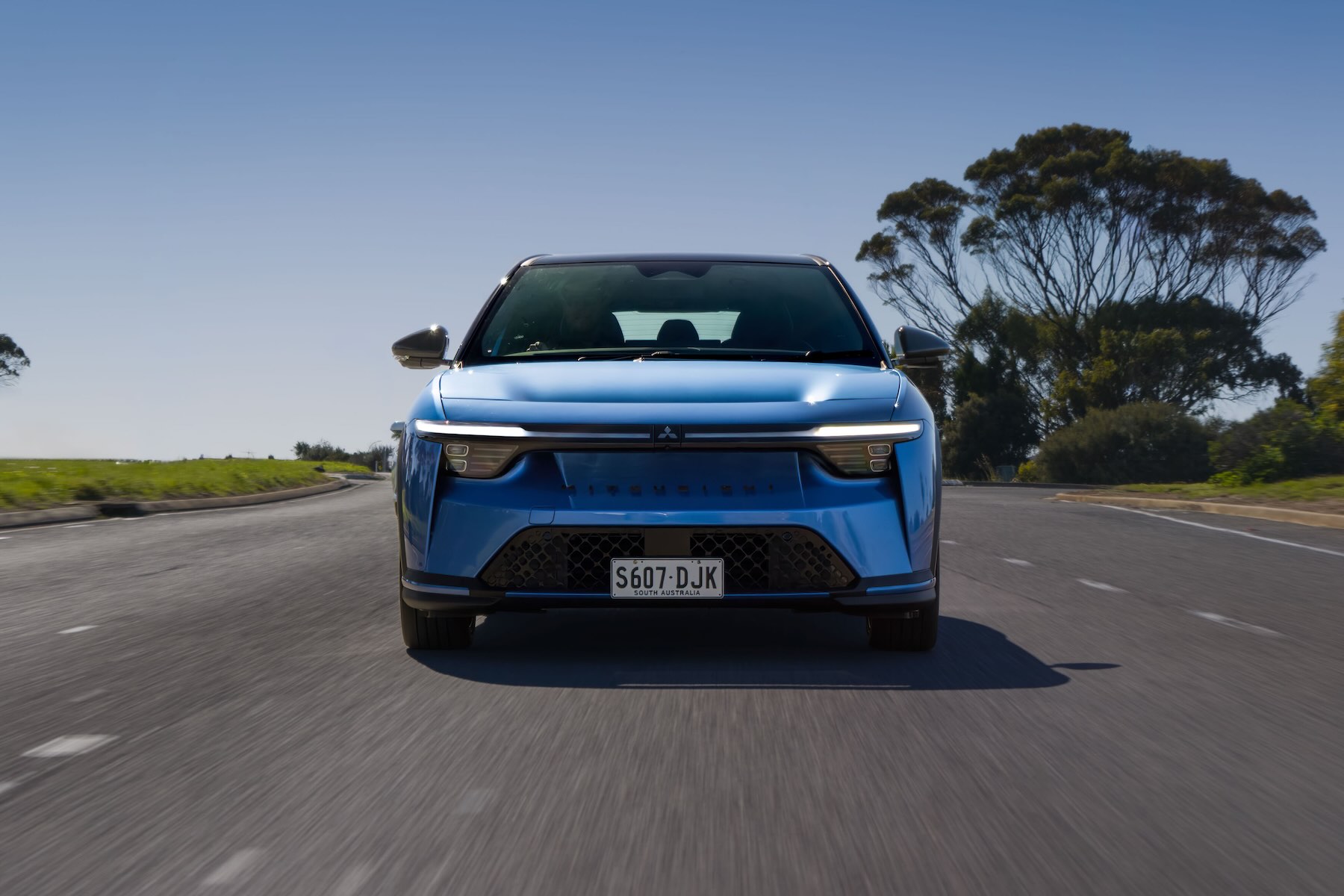
Mitsubishi has revealed full Australian specifications for its new ASX VR-e electric SUV, including a 342kW all-wheel-drive flagship that will become the fastest-accelerating Mitsubishi ever officially sold in Australia.
The new ASX VR-e will arrive in Australian showrooms before the end of 2026 in four variants – LS, Aspire, Exceed and GSR – marking Mitsubishi’s return to the battery-electric market more than a decade, having been a pioneer in the industry with the i-MiEV.
All four versions of the new SUV will use a relatively modest 57.7kWh lithium iron phosphate (LFP) battery, with the first three grades powered by a single rear-mounted motor producing 171kW and 350Nm. Mitsubishi says those rear-wheel-drive models will sprint from 0-100km/h in 6.8 seconds.
Things get rather more interesting with the GSR variant, adding a second electric motor on the front axle, taking combined output to 342kW and 700Nm and cutting the 0-100km/h time to just 3.9 seconds.
That makes it the fastest-accelerating Mitsubishi ever officially sold in Australia, perhaps an amusing distinction for a compact electric SUV from a company whose back catalogue includes the Lancer Evolution and Galant VR-4.
The VR-e name itself is no accident. Mitsubishi says it was inspired by the Galant VR-4, with the company attempting to give its new EV at least some connection to its performance-car heritage. The ASX VR-e is being supplied to Mitsubishi by Taiwanese manufacturer Foxtron, part of the Foxconn group.
The GSR also shifts its power distribution in Sport mode from an even 50:50 split to a more rear-biased 30:70, except under full throttle, while all variants get Eco, Comfort and Sport modes and three selectable steering-weight settings.
Charging specifications are less spectacular. All versions support CCS2 DC fast charging at up to 134kW, while AC charging tops out at just 6.6kW. Mitsubishi has not yet provided an Australian 10-80 per cent charging time.
Vehicle-to-load (V2L) is standard across the range, allowing external appliances to draw power from the battery through the Type 2 charging port.
Mitsubishi has also conspicuously left one important number out of its latest Australian announcement: driving range.
Across the Tasman, however, Mitsubishi New Zealand has already confirmed WLTP figures of up to 403km for the rear-drive LS, falling to 328km for the more powerful GSR. All variants there use the same 57.7kWh LFP pack.
If those specifications carry across unchanged, it will put the ASX VR-e firmly in the urban and shorter-distance electric SUV category rather than among the increasingly common 500km-plus EVs.
Inside, every ASX VR-e gets a sizeable 15.6-inch central touchscreen paired with a 9.2-inch digital instrument display. Perhaps mercifully, Mitsubishi hasn’t moved absolutely everything onto the touchscreen. Physical controls remain for commonly used functions including the climate system, de-misters and hazard lights, along with a programmable favourites button.
Wireless Apple CarPlay and Android Auto are standard, and Mitsubishi says the car has been developed as a software-defined vehicle with over-the-air software updates and connected-car functionality.
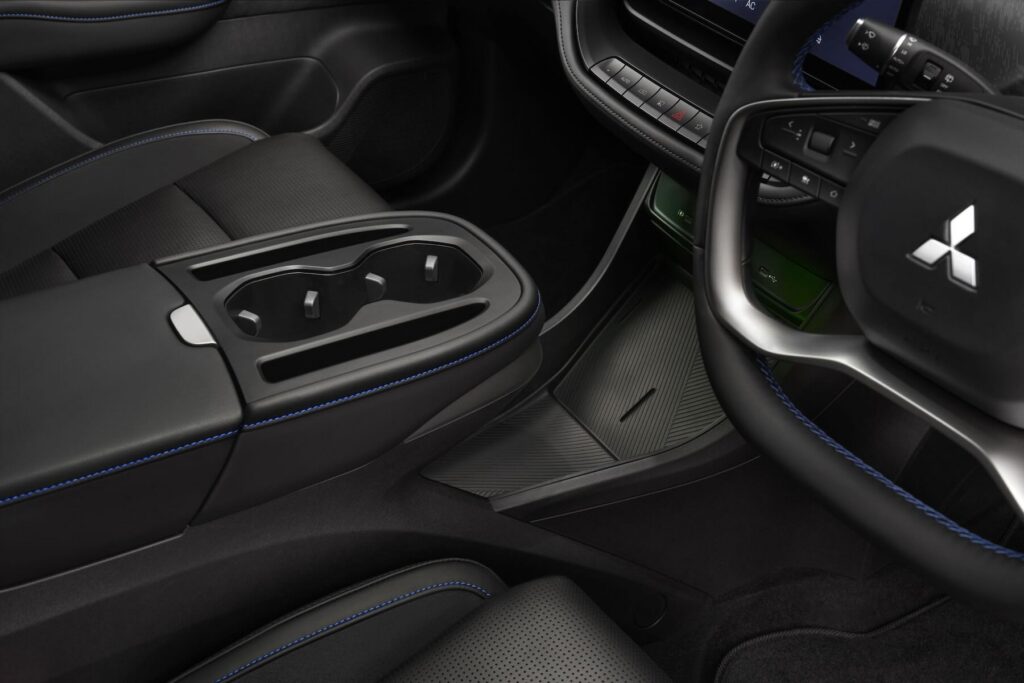
The Aspire adds heated and ventilated electrically adjustable front seats, a 360-degree camera, autonomous parking, ambient lighting and a front storage compartment, while the Exceed adds 20-inch wheels, a panoramic glass roof, powered tailgate and 12-speaker sound system.
The GSR then adds its dual-motor drivetrain, microsuede and artificial leather upholstery, blue stitching and two-tone exterior paint.
At 4315mm long, 1885mm wide and 1535mm high, with a long 2800mm wheelbase, the ASX VR-e sits firmly in compact SUV territory.
Its Pininfarina-designed body includes active grille shutters, air curtains, flush door handles and an unusual S-Duct that channels air through the front bumper and over the bonnet in an effort to reduce drag.
Australian pricing is yet to be announced. Mitsubishi has already confirmed New Zealand pricing starting at NZ$57,990 before on-road costs for the rear-drive LS and rising to NZ$72,990 for the dual-motor GSR. Converted directly, that points roughly to the high-$40,000s through to around $60,000 in Australian dollars, although local vehicle pricing rarely follows currency conversions neatly.
The ASX VR-e will be competing against a rapidly expanding field of electric SUVs from brands including BYD, MG, Geely, Kia and others, many of which have been pushing prices sharply lower.
Mitsubishi Australia CEO Shunichi Kihara says the new EV is intended to broaden the company’s powertrain options and marks a return to the market it first entered with the i-MiEV more than 15 years ago.
“It is a return to the BEV segment for Mitsubishi Motors, who pioneered with the i-MiEV over 15 years ago, and is thoroughly modern,” Kihara said.
Sign up for The Driven’s free daily newsletter and get the latest EV news and analysis delivered straight to your inbox.