Honda has finally brought an electric car to Australia, but you might need to look down a little to spot it.
The Super-One is a tiny, boxy, four-seat hatchback with a claimed 202 kilometres of range, a Boost button and a simulated seven-speed gearbox. It costs from $36,900 driveaway. There is quite a lot to unpack there, which is fortunate, because there isn’t much room in the boot.
The Super-One has its origins in a Japanese kei car, its styling owes something to the 1980s Honda City Turbo II, and its appeal rests heavily on the idea that a small car can be something you actually want, rather than simply what you can afford.
That is a worthwhile idea. Small electric cars make sense for plenty of Australian households, particularly those whose daily driving involves school, work and the shops rather than an expedition across the continent. The question is whether this particular small electric car makes sense at nearly $37,000.
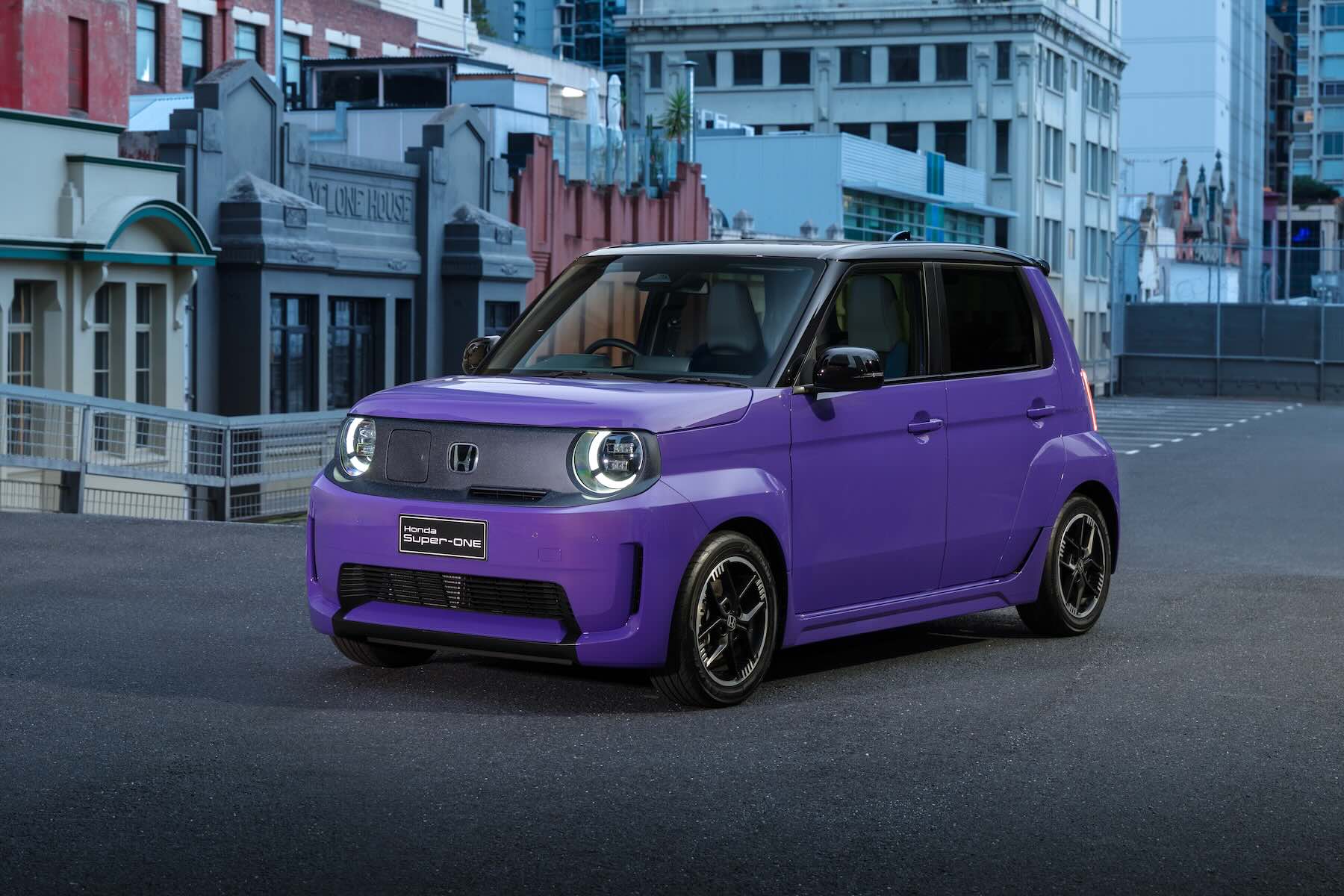
The styling does a fair amount of the heavy lifting. With its circular headlights, upright nose and flared wheel arches. The proportions are almost cartoonish, but there is a coherence to the design that makes it work.
Honda’s reference point is the City Turbo II, affectionately known as the Bulldog, and you can see the family resemblance in the boxy shape and wide stance.
The starting point underneath is Honda’s N-One e, although the Super-One is 100mm wider and 185mm longer. It remains just 3,582mm long and 1,573mm wide, riding on 15-inch alloy wheels.
Those dimensions deserve to be treated as a selling point. A narrow car is useful on narrow streets. A short car is useful in a small garage. Buying more vehicle than you need does not become more sensible simply because it runs on batteries.
There are thoughtful details, too. The charging port sits in the front grille, while Honda says recycled material recovered from old Honda vehicles is used in the grille and rear light housings.
But mostly, the appeal is that it looks like something. It has a face, a recognisable shape and a bit of cheek.
I think it’s fair to say Honda has put a surprising amount of effort into giving the Super-ONE things an electric car does not strictly need.
Press the Boost button and power rises from 47kW to 70kW. You also get a simulated seven-speed transmission, artificial engine sounds and a purple instrument display with a rev counter.
The paddles provide simulated gear changes in both Sport and Boost modes. In Normal and Econ they adjust regenerative braking, while City mode offers one-pedal driving with four deceleration settings.
It is easy to be sceptical about the simulated gearbox. Smooth, uninterrupted acceleration is one of the pleasures of electric driving, and adding interruptions back in is not an obvious improvement.
But there is also room for EVs that give the driver more to do. Whether that involvement needs to sound like a combustion engine is a matter of taste. For some buyers, it will be part of the attraction.
The more substantial part of Honda’s pitch is the weight, a quoted 1,093kg. Alongside 162Nm of torque and the extra power in Boost, that gives the Super-ONE a different starting point from a heavy car relying on a very large motor to get it moving quickly.
Honda says the suspension and steering have been specifically tuned for the model, with a wider track, revised spring and damper settings and tyres developed alongside the chassis.
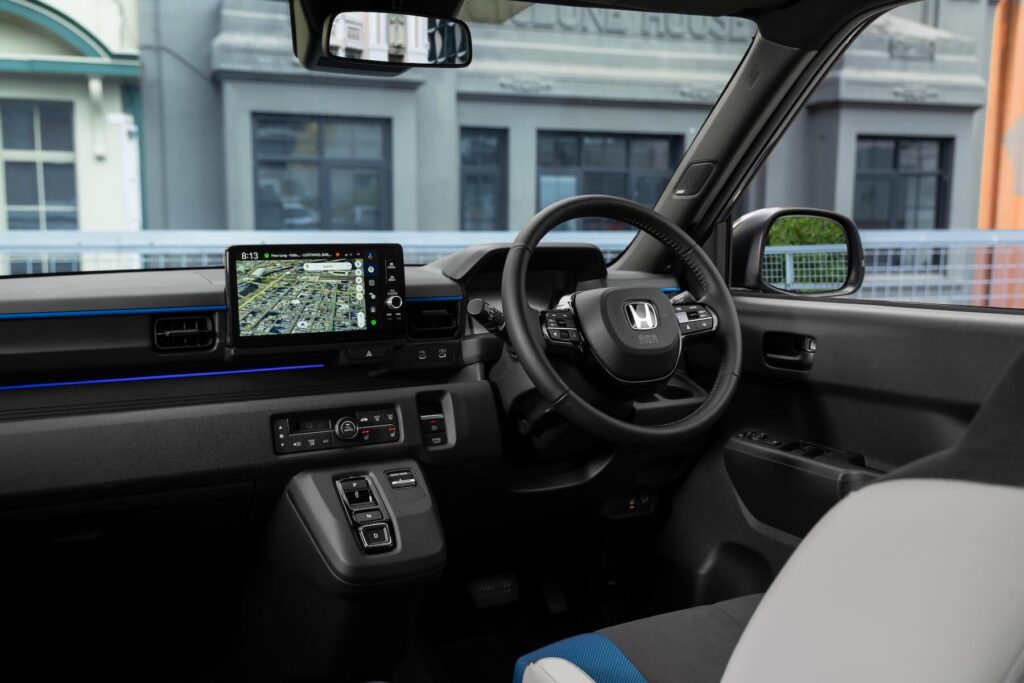
Inside, Honda has continued the retro theme without dispensing with modern conveniences. There is a seven-inch driver display, a nine-inch touchscreen with Google built-in, wireless Apple CarPlay and Android Auto, and an eight-speaker Bose system, including an impressively large subwoofer located in the boot.
The sports seats and coloured trim add to the sense that this is intended to be something more interesting than basic transport. While I didn’t have any issues with my 6’5 height, the seats seemed less accomodating for my wide hips, particularly with the presence of rather sizeable bolsters on each side of the front seats.
There are also physical climate controls, styled to resemble an old cassette player. Keeping everyday controls out of the touchscreen is a sensible decision. A small urban car should be easy to operate while you are keeping an eye on everything happening around it.
Space is where expectations need managing. This is a four-seater, and with all four seats available the boot holds just 162 litres.
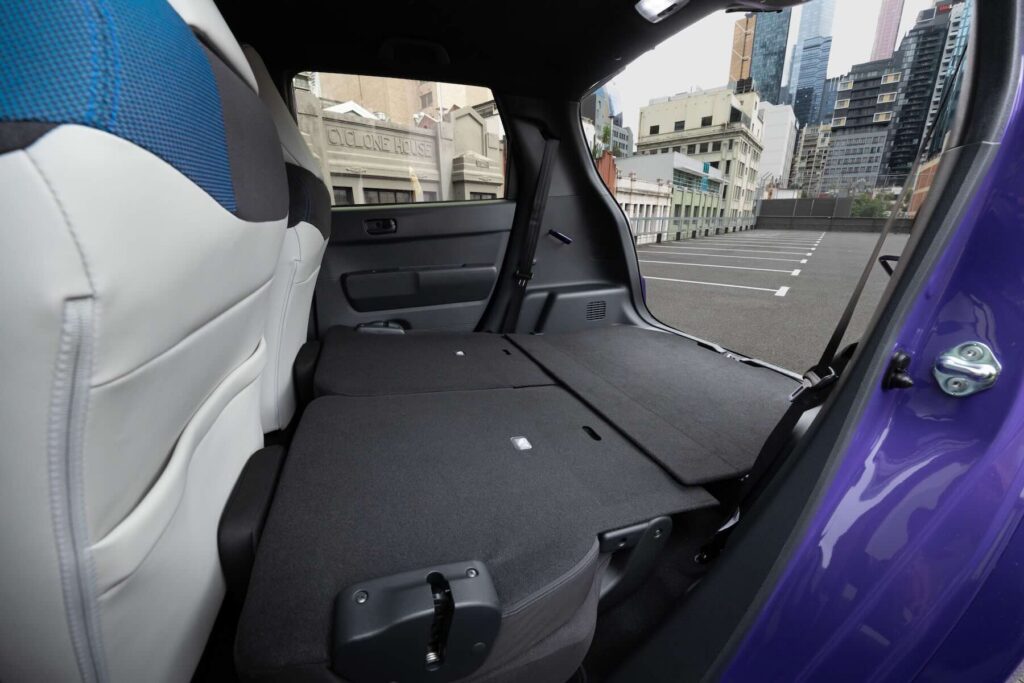
Honda’s Magic Seats do however add flexibility. Fold the rear seats and luggage capacity expands to 618 litres up to window height, or 967 litres to the roof. Those are useful options for carrying larger items, but the rear passengers will need other plans. There is only so much magic available in 3.58 metres.
The Super-ONE has a 29.6kWh battery and a claimed WLTP range of up to 202km. For some buyers, that will end the conversation. For others, it will comfortably cover the driving they actually do.
In fact, Japanese car companies seem to have made it a badge of honour to produce their first EVs with limited range, perhaps to justify their attachment to hybrids. Mazda’s first EV was a flop because of it, and Toyota’s first electric Hilux won’t go far.
But an average Australian only drives about 36km a day. So a household travelling 40km a day and plugging in at home does not necessarily need a battery capable of taking it 500km between charges. Smaller batteries can mean less weight, and the ability to charge where the car is parked changes the calculation considerably.
The important question is how often your routine changes. A short commute is one thing, but regular motorway trips, weekends away and reliance on public charging are another. The claimed range is also a test result, with actual distance affected by speed, conditions and heating or cooling use.
Charging is modest. DC power peaks at 50kW, with Honda quoting approximately 30 minutes for a 15 to 80 per cent charge under its stated conditions. AC charging reaches 6.6kW on single-phase power or 10kW on three-phase.
The Mono version costs $36,900 driveaway, with the Two-Tone at $37,400. Honda includes a five-year unlimited-kilometre vehicle warranty, an eight-year or 160,000km high-voltage battery warranty, five years of roadside assistance and five scheduled services at $199 each. Servicing is due every 12 months or 15,000km, whichever comes first.
There is certainly interest. Honda says almost 7,000 people registered expressions of interest and the initial 2026 allocation was taken within hours, although said allocation was a measly 130 cars.
The Super-One’s strongest argument is that its size, design and approach to driving might be precisely what a buyer wants. For that person, a bigger car is not automatically a better one, and extra range may be less valuable than something that fits their street, garage, and is genuinely fun to drive.
But nearly $37,000 is a substantial amount to spend on a car with such clear limits. Anyone needing generous luggage space, five seats or regular long-distance capability will have good reasons to look elsewhere, but this car is very clearly not pitched towards them.
There is room for a car like this. There should be more room for small, light EVs generally. Honda has given this one enough personality to get people interested.
As more stock arrives in 2027, the question is how many Australians Honda can convince to pay a premium for personality.