
A major new study has revealed that electric trucks are becoming increasingly cheaper to operate than their diesel counterparts, with savings reaching as much as €100,000 in some countries.
The new study from Europe-based Transport & Environment (T&E) showed that the total cost of ownership (TCO) of electric trucks was lower than that for diesel trucks in six out of nine major markets across the EU. These six markets account for 46 per cent of all new heavy trucks sold in the EU.
Savings in the Netherlands and Germany can reach €100,000 and €85,000 respectively over five years, with electric trucks paying themselves off after only 2 years.
When operating an electric truck made in China, savings over five years in the Netherlands increases to €128,000, thanks in part to their lower price tag.
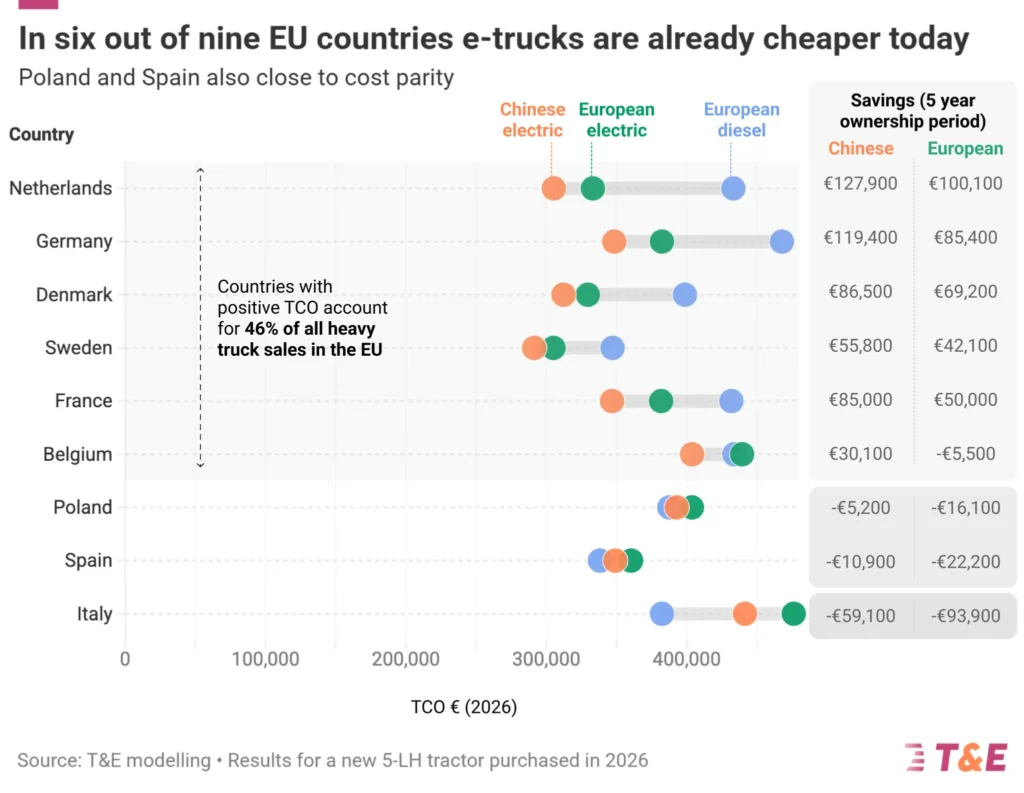
And taking into account yet another diesel price shock as a result of conditions in the Strait of Hormuz, savings on European-made electric trucks in could quickly rise to €123,000 and €106,000 respectively in the Netherlands and Germany.
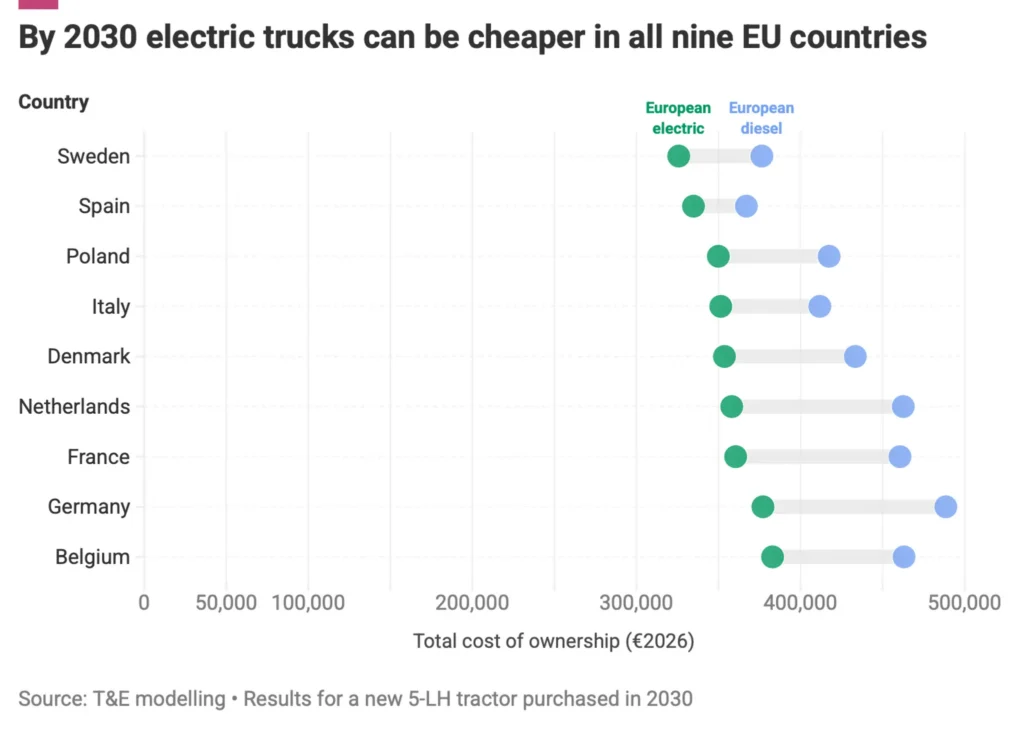
T&E also expects that by 2030 electric trucks could be cheaper to operate in all nine EU countries analysed with specific policy measures, even when vehicle purchase subsidies are reduced or phased out.
“Europe’s truckers are on the front line of the diesel crisis,” said Stef Cornelis, director of freight and fleets at T&E.
“There has never been a better time to switch from diesel to electric, but we need truck makers and governments to support them in doing so.”
T&E is calling on the EU to help accelerate the transition to electric trucks with three key policy measures, starting with maintaining the strength of the heavy-duty vehicle (HDV) CO2 standards, which specifies a 43 per cent reduction by 2030.
This target is seen as “crucial” to ensuring truck manufacturers continue to offer more electric trucks, delivering the economies of scale necessary to further push prices down.
T&E is also calling on the EU to expand CO2-based tolling in Italy, France, Spain, and Portugal, as well as exempt zero-emission trucks from tolling charges until 2031.
National governments should also continue to financially support both public and private depot charging while simultaneously accelerating grid upgrades and permitting.
“Europe’s truckmakers should be fully focused on increasing the scale of production of e-trucks to lower their up-front prices, rather than continuing their efforts to change the regulations,” added Cornelis.
“Every investor in the e-truck’s ecosystem needs stable policy, not going back and forth. Maintaining the CO2 standards will be critical for Europe’s truck industry to compete with Chinese e-trucks and the Tesla Semi and avoid a repeat of what we saw in the auto industry.”
Sign up for The Driven’s free daily newsletter and get the latest EV news and analysis delivered straight to your inbox.