South Korean automaker Hyundai last week took to the stage in Seoul for its 2026 CEO Investor Day, revealing a handful of announcements that go a long way to describing the company’s half-hearted approach to full electrification.
Hyundai announced that it had developed its own battery cells, which they say are capable of delivering more than double the output of the high-nickel battery cells the company was using previously, while also cutting charging time by 40 per cent.
But the new battery cells will make their debut next year in the company’s first extended range electric vehicle (EREV), a hybrid car in all but name that uses an internal combustion engine to charge the battery.
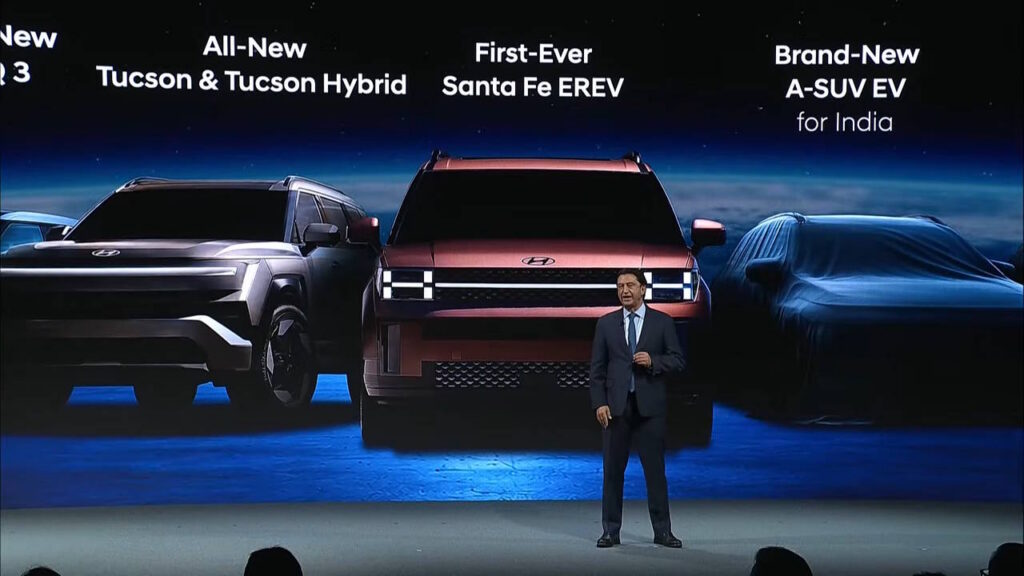
The first Hyundai EREV will be the Santa Fe EREV which will arrive in the first half of 2027 and be built in the United States, boasting an EREV range of nearly 1,000 kilometres.
Hyundai’s luxury vehicle brand Genesis will also add its own EREV SUV early next year with a target range of over 1,000 kilometres. The company will also launch an EREV in China some time next year.
The company also reaffirmed its goal of reaching 5.55 million global vehicle sales by 2030, which would see electrified vehicles account for 60 per cent of sales, up from 23 per cent in 2025.
In Europe, Hyundai’s ambitions are slightly more impressive, with a goal to cover 85 per cent of the continent’s market with a fully electrified portfolio. The company also hopes to expand EV sales across the continent to over 420,000 units by 2030, up from 116,000 in 2025.
There were not a lot of new BEV announcements from Hyundai – a new A-segment electric SUV in India and a new EV in China. Hyundai also highlighted the soon-to-be-opened new EV plant at its Ulsan operations in South Korea, which will begin production with the Genesis GV90.
José Muñoz, Hyundai Motor Company president and CEO, also revealed five new EVs set to launch in Europe, including two B-segment SUVs, a pair of light commercial vehicles, as well as a so-called “D-SUV” that sits between the Ioniq 5 and Santa Fe in the company’s lineup.
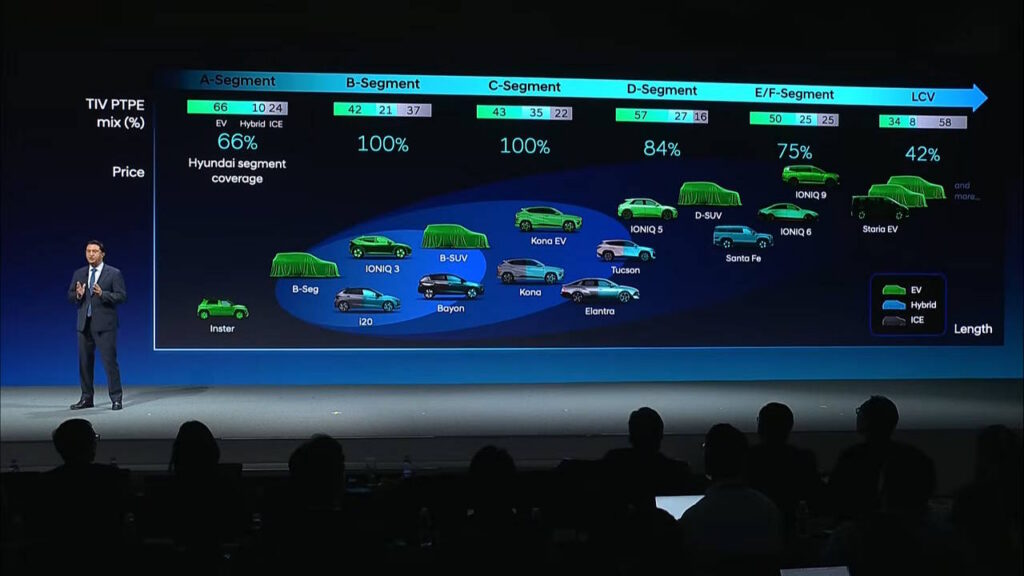
However, Hyundai also boasted it plans to launch or refresh over 100 models by 2030, suggesting that there are either a lot of new electric or electrified models that are being kept heavily under wraps, or a lot of new models that won’t be electrified at all and are therefore not worth publicising.