This is a follow-up to S-curve modelling says renewables can kick coal out of Australia by 2032, published on The Driven’s sister site Renew Economy last week. That piece used logistic S-curve modelling to project when renewables displace coal. This one applies the same technique to a different question: where is our grid storage actually going to come from?
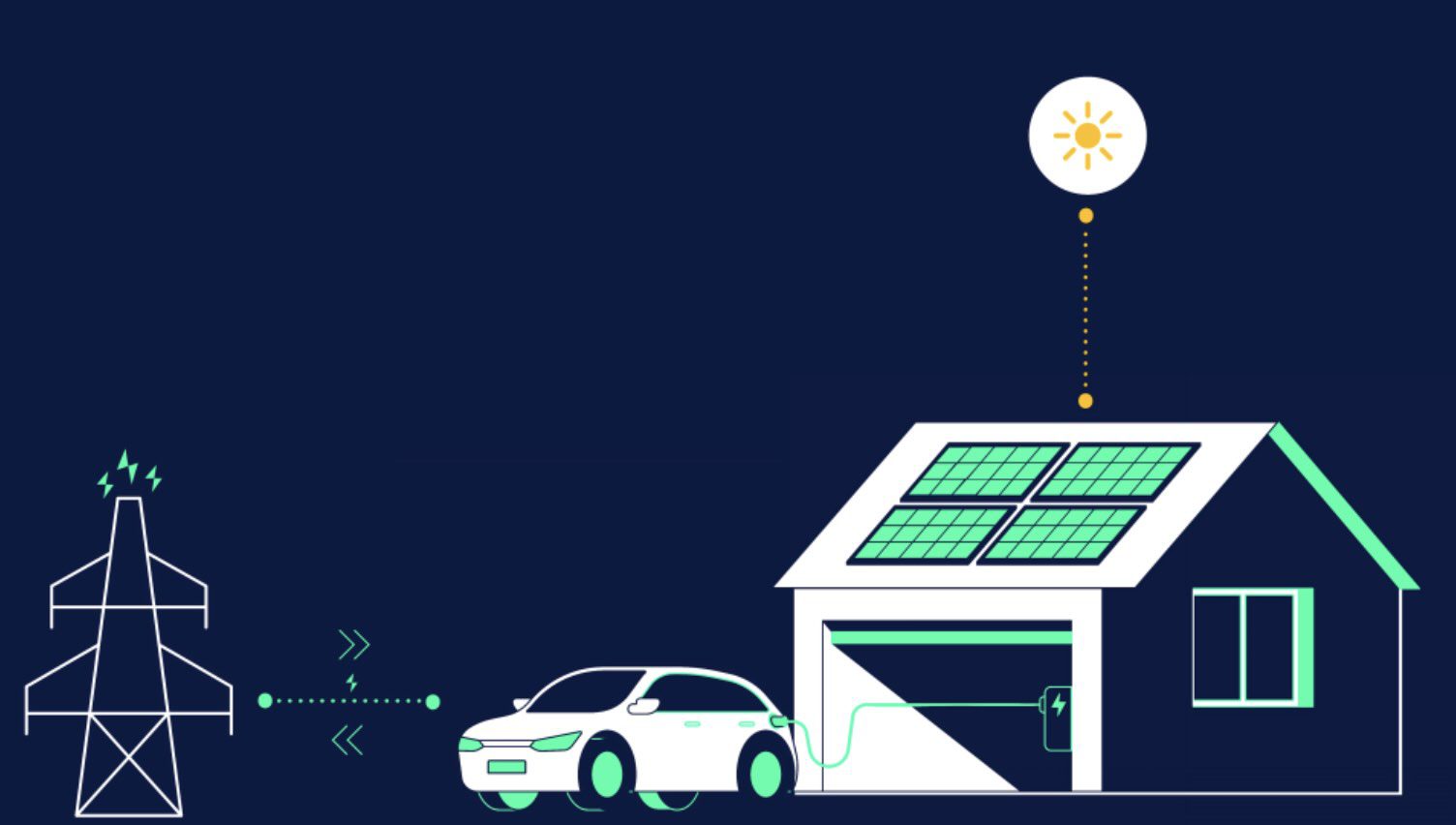
In 2021, I wrote about our myopic thinking on electric vehicles and renewable power and failure to anticipate the coming transition to electric vehicles, the inevitability of bi-directional (vehicle-to-grid, or V2G) charging, and what it would mean for the grid.
Five years on, with a lot more EV uptake data in hand, it’s time for an update.
Overall, the original story has held up well. But we now have five more years of adoption data, and a much clearer sense of the trajectory.
Why S-curves, not straight lines
I use logistic S-curve modelling to approximate the uptake of disruptive technologies – the same approach behind the coal-displacement analysis – because our brains are wired to assume linear change, and disruptive technologies entering an established market almost never behave that way. They muscle in, elbowing out the incumbent that we had all come to see as permanent.
“Tipping points” describe how this happens qualitatively; the S-curve tries to attach numbers to the same idea. A handful of wealthy innovators try the new technology first – it’s expensive and exclusive.
Early adopters follow, driven partly by FOMO, and a real market starts to form; this is the stage where government incentives, and the credibility they lend, can make or break the transition.
As more people see and experience the technology, growth turns exponential and economies of scale bring costs down. Then the market tips, growth becomes linear at around half of eventual market penetration, and finally the curve flattens into a logarithmic tail as fewer and fewer holdouts remain to convert.
Modelling the storage transition
So what happens if we apply S-curve modelling to bi-directionally charged EVs, and what does that mean for how we plan the electricity system – specifically, the storage needed to smooth out renewables intermittency?

The curve tracked the exponential growth phase closely for several years. Then federal and state EV incentives were wound back, and uptake adjusted onto a new, delayed S-curve – a sign that the incentives had done their job and were no longer needed to sustain momentum, not that the underlying transition had stalled.
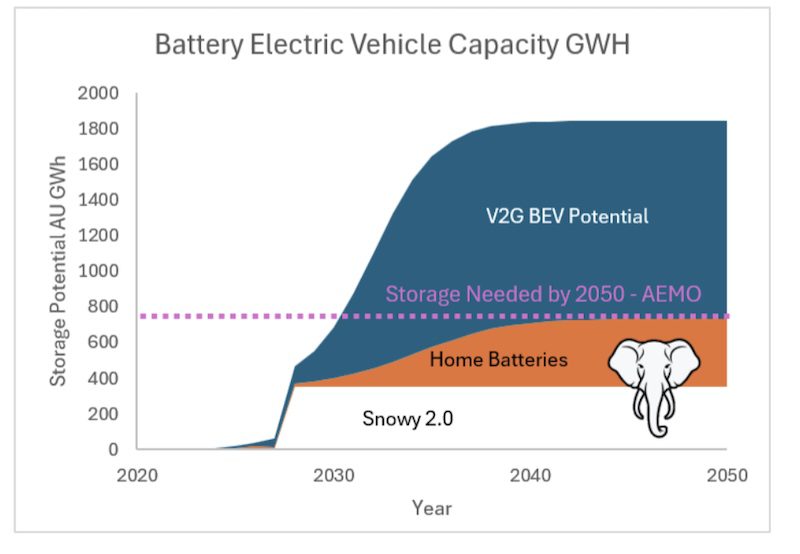
Extrapolating forward, the model gives approximate projections for home battery storage and bi-directionally charged EV storage, with Snowy 2.0 coming online in 2028. AEMO’s 2026 Integrated System Plan projects the National Electricity Market will need roughly 640 GWh of dispatchable storage by 2050, shown here as the pink dotted line:
Forecasting is always uncertain, but taken at face value, this throws up some striking implications.
A silver bullet hiding in plain sight
Ubiquitous bi-directionally charged EVs look like the closest thing to a silver bullet for meeting Australia’s energy storage needs and taming renewables intermittency.
There are two ways to read the resulting graph. The first is to acknowledge the brilliance of the Cheaper Home Batteries Program: combined with Snowy 2.0, it looks set to deliver nearly all of our forecast storage needs by 2050 – though that may not be enough once the electrification of industry, transport and data centres is factored in.
The second reading is more provocative: the case for bi-directional charging is so compelling that it’s likely to become the dominant home storage technology regardless, simply because we will transition to electric vehicles – the car battery will already be there.
A 75.8 kWh average EV battery can soak up storage at times of renewable excess and low or negative prices, then sell back to the grid during scarcity – overnight, or when renewables output is low.
If so, perhaps bi-directional charging deserves incentives at least as generous as those given to home batteries, to kick-start and accelerate the transition. If this transition is inevitable anyway, both Snowy 2.0 and standalone home batteries could become largely redundant by 2035.
It’s easy to criticise with hindsight, and the home battery program has genuinely delivered – so a better question is: how do we build on what has already been achieved?
Incentivising bi-directional charging would have a second-order benefit too: it would further accelerate EV uptake and give homeowners a reason to size their solar for both house and car.
Typical mileage needs an extra 3-5 kW of solar on top of the roughly 6 kW needed to run an average Australian home. Given the average new residential solar install is already 9-11 kW, that’s not a hard ask.
The value-for-money case
Using the S-curve forecasts, we can estimate how much storage each initiative is likely to ultimately unlock per dollar of public money, and compare that to Snowy 2.0.
Snowy 2.0 was budgeted at $12bn, but has now blown out appallingly – independent estimates now put total project costs closer to $42 billion. As originally budgeted the cost per GWH is about $34 billion/GWh, but may now have blown out to about $120bn/GWH.
By comparison, incentive programs look like exceptional value:
– The home battery incentive: ~$22 billion/GWh
– The EV incentive: ~$4.5 billion/GWh
– Extending the home battery incentive to bi-directional charging: ~$3.5 billion/GWh
Extending the home battery incentive to bi-directional charging could give up to 30 times more storage per public dollar than Snowy 2.0 and six times more than the home battery incentive alone, and it capitalises on incentives already committed to EV uptake. Let’s back this in, Minister Bowen.
The “but it’s only short-term storage” objection
A fair objection: bi-directional EV charging only provides short-duration storage. But the average car battery is around three times larger than the average home battery, so it’s likely to cover several days of typical household use, not just one – materially improving household resilience during low-renewables periods.
And our grid, the NEM, spans eight climate zones for generation; once generation, storage and consumption are diversified across the whole network, the case for long-duration storage weakens further.
Like home batteries, bi-directionally charged EVs are distributed storage. Distributed storage lets local generation – especially rooftop solar – be stored and reused locally, behind the meter, or sold back to the grid when there’s a local surplus. The net effect is a more resilient grid with less need (and lower cost) for grid firming. And if that still isn’t enough, we’ll have Snowy 2.0 to fall back on.
Nigel Howard is Principal of Clarity Environment, with a background in environmental life cycle assessment and carbon accounting across the UK, US and Australia. He is currently working with Professor Peter Newman (Curtin University Sustainability Policy Institute) on modelling climate-related mortality.