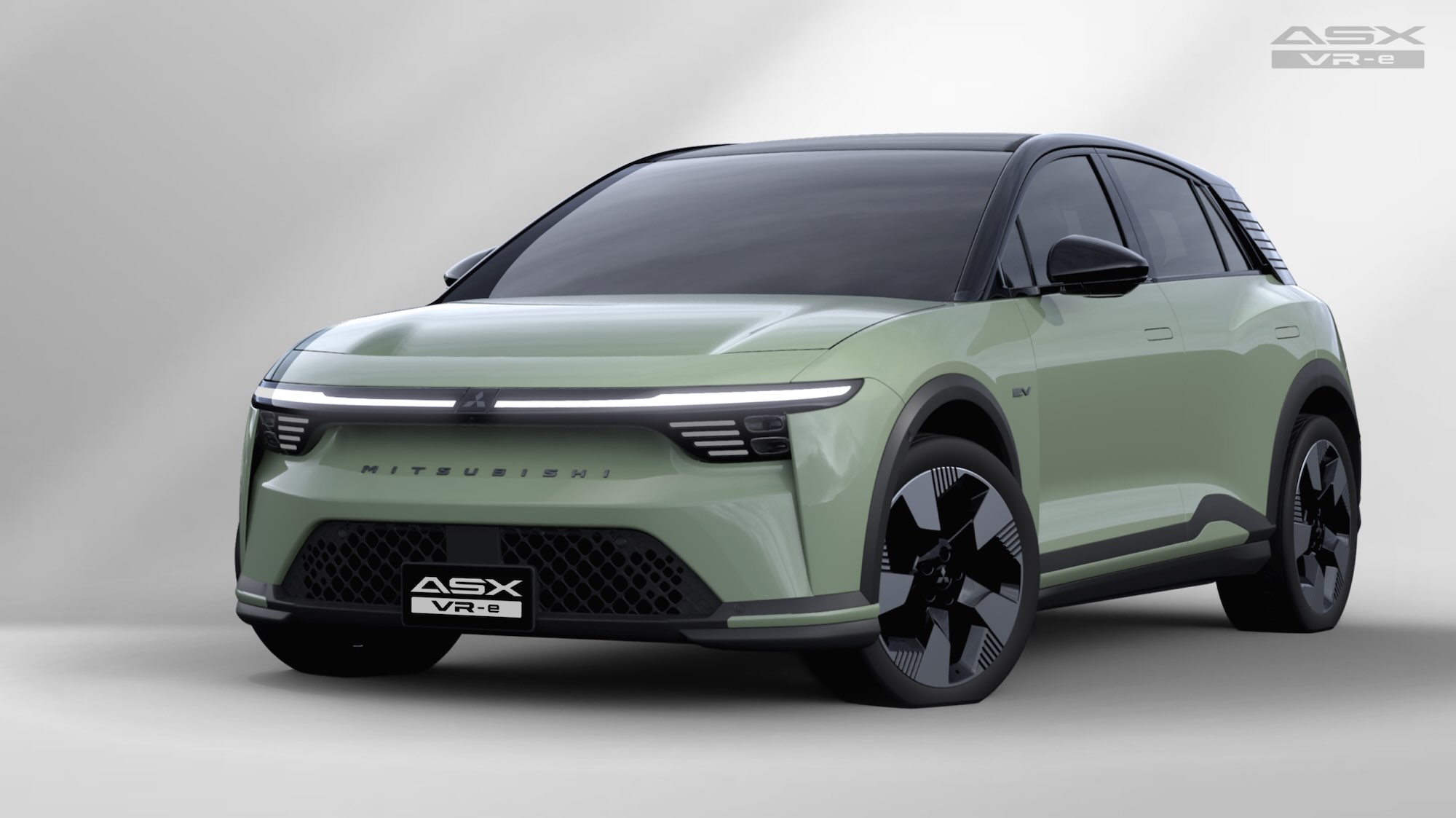
Mitsubishi has confirmed its long-awaited return to the Australian battery electric vehicle market, announcing on Monday that the new ASX VR-e will arrive in the fourth quarter of 2026.
The new electric crossover will be Mitsubishi’s first fully electric model sold in Australia since the diminutive i-MiEV more than a decade ago, and will launch in four variants: LS, Aspire, Exceed and GSR.
It also gives a familiar Mitsubishi name a very different new role. ASX stands for “Active Sports Crossover” and has been attached to one of Mitsubishi’s best-known compact SUVs in Australia, but the new ASX VR-e is a completely different vehicle from the petrol-powered ASX currently sold locally.
The “VR-e” suffix also reaches further back into Mitsubishi’s history, with the company saying it is a nod to the Galant VR-4 performance sedan.
“ASX VR-e marks a significant milestone in our refreshed Mitsubishi range as the first BEV since the i-MiEV – Australia’s first mass-produced electric vehicle,” Mitsubishi Motors Australia CEO Shunichi Kihara said in a statement.
“The new Mitsubishi ASX VR-e continues this path of innovation with an immersive infotainment system, bold design and excellent electric driving performance.”
Unlike Mitsubishi’s more conventional models, the new EV has been developed through the Japanese car maker’s partnership with Taiwanese electric vehicle company Foxtron Vehicle Technologies.
The relationship represents a somewhat unusual new approach for Mitsubishi. Rather than developing the vehicle entirely in-house or sourcing it through alliance partners Nissan and Renault, the new EV uses a Foxtron-developed platform which has undergone testing and tuning for Australian conditions.
Mitsubishi says global and regional development teams have carried out extensive local testing to give the ASX VR-e the sporty performance and responsive handling suggested by its name.
The underlying vehicle design comes from Italian design house Pininfarina, although Mitsubishi has added its own styling elements across the front and rear fascias, wheels and interior.
An S-Duct in the nose channels air entering through the centre of the front bumper over the bonnet, while active grille shutters can open and close depending on driving conditions to reduce aerodynamic drag.
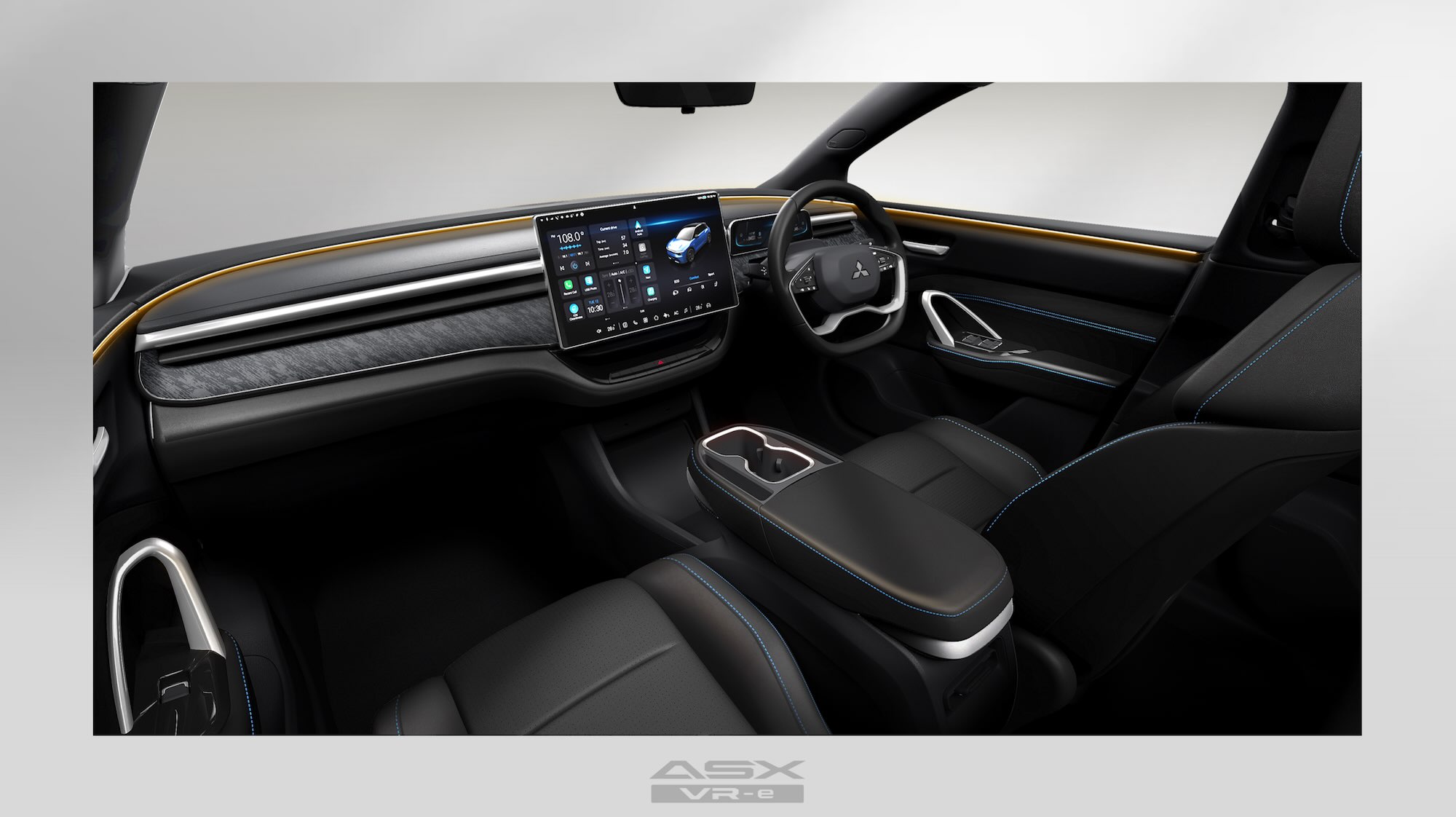
Mitsubishi has not yet revealed the Australian car’s battery capacity, driving range, motor outputs, charging speeds or pricing. Needless to say those figures will be critical to its success, given just how competitive Australia’s electric vehicle market has become ahead of the ASX VR-e’s arrival.
You can find The Driven’s detailed EV sales data here: Australian electric vehicle sales by month in 2026; by model and by brand.
The electric SUV segment now includes a growing number of models from established manufacturers as well as rapidly expanding Chinese brands. Mitsubishi will need more than its familiar badge to stand out.
There could be some substantial performance available further up the ASX VR-e range. The vehicle has previously been linked to the Foxtron Bria, which in Taiwan is offered with a 57.7 kWh LFP battery and, in single-motor form, produces 171 kW.
Foxtron also offers a higher-performance version of the ASX VR-e, although Mitsubishi has yet to confirm which powertrains will be offered in Australia. Foxtron’s official specification for the Bria lists a 516 km NEDC range for the rear-wheel-drive model.
The original Foxtron Model B on which the production vehicle is based was also designed with aerodynamics in mind, with Foxconn claiming a drag coefficient of 0.26 for the concept. Mitsubishi’s decision to offer four grades, culminating in the familiar GSR badge, suggests it hopes to cover a fairly broad section of the market rather than offering a single niche model.
Perhaps more importantly, the ASX VR-e signals the beginning of what should be a much larger electrification push from Mitsubishi in Australia.
“It joins an evolving multi-powertrain vehicle lineup designed and tuned with Australian lifestyles in mind as part of our Momentum 2030 plan – which will see the electrification of new models in the years to come,” Kihara said.
Mitsubishi was one of the earliest established car makers to sell a mass-produced electric vehicle in Australia with the i-MiEV, but subsequently focused heavily on plug-in hybrids, particularly the Outlander PHEV.
The ASX VR-e will finally bring the company back into the rapidly expanding Australian battery-electric market when it arrives before the end of the year. Australian pricing and full specifications are expected to be announced closer to launch.
For a full rundown of all available EV models in Australia, please go to our Compare EVs page here.
And you can sign up for The Driven’s free daily newsletter and get the latest EV news and analysis delivered straight to your inbox.