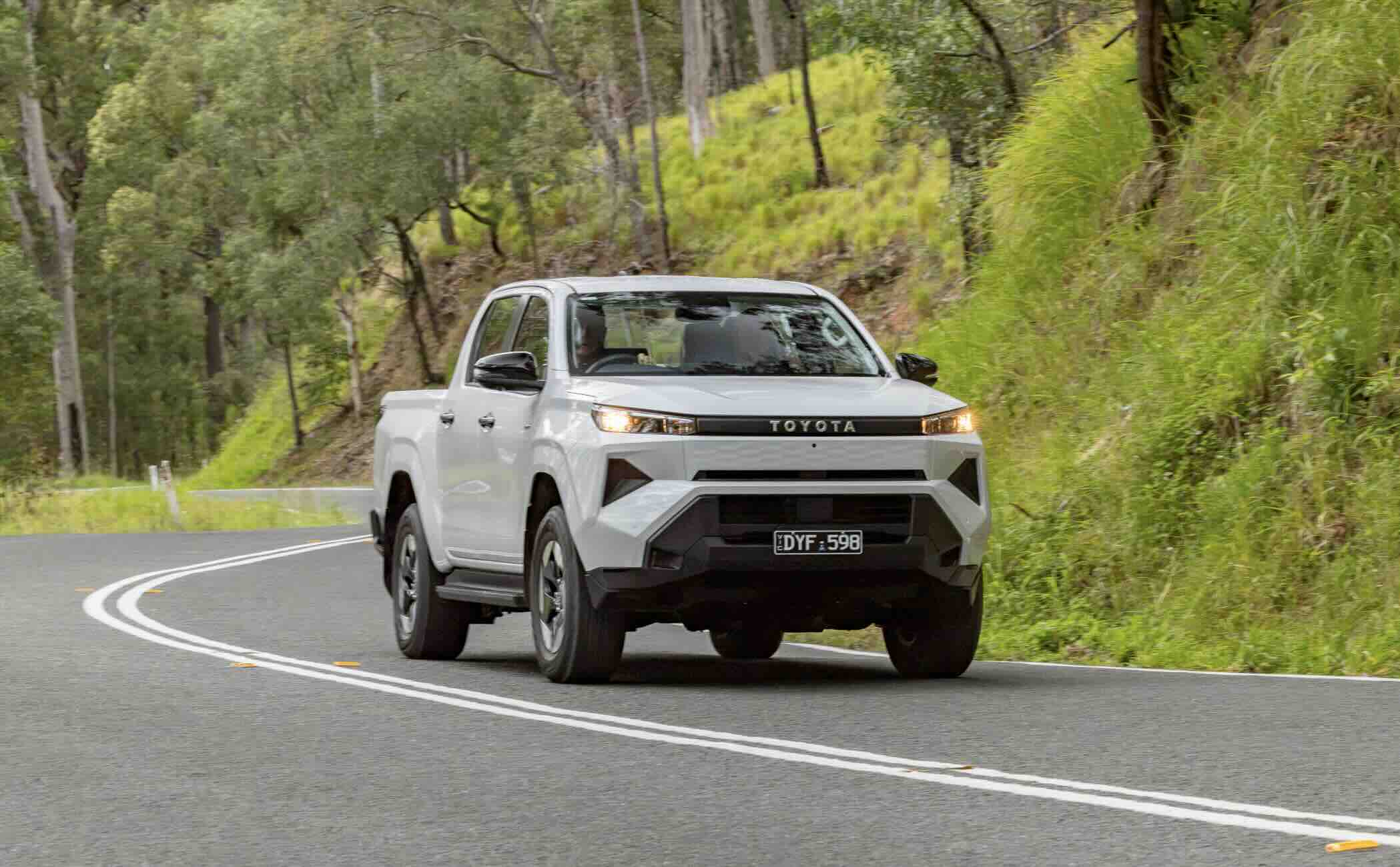
It would be fair to say that the new Hilux electric ute has divided opinions like few other EVs on offer in Australia, even before its first deliveries: Why the limited range? Will it tow my boat? Can it carry a load?
My co-driver in the Toyota media day test drive was one of those skeptics. “What the …. why …. really?” he muttered as he inspected the interior from the passenger seat. And then he got to drive it, and decided to overtake the three cars in front of him with a relatively short overtaking lane. And he did so, no problems. “Oh,” he said. “Well, you can’t do that in a diesel ute.”
The Australian public has been conditioned by mainstream and social media to be highly skeptical about the transition to EVs. The Coalition told us nearly a decade ago it wouldn’t tow our boats and would ruin our weekend, and that the Labor government would steal their utes.
And as stupid as that sounded at the time, the attitude has more or less stuck with a sizeable number of the Australian population, fuelled by fears of range anxiety and broken EV chargers, and a deep suspicion of anything Green.
Finally, though, the long-standing best selling car in Australia – the Toyota Hilux ute – is going electric. Well, at least partially. Toyota led the world into hybrids with the release of the Prius more than two decades ago, but have been dragging their feet on full battery electrics, which makes the release of the Hilux BEV a potentially pivotal moment.
But before we get too excited, let’s be clear about what it is, and what it is not.
The electric Hilux has a relatively small 59.2 kWh lithium phosphate battery that translates into a range of just 315 km NEDC (the measurement that is often referred to as Not Even Damn Close), and less than that for some models.
We didn’t get to drive it far enough to test, and most of the time we did spend in it was off-road on a 4WD circuit. But you’d be lucky to get 200km on the highway, probably less.
Toyota’s defence of this smallish battery and limited range is that they wanted to maintain as much of the Hilux’s 4WD capabilities and its load and towing capacity as they could.
Which meant adjusting the chassis to protect the battery from rocks and roots, and keeping the battery under the twin-cab. That placed a limit on its battery size, and Toyota’s engineers insist it won’t change much without a major leap forward in battery chemistry.
For that reason, the target market for this Hilux BEV is not your everyday tradie, the biggest buyer of the diesel Hilux. The electric Hilux is being pitched at mine operators, farmers, and those company fleets that need utes capable of carrying stuff and going off-road, but not too far, and not too heavy, and which return back to base most evenings.
Enter the likes of BHP, where the utes have been tested for 12 months in the searing 50°C heat of the Pilbara, along with infrastructure company Acciona, network company Essential Energy, and – probably for the sake of a green sheen and its growing renewable business – Newcastle Coal Ports. All have placed major orders, and some have already taken delivery.
On the road, the electric will always outperform the diesel. The sheer power, the torque, the silence. It was actually quite weird, and wonderful, to be both inside and outside a ute that didn’t have the roar of an internal combustion engine. Some might feel deprived by the lack of noise, but there is really no contest on performance and drivability, apart from range.
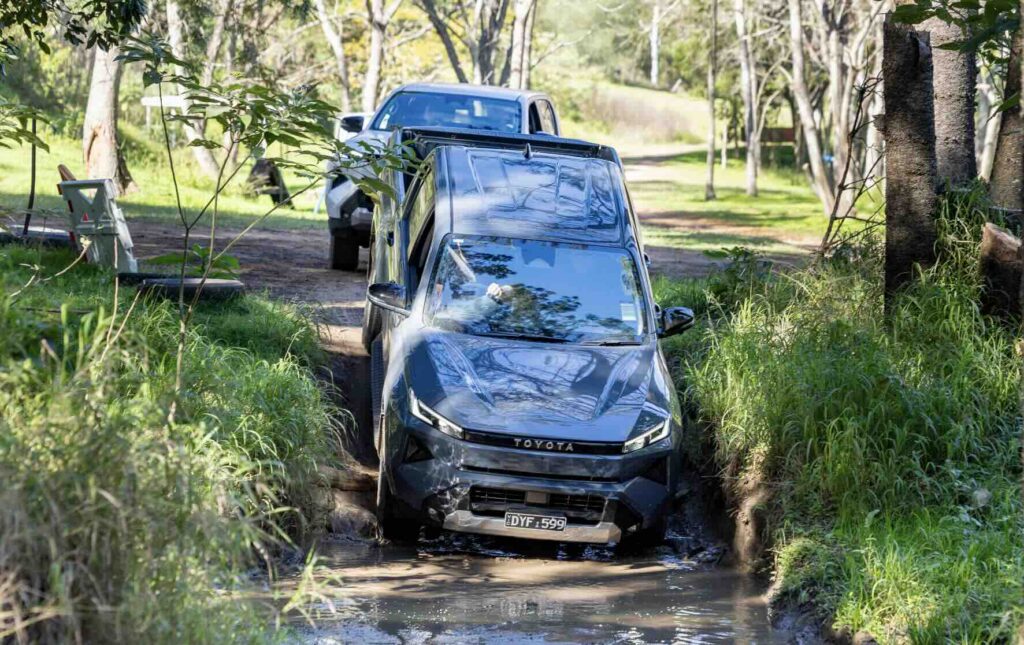
Off road, the electric Hilux is also quite capable. We took it through a moderately challenging circuit in a 4WD adventure park south of Brisbane. We got to drive the new Landcruiser 300 performance hybrid first, which ate up the trail with ease.
The Hilux electric performed pretty well, if notably a little stiffer and with a lot more bumps. We didn’t tackle the hardest trails and it won’t, and it didn’t, impress the hard-core 4WD set. But that’s not what it’s pretending to be, and it’s not the target market.
Given the fact that so many Australians want to drive a ute, even if they don’t really need one, the success of its transition to electric will be key to the success of the EV transition in Australia.
Ford gave it a shot with its ridiculously expensive F150 Lightning, but is not making them any more, and we are unlikely to see the Tesla Cybertruck or the Rivian RIT anytime soon, if ever. The Chinese have been having a crack, with mixed success, although the Musso appeals as a suitable city ute if range is not your primary ambition.
But the Chinese will keep trying. The BYD Shark plug in hybrid has been a huge success, and with pretty good 4WD credentials, and it’s only a matter of time before they, or another, produce a fully electric ute of consequence.
Toyota seems to be counting on them not doing that. Its engineers can’t see a way round making the batteries big enough to deliver the Hilux performance metrics, although one does wonder if they are selling themselves short on the single cab, 2WD brigade. Surely there is an electric solution for this cohort.
For the heavy lifters, and Toyota insists that the bulk of its Hilux buyers like to carry lots of stuff, and tow big things, Toyota is counting on a hydrogen fuel cell ute, despite the complete failure of this technology to grab market share in passenger cars and even big trucks. It plans its first by 2028. Good luck with that.
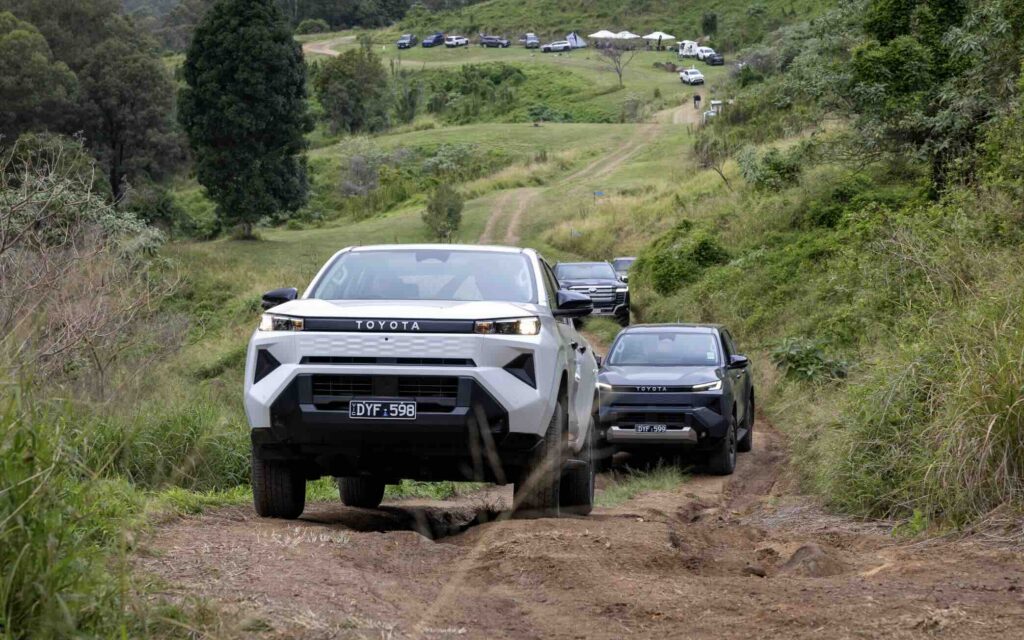
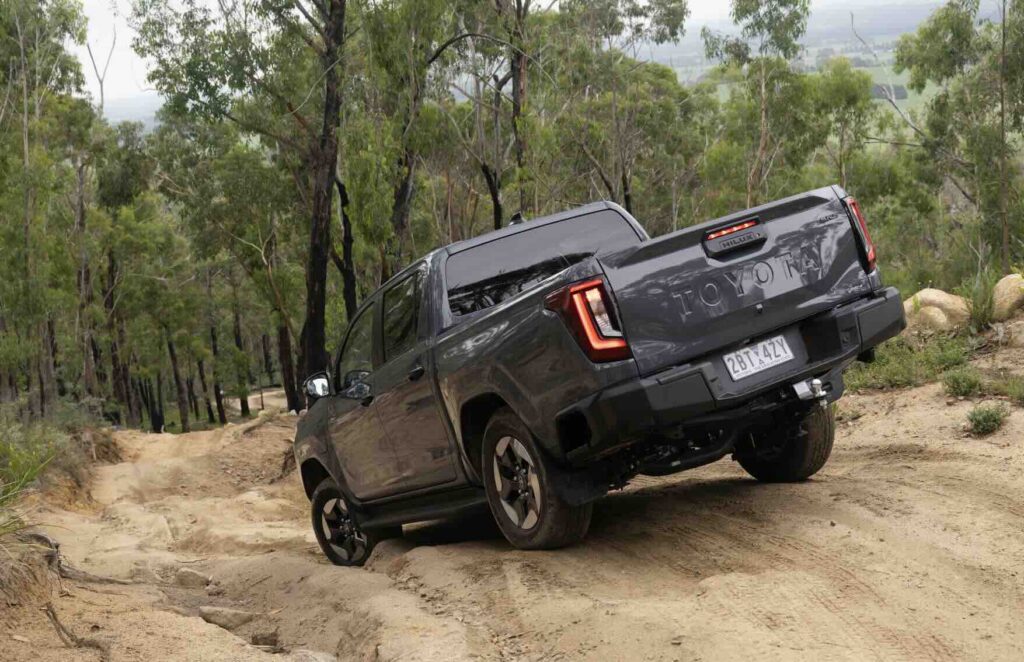
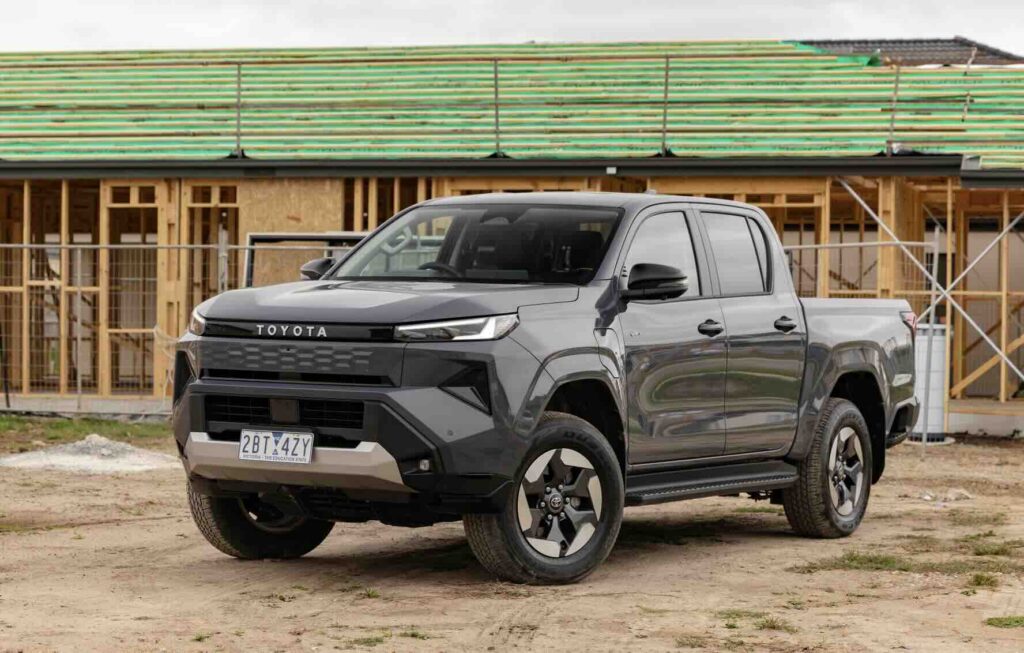
In the meantime, Toyota is offering the Hilux BEV only as an AWD double-cab pick-up or double-cab chassis in SR and SR5 grades, and the good news is that it has a spare tyre – not something you see often in an EV – which is located under the tray or tub.
Inside, there is little difference between the diesel and electric versions, with the notable exception that the centre console of the BEV has vehicle to load, in the form of a three-pin AC outlet to power small appliances with energy coming from a 220V/1500W inverter.
The 59.2 kWh battery is standard, and maximum outputs for the front motor are 82.2kW of power and 205.5Nm of torque while the rear motor offers 129.3kW and 268Nm. Driving range for the pick-up grades is 315km on the combined NEDC cycle, while the SR cab-chassis is rated at just 245km, also NEDC – so not very far.
The payload is up 725kg and 855kg for the SR cab-chassis4. All models feature a 2000kg braked towing capacity.
The pricing is key. The SR double cab-chassis: comes in at $74,990, the SR double-cab pick-up at $76,490, and the SR5 double-cab pick-up at $82,990.
Those prices are around $17,000 more than the diesel version, so you would really be wanting to either be green – or see the total cost of ownership savings to make that work.
Toyota itself only expected limited uptake, they banked on just 500 sales in their first year. They admit to already being surprised by the response, and are trying to get more vehicles delivered from Japan.
I think they might be surprised by the potential demand that is out there – despite its limitations: Soccer mums, tradies that don’t need to travel much, but the mining and corporate fleet market would have to be huge. Maybe innovate a bit with single cabs, 2WD and even a bigger battery. But a lack of ambition seems to be symptomatic of the company’s approach to going electric.
For more EV reviews, please go to our dedicated page. And for a full rundown of all available EV models, please go to our Compare EVs page here.
See The Driven’s detailed EV sales data here: Australian electric vehicle sales by month in 2026; by model and by brand.
Sign up for The Driven’s free daily newsletter and get the latest EV news and analysis delivered straight to your inbox.