Australia’s public charging network looks healthy until you leave the south-east — but the picture is more uneven, and on the remote routes far more improved, than headline charger counts suggest.
We mapped all 1,282 operational public chargers in the country, combining Open Charge Map data with the government-funded remote networks it under-reports (RAA Charge, the WA EV Network and NRMA), to see where fast charging is genuinely solved and where it isn’t.
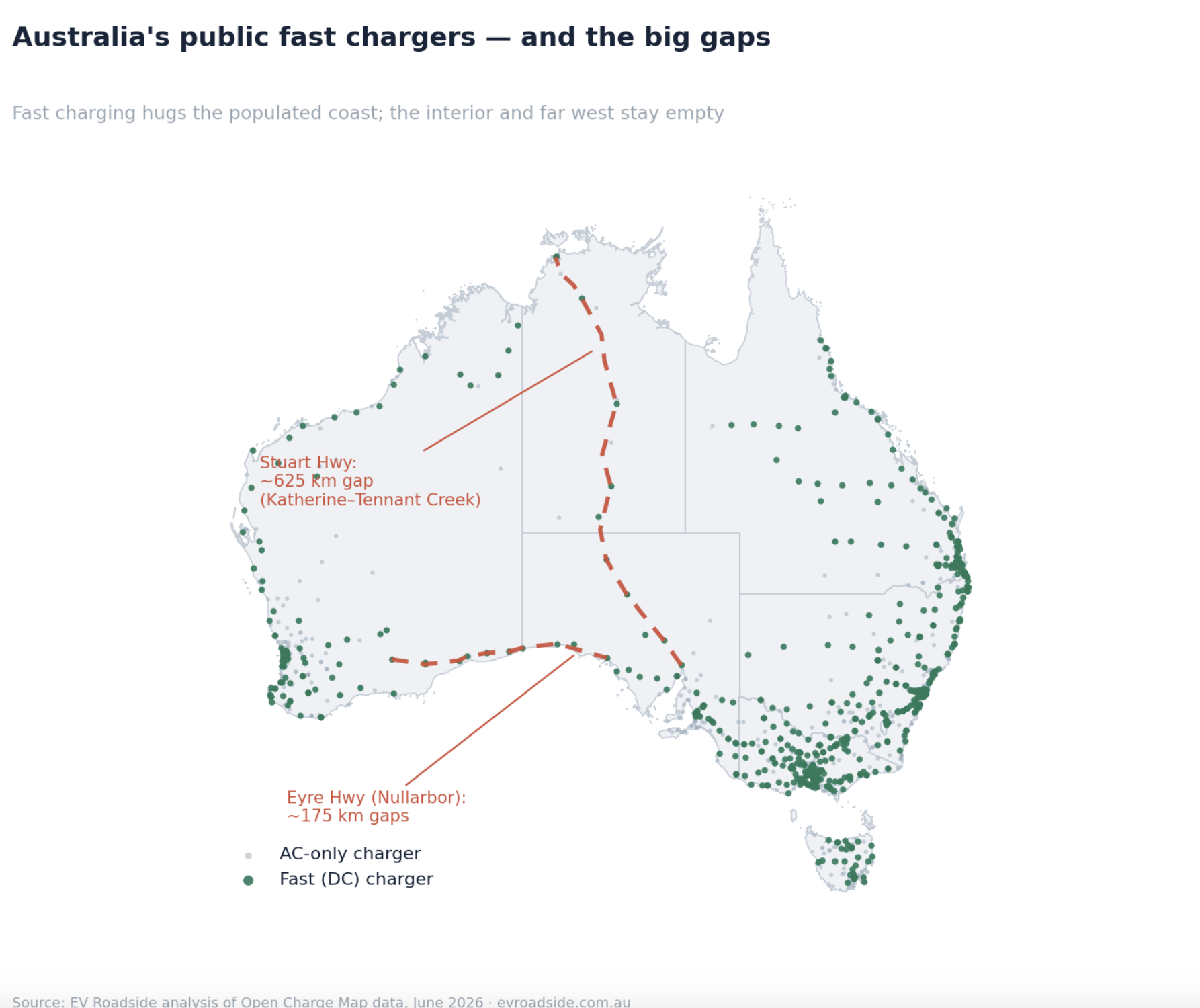
Of those 1,282 chargers, 703 are fast — DC chargers rated 50 kW or more, the kind that make long-distance EV travel practical. More than half (54%) sit in just two states: NSW and Victoria. Victoria alone has 208 fast chargers — nearly as many as WA, SA, the NT, Tasmania and the ACT combined (213).
Measured against the distances involved, the imbalance is starker. Victoria has 9.15 fast chargers per 10,000 km²; NSW 2.11. Queensland has 0.65, WA 0.47, SA 0.50, and the NT just 0.04 — six fast chargers across 1.35 million km².
The routes: mostly solved, with one frontier left. Charger counts don’t tell you what a road trip feels like, so we placed every fast charger along seven major touring routes and measured the longest stretch with none.
The striking finding is how much has closed. The Eyre Highway across the Nullarbor — the crossing that for years “proved” you couldn’t drive an EV across Australia — now has no gap larger than about 175 km, after WA EV Network and RAA Charge sites came online in 2024–25.
The one genuine outlier is the Stuart Highway. Between Katherine and Tennant Creek in the Northern Territory, there’s still roughly 625 km with no public fast charger — the longest gap in the country, and beyond a single charge for most EVs.
The Territory’s town chargers (NRMA, opened 2024) are spaced wide; the South Australian leg, by contrast, is comfortable. After the Stuart, the next-largest gap is around 250 km on the North West Coastal Highway.
The busy corridors are fine. Worth saying plainly, because range anxiety is so often overstated: on the Hume, Pacific, Bruce and Western highways, no gap between fast chargers exceeds about 150 km — comfortable for any current EV. For the capital-to-capital runs most people actually drive, the “can you even drive an EV across Australia?” worry is misplaced.
Two quieter problems the counts hide. First, AC-only charging: a large share of public charging in the west and centre is slow AC — fine overnight, useless when you need range quickly on a long drive. About 68% of WA’s public chargers, and 62% of SA’s, are AC-only. Second, single-network reliance: in Tasmania, Chargefox runs 83% of all public chargers; in WA, 58%. If that network has an outage, most of a state’s public charging can go down at once — a reliability risk headline counts don’t show.
The takeaway. The story has shifted. Two years ago the remote crossings were the headline gap; today most are bridged, and for the vast majority of trips an EV needs no more planning than a petrol car.
What’s left is narrower and more specific: one real distance gap on the Stuart Highway, and a quieter, structural question of reliability — slow AC charging and single-network dependence — in the west and the islands. That’s a more mature network than the raw “gaps” framing suggests, and a more useful map of where the work still is.
Editor’s note: This story has been heavily revised from the original after feedback from The Driven readers, for which we are grateful. The author acknowledges the errors, saying his original data effectively ignored some government-funded chargers.
The full analysis is at EV Roadside, with the underlying data free to download. Figures reflect operational public chargers as of June 2026, drawn from Open Charge Map and supplemented with verified remote-network sites (RAA Charge, WA EV Network, NRMA) that Open Charge Map under-reports; a “fast charger” is any site rated 50 kW or more. Luke Moulton is the founder of EV Roadside.