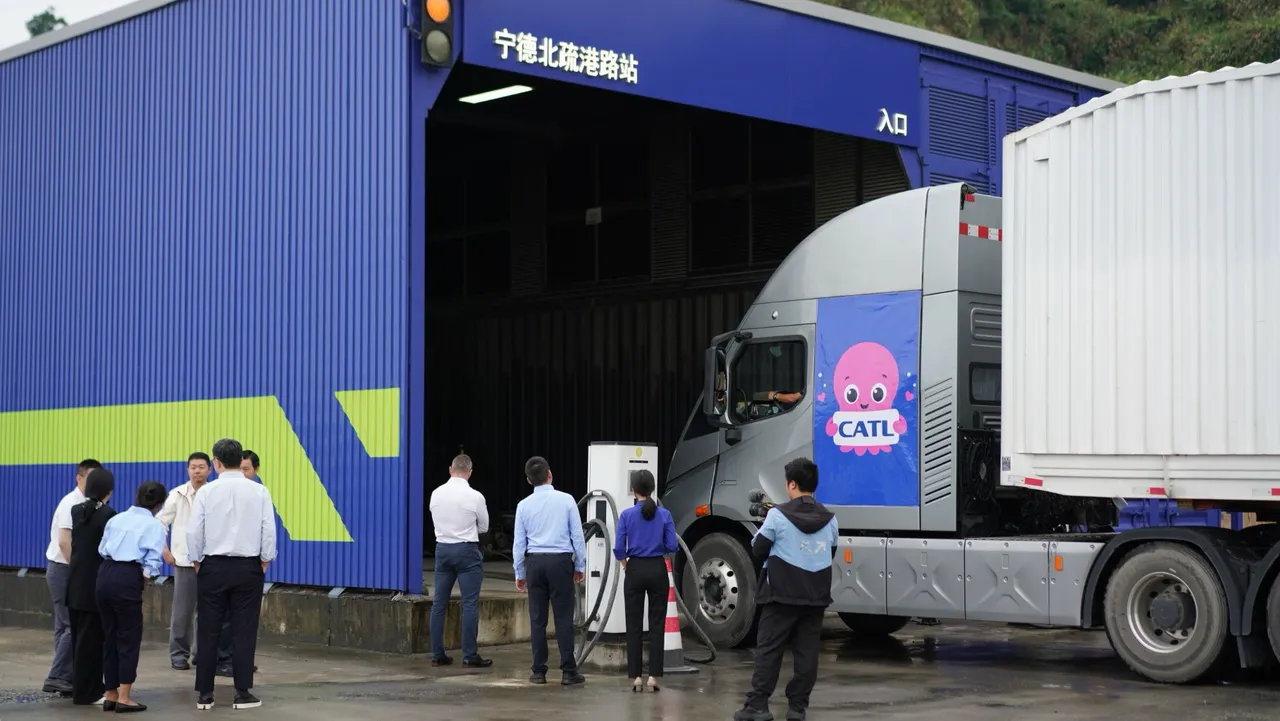
British clean energy technology company Octopus Energy and Chinese battery manufacturing giant CATL will partner to roll out an ultra-fast battery swap network for electric trucks across the United Kingdom and Europe.
The new venture, named “Swaptopus”, could eventually support in excess of 300,000 electric trucks while unlocking £30 billion worth of private investment, the two companies say.
The first battery-swapping hubs will be launched in the UK next year, and more than 30 will be deployed across Europe by 2035.
“We believe the future of land-based transport is electric and autonomous, and battery swapping is a massive part of the enabling infrastructure,” said William Rowe, CEO and founder of Swaptopus.
“Not only does it significantly reduce down time but since the batteries at the swapping stations can be charged and discharged when the grid needs it, they act as a virtual power plant and in turn lower costs for consumers.”
Unlike the more common charging stations which rely upon both the type of charger and the car’s electrical charging architecture to dictate the speed with which an electric vehicle can get back on the road, battery swapping does exactly what it says on the tin – swaps the battery.
While not just any battery can be swapped out, a region-wide battery-swap network will allow electric trucks with corresponding batteries to be able to get on the way again in minutes.
CATL has prioritised the development of its own swappable batteries and battery-swapping stations and has also begun partnering with other Chinese peers to begin building common battery swapping networks.
CATL signed a strategic partnership with Chinese electric carmaker Nio in March 2025 to create the “largest and most advanced battery swapping service network for passenger vehicles” in the world. But the agreement also aimed to promote the standardisation of battery swapping technologies.
A month later, CATL signed another agreement with Sinopec, one of China’s largest integrated energy and chemical companies, to immediately begin building a nationwide battery swap network.
CATL will also be building on partnerships with some of the world’s most recognisable automakers – including BMW, Hyundai, Honda, Tesla, Toyota, Volkswagen, and Volvo, as well as a number of Chinese carmakers.
The company also launched in mid-2025 a new standardised battery pack for battery-swap enabled heavy-duty electric trucks.
“Battery swapping will be a significant part of the future of commercial transport,” said Dr. Robin Zeng, Chairman and CEO of CATL.
“We have field-proven this technology in China, and we are delighted to bring it to the UK and Europe as part of our joint venture with Octopus.
“Together, our expertise in battery swapping, B2G and energy storage, paired with Octopus’s AI-powered energy trading and management technologies, will speed up the electrification of road transport across the region.”
The announcement was also framed as another key step in reducing Europe’s dependence on imported oil, replacing it with locally generated green electricity.
“Electric trucks already beat diesel on running costs, the challenge is keeping them moving,” said Greg Jackson, CEO and founder of Octopus Energy Group.
“Battery swapping changes that. Instead of waiting for hours, trucks can be back on the road in minutes.
“By combining Octopus’s software and energy expertise with CATL’s world-class battery technology, we’re making clean freight practical at scale across Europe.”
The announcement was made at Octopus Energy’s flagship The Energy Tech Summit event on Monday, which also saw the company launch its own range of new home batteries which will be available across Europe.
The new range of batteries, known as ‘Nook’, includes both standard wall-mounted options as well as plug-in batteries designed specifically for renters and apartment dwellers.
Please sign up for The Driven’s free daily newsletter and get the latest EV news and analysis delivered straight to your inbox.