A new analysis has revealed that Japanese carmakers are employing a cross-market strategy at home and abroad to slow the transition to electric vehicles, with calls for a “multi-pathway” approach that prioritises alternative fuels and hybrid vehicles.
At the same time, Chinese automakers are more supportive of electrification and are capturing an increasing share of global vehicle sales but are less engaged and comparatively absent from policy debates than their Japanese counterparts.
With Japanese and Chinese automakers collectively representing 57 per cent of global vehicle sales last year, their attitudes towards the decarbonisation of the global transport sector carry significant weight and can help or hinder the transition.
This influence, however, is not being wielded equally, according to a new analysis from London based climate risk think tank InfluenceMap.
InfluenceMap analysed the corporate policy engagement of ten Chinese and Japanese automakers – BYD, Geely, Chery, SAIC Motor, FAW, Changan, Toyota, Honda, Nissan, and Suzuki – both domestically and in the emerging markets of Brazil, Colombia, and Indonesia, between January 2024 and December 2025.
The analysis also assessed automotive associations from each of the five countries.
The analysis showed that, even though Chinese automakers are dominating the global electric vehicle (EV) market and capturing an ever-increasing share of global vehicle sales along with it, it is the Japanese automakers – still dominant in so many parts of the globe – that are actively painting an anti-EV narrative to slow the transition.
Japanese automakers, particularly Toyota, as well as the Japan Automobile Manufacturers Association (JAMA), were found to frequently promote a “multi-pathway” approach to the transition which deemphasises battery EVs (BEVs).
Instead, they promotes as viable options alternatives that are not aligned to the science of reducing emissions or which are merely short-term solutions – such as alternative fuels and ICE-powered hybrids.
The contrast in policies is striking, especially domestically. According to InfluenceMap, almost 55 per cent of new cars sold in 2025 were electric, whereas in Japan EVs accounted for less than 3 per cent of sales.
In addition to making these arguments at home, Japan’s automotive industry is using its role within regional industry associations to push the same narrative abroad.
As can be seen below, Japanese automakers hold influential roles in the industry associations of Brazil, Colombia, and Indonesia, whereas Chinese automakers are less represented.
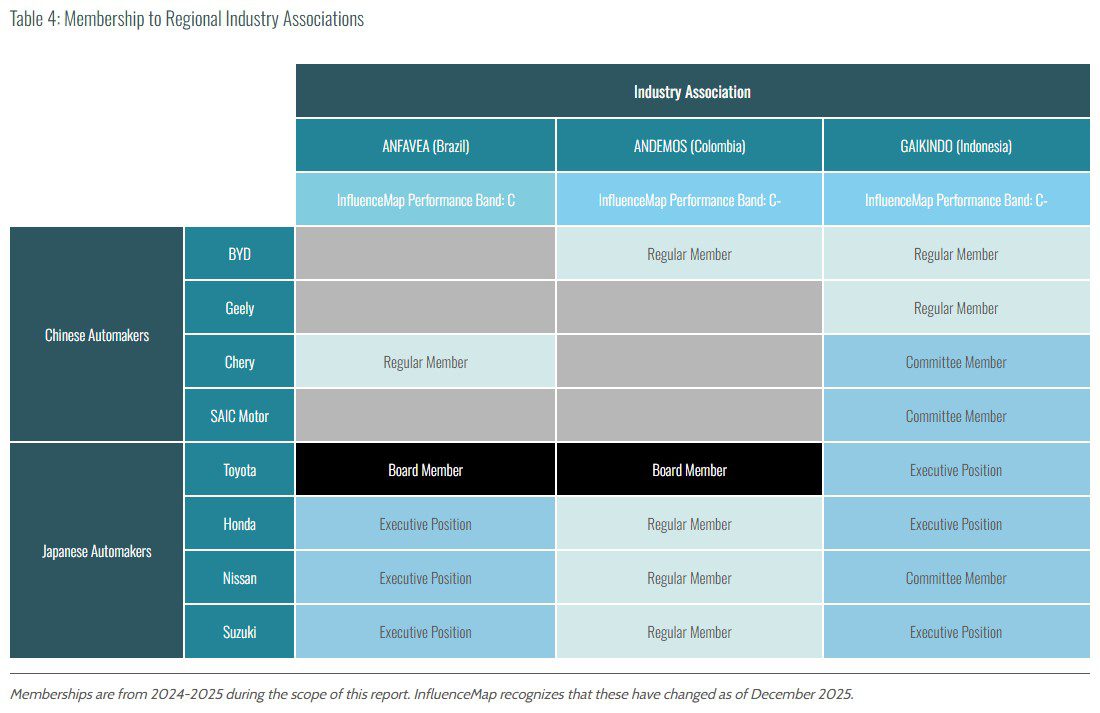
As a result, the anti-EV narrative important to Japanese automakers outweighs the pro-EV narrative that Chinese automakers could be bringing to the table.
In Brazil and Colombia, for example, where Japanese automakers hold significant influence, both automotive associations have opposed measures to accelerate prohibit environmentally harmful vehicles and accelerate EV adoption.
This is particularly important as emerging markets elsewhere are quickly becoming leaders in EV adoption. If the anti-EV narrative painted by Japanese automakers is able to gain further foothold in these markets, the adoption of electric cars will swing more towards hybrids than BEVs.
In Brazil, for example, electrified vehicles accounted for only a 9 per cent share in 2025, up from 6.5 per cent in 2024, with BEVs accounting for only 44 per cent of all these sales. In Colombia, electrified vehicles accounted for 10 per cent of sales in 2025, up from 1 per cent in 2020, but BEVs were responsible for only 8 per cent of this.
“Across markets, from Japan to Brazil, Colombia, and Indonesia, the same core arguments from Japanese automakers are appearing in policy debates, consistently pushing for a slower EV transition,” said Emily Zhang, analyst at InfluenceMap.
“Chinese automakers, while more supportive of electrification, are largely absent from these debates. The result is that discussions on transport decarbonization are dominated by voices advocating delay.”
Please sign up for The Driven’s free daily newsletter and get the latest EV news and analysis delivered straight to your inbox.