Europe’s road freight sector is at a turning point. Current geopolitical tensions and renewed energy price volatility strengthen the case for reducing Europe’s dependence on diesel in road freight.
Still, in many countries, zero-emission trucks (ZETs) remain more expensive to own and operate than diesel trucks. Looking ahead, accelerating total cost of ownership (TCO) parity between ZETs and diesel counterparts is critical to faster rollout.
That’s where the Eurovignette Directive steps in.
The Eurovignette as a driver of ZET adoption
Revised in 2022, the Eurovignette Directive allows EU Member States to exempt zero-emission trucks from road tolls and requires that distance-based toll systems charge trucks differently based on their CO2 emissions.
This levels the playing field between diesel and zero-emission trucks by making diesel operators pay for the climate and air pollution costs of their vehicles, while also supporting a future-proof clean technology at an early stage of market uptake.
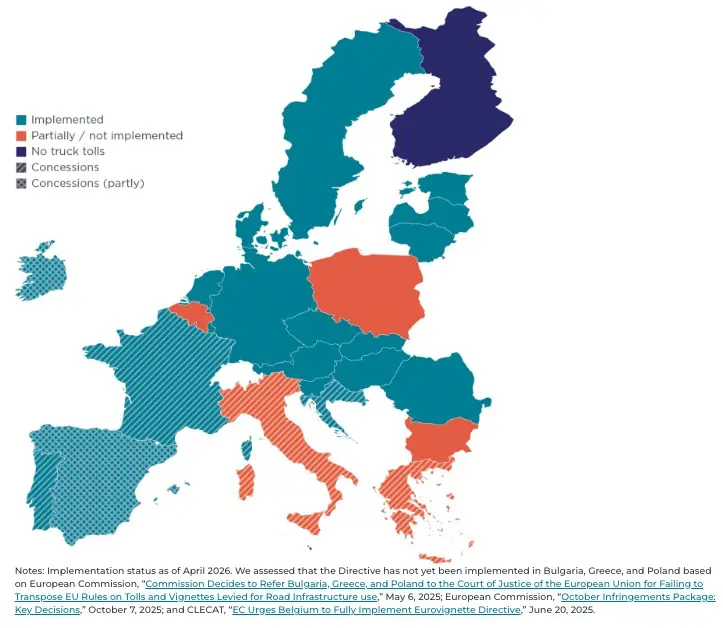
Eurovignette implementation is far along in Germany, a regional leader in ZET uptake, and underway in Austria, Denmark, and Czechia, among other countries (Figure 1).
Implementation may be more challenging in markets such as France, Italy, and Spain, where motorways may be operated by private concessionaires. Under the Directive, motorway concession contracts signed before March 2022 do not have to apply CO2-based toll variation until they are renewed or substantially amended.
This risks delaying the Eurovignette’s full implementation for years, making it harder for countries to meet their ZET rollout and emissions reduction targets.
But concession systems need not be a barrier to progress. Toll exemptions for zero-emission trucks can be introduced earlier, even in concession systems, if governments negotiate the necessary changes with operators.
France, for example, is forging ahead by establishing the legal framework for CO2-based toll modulation and is actively engaging with motorway concessionaires to explore how differentiated tolls could be implemented ahead of contract renewals.
Figure 1. Truck tolling systems and Eurovignette Directive status in EU member states
Are road-toll exemptions for ZEVs sufficient to achieve cost parity?
In our latest analysis, we examined the power of road-toll exemptions and CO2-based charges to narrow the TCO gap between diesel and battery electric trucks (BETs).
Focusing on regional and long-haul trucks in six key markets—France, Germany, Italy, Poland, Spain, and Sweden—we compared total cost of ownership under three scenarios: a reference scenario that reflects current policies applied in each country, a road-toll exemption scenario assuming full exemption for BETs, and a CO2-based charge scenario considering the maximum fee allowed by the Directive (€0.16/km).
For each scenario, we considered trucks of model year (MY) 2026 and 2030 to capture expected implementation timelines across Member States. The analysis was based on a previous ICCT study; charging price, road toll, and average net fuel-price assumptions were updated to reflect February 2026 conditions and did not account for recent oil market volatility.
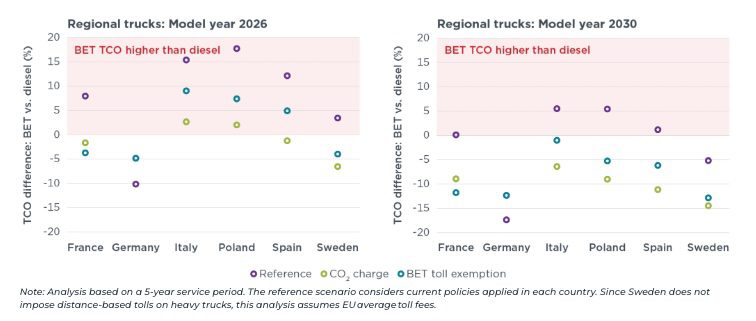
The overall impact of ZEV road-toll exemptions depends on the current toll levels in each country and the exemption applied. As illustrated in Figure 2, we found that full toll exemptions for BETs would be sufficient to bring about cost parity for MY 2026 regional trucks in France, Germany, and Sweden and reduce the TCO gap to 9% in Italy, 7% in Poland, and 5% in Spain. Looking ahead to MY 2030, road-toll exemptions alone achieve cost parity across all countries.
Figure 2. BET vs. diesel TCO difference for regional trucks in 2026 and 2030
As for long-haul trucks, shown in Figure 3, we found that full road-toll exemptions can bring the TCO of MY 2026 BETs below that of diesel trucks in France and Germany and reduce the TCO gap to 15% in Italy, 13% in Spain, and just 3% in Sweden.
Poland would need to combine such exemptions with moderate CO2 charges to substantially narrow the gap. By MY 2030, Spain and Sweden could also achieve cost parity with road-toll exemptions alone, while Italy and Poland could narrow the gap to only 4% and 7%, respectively.
Figure 3. BET vs. diesel TCO difference for long-haul trucks in 2026 and 2030

Prioritizing road toll exemptions can drive ZEV competitiveness
The results emphasize that the Eurovignette Directive can be a powerful tool to narrow or eliminate the TCO gap between BETs and diesel trucks. In both regional and long‑haul applications, road-toll exemptions alone can substantially shift the economics of trucking in most countries.
This is particularly encouraging for countries with concession systems such as France, Italy, and Spain, as the results show that these countries may not need to wait for concession contracts to expire to improve the TCO competitiveness of ZETs, provided they can negotiate such exemptions with concessionaires.
In countries where parity is not projected to be reached with road-toll exemptions alone, such as Poland, the TCO gap still narrows significantly, meaning that moderate CO2-based charges may be enough to bring the TCO of BETs below diesel.
Overall, this analysis shows that road-toll exemptions, the fastest lever within the Directive, can offer quick and high-impact results for BET economic competitiveness. Governments already have all the tools they need under the Eurovignette to accelerate the rollout of ZEVs in Europe—and prioritizing road-toll exemptions is the most effective place to start.
Albert Alonso-Villar is an Associate Researcher with the International Council on Clean Transport. Reproduced with permission.