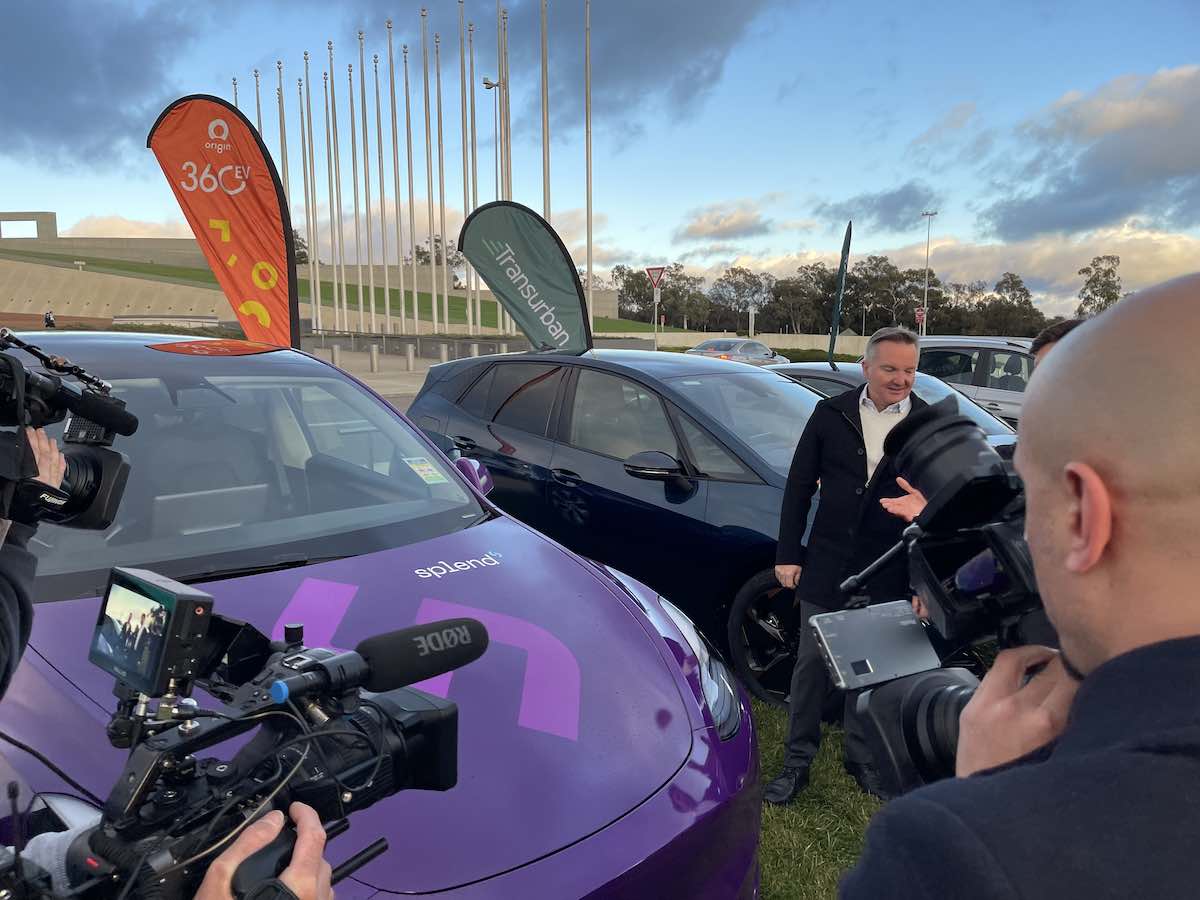
Federal energy and climate minister Chris Bowen has downplayed fears of an arbitrary tax on electric vehicles, saying a road user charge would only happen “when it is ready.”
There has been a major new campaign – supported largely by the country’s big motoring groups – for a road user charge to be imposed on EVs – they suggest 3c a kilometre – because of the fall in revenues from the fuel excise.
The EV industry itself has argued that a road user charge is inevitable as the passenger car fleet switches from petrol and diesel to electric, but argue that it should be calibrated to all vehicles are fairly treated, and that the much needed uptake of EVs is not discouraged. The motoring group proposal would cost $400 a year for EVs travelling 20,000 kms.
Bowen appears to have sympathy with the EV industry position, noting in an interview on the weekly Energy Insiders podcast, hosted by The Driven’s sister site Renew Economy, that excise revenues have been falling also because of the popularity of hybrids, which have also reduced levels of fuel consumption.
“My view about a road user charge hasn’t changed,” Bowen told the Energy Insiders podcast (where he also discusses renewable energy targets, the fossil fuel crisis, electrification and UN negotiations).
“It needs to happen when it’s ready. It’s a destination, and we’re getting less and revenue, not only because of EVs, but because the New Vehicle Efficiency Standards is driving more efficient petrol cars. So you lose less petrol, even in a petrol car.
“It shouldn’t be one that we’re meeting on an arbitrary deadline. It’s an important policy destination, but one that must be got right. It can be a good thing, but it should not be rushed.”
EV sales surged to a record high in the month of March, driven mostly by the latent demand that had been triggered by the sudden surge in petrol and diesel prices as a result of the Iran war and the blockages in the Strait of Hormuz and its impact on global fuel supplies.
That high demand for EVs is expected to continue for months, and perhaps become a fixture, because few people expect petrol and diesel prices to return to their previous levels anytime soon. The major EV makers report waiting times of several months, and have vowed to import tens of thousands more to meet the growing demand.
An EV road tax applied to EVs only is seen as a retrograde step, although the EV lobby has long acknowledged such a policy is inevitable, but should be applied across all vehicles, regardless of fuel type, and not in a way that discourages customers from going electric.
Others, such as Fortescue boss Andrew Forrest and Energy Insiders co-host and industry analyst David Leitch, argue that the fuel excise rebates should be abandoned, particularly for the mining industry which gets hundreds of millions of dollars in rebates.
Forrest says cancelling the rebate will encourage others to do what his company is doing, and swap all its diesel trucks and mining equipment with battery powered trucks and excavators. Leitch says at the very least the coal industry, which is now using even more diesel than before, should have the rebate removed. Others say it should be capped at $50 million for each company.
You can hear the full interview with Chris Bowen on the latest episode of the Energy Insiders podcast: Energy Insiders Podcast: Chris Bowen on renewable target, wind delays, EVs and electrification