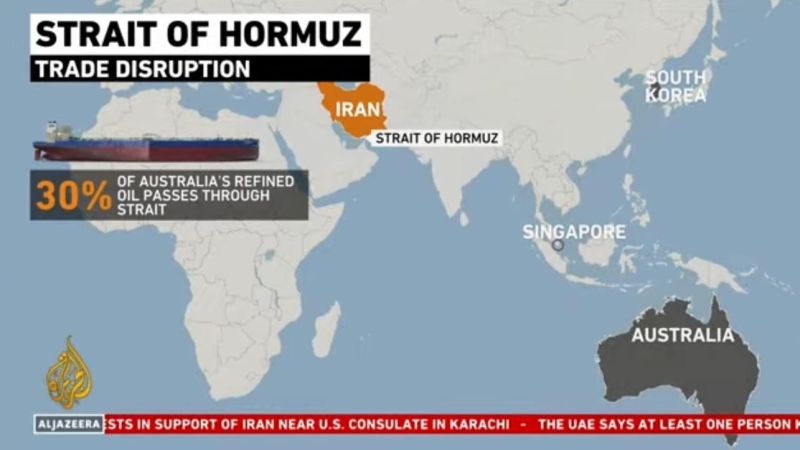
Escalating conflict in the Middle East and the closure of the Strait of Hormuz once again highlights the extreme vulnerability of Australia’s diesel-dependent road freight and food distribution system. After the US, Australia is the second most road freight dependent nation on earth. Unlike the US, 90% of Australia’s refined diesel and crude oil is imported through a handful of shipping lanes with roughly 30% coming via the Strait of Hormuz. With JP Morgan projecting oil prices could now hit $120 per barrel, alarm bells are ringing.
As concerns grow that Australia could face shortages of liquid fuels during a prolonged global disruption, pressure is mounting on the government to invest billions of dollars in additional fuel storage. Stockpiling fuel may appear prudent in an uncertain world, but it risks locking Australia deeper into an expensive and fragile imported oil-dependent energy system.
There is a more effective alternative – one that strengthens energy security while reducing costs, emissions and supply-chain risk at the same time – electrifying road freight.
Faster, cheaper, cleaner – and stronger
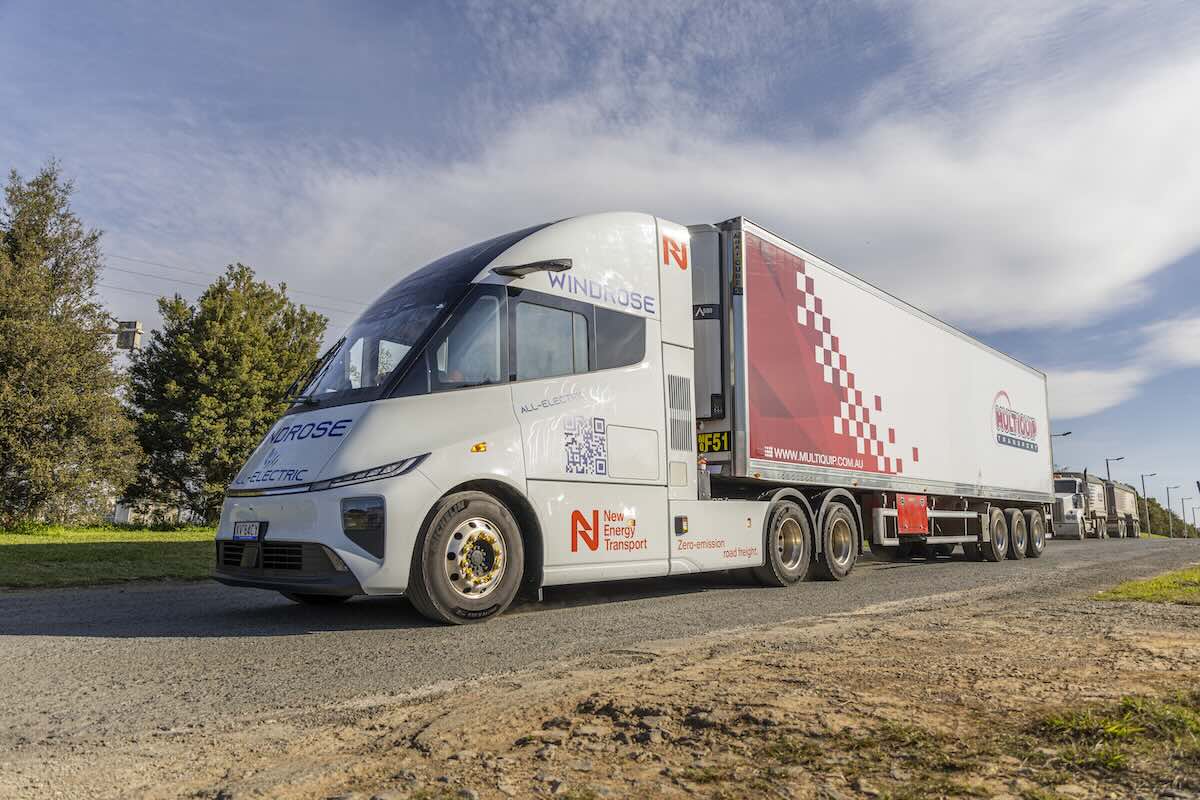
Australian electric trucking startup New Energy Transport (NET) recently completed a record-breaking demonstration, transporting 36 tonnes over 480 kilometres on a single charge. The truck completed the journey 40 minutes faster than a comparable diesel run because it maintained speed on steep gradients.
The electric prime mover, supplied by Chinese manufacturer Windrose, shows what is now possible. NET plans to break ground in mid-2026 on its flagship 50-truck electric depot in south-west of Sydney to service routes to Newcastle, Wollongong and Canberra.
NET is applying a first-principles rethink to road freight for the electric era, combining electric prime movers, high-speed charging and low-cost renewable energy. NET’s modelling demonstrates the potential to reduce the cost of road freight by more than 20%.
Electric road freight is the key to energy security
Australia is the second most road-freight-dependent country in the world, leaving food and essential goods supply chains highly exposed to fuel price shocks and geopolitical disruption. Around 90% of the 30 billion litres of diesel used annually by Australia’s road transport sector is imported.
In a world of intensifying geopolitical tension and conflicts, this dependence is a serious economic and food-security vulnerability, putting at risk our national security.
Electrifying heavy road freight fundamentally changes this equation. Instead of relying on imported liquid fuels, transport energy can be produced domestically through a distributed network of solar, wind and storage assets. Freight becomes powered by Australian sunshine rather than overseas oil supply chains.
Electrifying the trucks we already have
New trucks are only part of the answer. Australia’s existing diesel fleet represents a vast embedded asset—and an opportunity to accelerate the transition.
Central Coast-based company Janus is retrofitting diesel engines with electric drivetrains and modular battery systems, instead of major engine rebuilds. The incremental cost is typically paid back within a year and battery packs can be swapped in minutes.
This approach allows electrification to proceed faster than waiting for full fleet replacement, while avoiding unnecessary scrappage of otherwise serviceable vehicles. Automation is already on the horizon, with Solarh2e working with Chinese equipment supplier Sany to deploy automated battery-swap systems on mine sites.
Rethinking charging infrastructure
A common concern is whether the electricity grid can support large-scale truck charging. But charging does not need to rely on major grid upgrades.
Australian companies, like eLumina and New Volt are borrowing lessons from Tesla’s massive Lost Hills charging station in California, which pairs a modest grid connection with large battery storage and solar PV, particularly along major freight corridors and in regional locations, improving grid resilience.
Learning from China’s lead
China has already demonstrated what ambition and scale look like. Roughly 30% of new trucks sold in China are now battery electric, with diesel down to around 40%. Chinese manufacturers accounted for 80% of the world’s 90,000 electric truck sales in 2024, according to the International Energy Agency (IEA). This rapid uptake has materially reduced China’s oil consumption, which is now expected to peak in 2027.
Consistent policy support and industrial scale have enabled companies such as CATL and BYD to become global leaders in battery and EV technology, with Chinese clean-tech firms now investing heavily in Asia, Europe and the Middle East, including CATL’s US$6 billion integrated battery project in Indonesia and multibillion-dollar battery gigafactories in Morocco, Spain, Hungary, Portugal and the UK.
Strategic collaboration with China on zero-emissions transport – particularly charging networks and battery swapping – could accelerate Australia’s transition while strengthening national resilience.
Where transport meets the power system
Quieter, cleaner trucks that significantly improve working conditions for drivers and quality of life for local communities are just the beginning. Electric trucking represents the convergence of the transport and electricity sectors which have traditionally been completely separated..
A fleet of 100 heavy electric trucks has around 60MWh of battery capacity, about half the capacity of the original South Australian big battery. With the recently developed Megawatt Charging Standard capable of bi-directional charging, these fleets will be able to participate in the electricity market during daily demand peaks and network disruptions.
A strategic opportunity
The electrification of road freight is an opportunity for Australia to completely reimagine how we power and supply our economy. With its vast renewable energy resources, dense road-freight corridors and supportive policy environment, Australia is well-positioned to capture the benefits of electric road freight. If Australia is serious about energy security, the fastest and most cost-effective path is not building more tanks to store imported diesel, it’s eliminating diesel dependence altogether.
Richard Neumann is Chair of the Smart Energy Council Pacific Working Group and a member of the Advisory Council of the Franco-Australian Centre for Energy Transition at Swinburne University. He is a former diplomat who served overseas in Beijing, Seoul and Taipei, and was Director of the Climate Mitigation and Investment Section in the Department of Foreign Affairs and Trade from 2019 to 2024. He has a Masters Degree in Foreign Affairs and Trade from Monash University, co-designed a Grid Integration of Renewable Energy Course with the Australian National University and managed the Australia-Germany Hydrogen from Renewable Energy Supply Chain Feasibility Study with the University of New South Wales.