
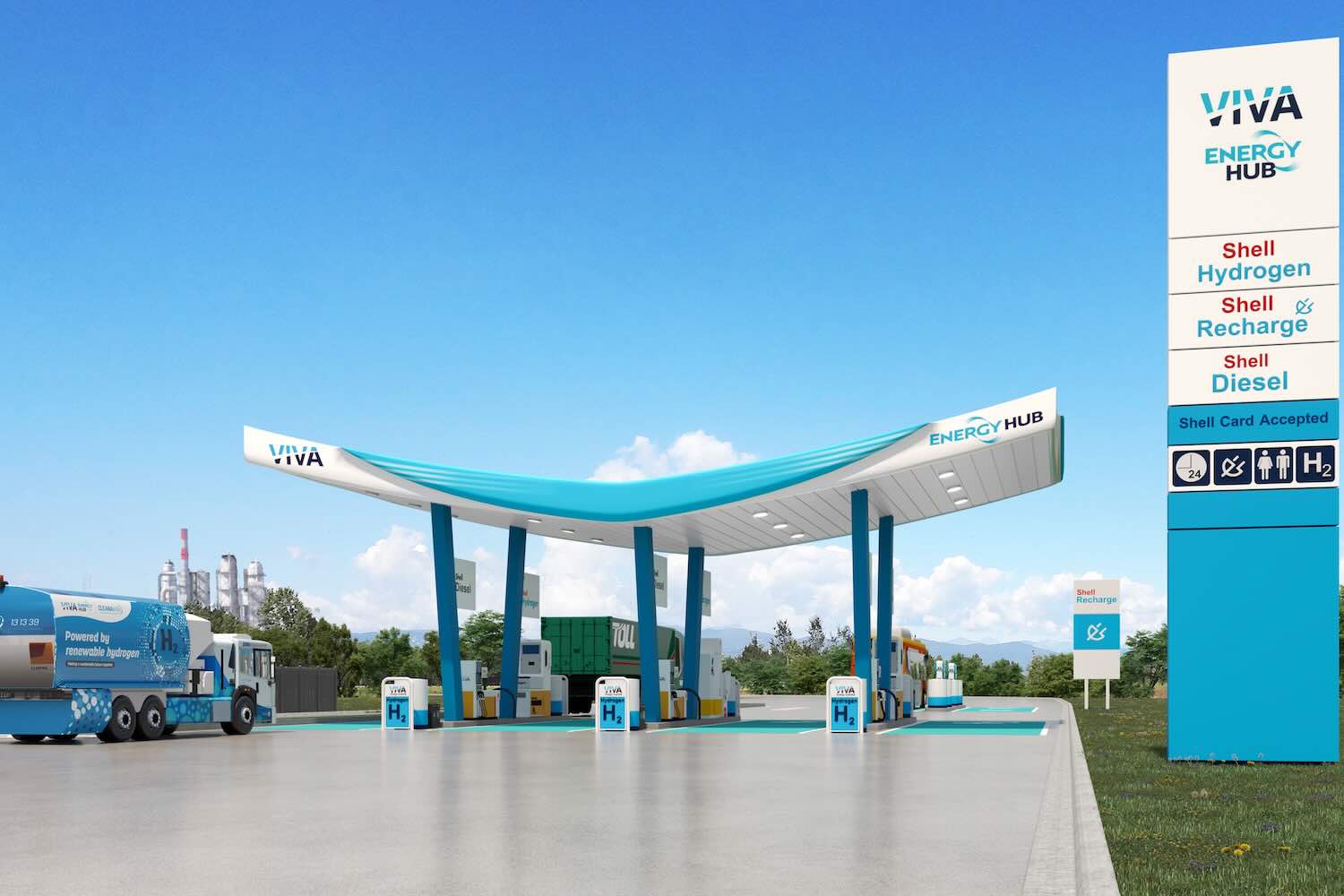
Viva Energy has launched its first renewable hydrogen refuelling station at the site of one of Australia’s last remaining oil and gas refineries in Geelong, Victoria.
Dubbed the “New Energies Service Station”, the project comprises a 2.5 megawatt (MW) proton exchange membrane (PEM) electrolyser from Norway’s Nel Hydrogen, which uses “sustainable electricity from the grid” and water from Barwon Water to produce hydrogen.
Viva says the facility is Australia’s first “publicly accessible commercial hydrogen refuelling station” and will be the hub for a fleet of hydrogen-powered, emission-free commercial heavy vehicles servicing the Geelong region.
“By providing hydrogen as an alternative fuel, we are aiming to reduce emissions and contribute to the development of a more sustainable heavy transport sector in Australia,” said Viva’s chief strategy officer, Lachlan Pfeiffer.
At maximum production capacity, Viva claims the project will be able to produce up to 1,000kg of hydrogen a day to be used by heavy hydrogen-powered trucks and buses in the region.
Viva says the facility will be able to dispense up to 300kg of hydrogen in under two hours, offering a “refuelling experience” similar to filling up with diesel. It is designed to refuel at least 10 trucks consecutively.
A Viva spokesperson told The Driven that 1,000 kg of hydrogen a day will be “more than enough to cater for demand for the forseeable future.”
The spokesperson added that the company was, in fact, “exploring opportunities to sell bulk renewable hydrogen offtake via tube trailers for businesses looking to reduce their carbon footprint.”
Viva has so far partnered with four companies who plan to use the hydrogen produced at the site to collectively power seven hydrogen fuel cell vehicles.
Alongside Barwon Water, Viva Energy has also struck up offtake deals with freight company Toll Group, transport provider ComfortDelGro Corporation Australia (CDC) and waste management firm Cleanaway.
Additionally, Viva has said it will deploy up to 15 hydrogen-powered heavy vehicles within two years.
The project has been partially financed by Arena and the Victorian Government’s Renewable Hydrogen Commercialisation Pathways Fund, who pledged A$22.8 million and A$1 million, respectively.
“We are supporting our emerging renewable hydrogen sector to expand and help industries like transport reduce their emissions – helping Victoria achieve net-zero emissions by 2045,” said state energy minister Lily D’Ambrosio at the facility’s launch.
How green is your hydrogen?
Often regarded as the gold (or should I say green) standard, “green” hydrogen is produced by an electolsyer that takes water and turns it into hydrogen and oxygen as a byproduct, through a process called electrolysis.
The process of electrolysis is incredibly energy intensive and for the produced hydrogen to be seen as green, renewable energy needs to be used.
To achieve this, developers will often pair an electrolyser-based hydrogen production plant with renewable energy generation and some form of battery storage, connected behind-the-meter, enabling truly carbon-free hydrogen to be produced as close to 24/7 as possible.
Although lauding it as “Australia’s-first renewable hydrogen refuelling station”, the statement from Viva Energy is somewhat ambiguous with the electrolyser being hooked up to the wider electricity network.
As with any consumer connected to AEMO’s grid, Viva Energy is unable to decide where its electricity is coming from to power its electrolyser.
Despite renewable energy making up an increasingly higher proportion of the National Electricity Market’s energy mix, it’s still heavily reliant on black and brown coal, as well as on gas.
As it stands, the majority of the world’s hydrogen is referred to as “grey”, meaning it’s been produced through a carbon intensive process known as steam methane reformation. During this process, natural gas is turned into hydrogen and carbon dioxide as a byproduct.
According to statistics from Harvard’s Belfer Center for Science and International Affairs, over 95% of the world’s hydrogen is “grey.”
In an emailed statement to Renew Economy, a Viva spokesperson said the company was “buying sustainable electricity from the grid to power the electrolyser.”