
I am more often now being called upon to do EV presentations in regional areas as well as the usual round of Melbourne gigs.
Having now driven my trusty Kona electric all over Victoria, as far north as Coffs Harbour and west as far as Perth and back – it’s safe to say that the EV didn’t ‘ruin the long weekend’ … or even the interstate commuter trip where DC fast-charging is available.
In fact, with the advent of Vehicle to Load (V2L) providing 10A or even 15A of 240V power from the car, the EV has become an enhancement to the camping weekend.
As a result, for my most recent regional talk in the Gippsland town of Sale (in Victoria’s east) I decided to tackle the second of the former coalition government’s infamous anti-EV statements: that a future ban on internal combustion engine vehicle (ICEV) sales would “steal the tradies ute.”
(The implication being that EVs would never be viable in commercial vehicle form so, unlike most of the OECD, we should not set a phase-out date to end sales of ICEVs.)
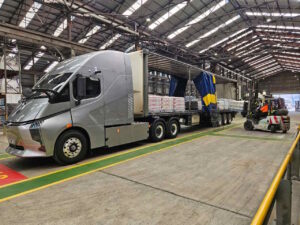
To test the idea, I borrowed one of Ford’s press fleet of E-Transit vans and headed off for a day trip to Sale and back to do my presentation and display the van. (A round trip of around 420km).
This, by the way, would not be a ‘typical’ commercial van use: whilst there are delivery businesses and tradespeople who do long runs to or between regional areas, Ford themselves suggest the ‘average’ Australian daily van use is 115km. By that metric, for my test I was exceeding this average nearly four time over!

On start-up with 100% charge, the range estimator was showing 230km (the WLTP range for the mid-roof van I had is 230km to 307km) so I was a little concerned should a 110km/h run with the heater flat out reduce that further. (It was a very cold morning at around 1 degree).
However, just like back in 2019 for my EV Long Weekend Tour, I wasn’t going to make compromises over how I would drive an ICEV on the same trip – so it was heater for comfort and, where allowed, 110km/h.
Interestingly, in my Kona I would have either not have bothered to recharge for the trip (and roll home with about 5 – 10% charge) or do one stop for a 15 to 20 min recharge to get home with a more comfortable 20 to 30% remaining.
For the E-Transit, well the range estimator turned out to be relatively conservative and I would have made it to Sale with about 5% to 10% left to DC recharge there. However the Sale DC charger site contains only one charger – and I don’t like relying on a single charger site to be working to make it home.
Charge early, charge often
Consequently, I decided that was ‘Plan C’ only. ‘Charge early, charge often’ is the still the best approach for DC charging until we get a fully mature network.
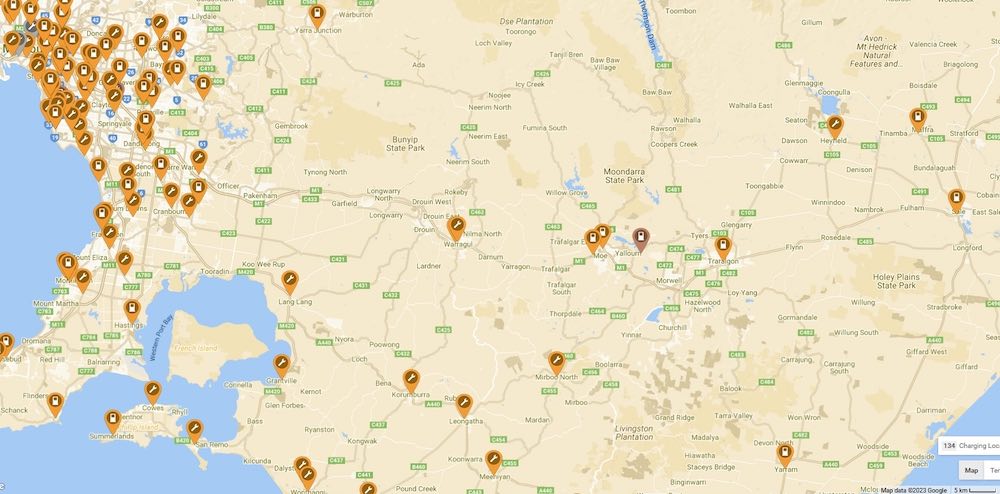
I therefore planned to stop at the Moe DC charger site on the way there as well as on my return, meaning I had the Traralgon DC charger site as plan B on my way there. For the return trip I made the Moe Tesla Supercharger site my ‘Plan B’. (That one has recently opened to all EVs as part of the opening up of that network here).
Having been driving EVs for some time, when planning this trip I noticed the number of DC charger sites has increased massively.
When I did that long weekend tour back in 2019, there were effectively none on my entire route and only 5 DC charger sites in the whole of Victoria. (Four of those being in Melbourne).
Now, just from Melbourne to Sale there are four in the regional area and many more in the outer suburbs of Melbourne itself, plus two more in Warragul about to open. In fact, the orange DC charger markers in Plugshare are proliferating at a rapid rate – and the network is still really only in the early stages of development.
Chargers that work
Anyway – I digress! The Chargefox site in Moe has four chargers and I found all of them to be working, although the screen of one had been slightly vandalised. Also, as usual, the site was not blocked by waiting EVs – despite being a weekend. In the morning there was only one (a BYD Atto 3) and on the return visit in the afternoon I found a single Hyundai Ioniq 5 there.
Both visits to the Moe charger took around 35 minutes each and I added about 45kWh on each occasion. For the whole trip the E-Transit averaged 30kWh/100km, which is about double what my Kona does on that same journey. (And probably all you could expect for something that is about as aerodynamic as a shoebox when travelling at highway speeds).
Total cost was $52 at the chargers. Add another 35-ish kWh from home charging (at 25c/kWh), the total cost for the trip was just under $61. For a diesel version at 13.8L/100km (US EPA rating) and using the current average price of diesel ($2.10) I would have paid twice as much at just on $122!
Whilst in Sale the van attracted a lot of interest – but not just from the local tradies. A lot of retirees (potential ‘grey nomads’) were inspecting it and asking about whether there was a high-roof version. (There is one by the way.)
The reason? They were checking it out as a camper conversion. Given fuel is one of the biggest costs in running the grey nomad lifestyle: the allure of free fuel at powered caravan park sites was apparently creating a strong ‘business case’ for considering one!
In conclusion
Summing up – whilst the E-Transit would be easy to use as an around town or nearby regional delivery van or larger tradie vehicle, it would be a bit limiting with its 230-ish highway range for those who want to include regional or long distance runs.
However, if you didn’t mind a 30 minute stop every 150 to 200km, then it would still be a viable (if not the fastest) choice for covering a good chunk of Victoria or regional NSW with its NRMA DC charger network.
For that use though, a reliable 400-ish km highway range would be a better option to match it with the ICEV it would be replacing. There is a rumoured bigger battery coming for the E-Transit that is supposed to be close to that – and the E-Transit Custom due late this year or early next (the Custom is a physically smaller van with a 1 tonne load capacity) is expected to do around 380km.
Going by the tradies I talk to, the E-Transit Custom is the one they are waiting for – they want a van that has a low enough roof to reach for ladders, lengths of conduit and like the idea of its longer range.
So circling back to the Coalition’s statement back in 2019: I definitely did get there in a reasonable time, I didn’t run out of charge or get let down by broken or crowded chargers AND my fuel cost was half that of an equivalent diesel Transit van. (Even using fast-charging for most of the travel).
Seems to me that electrification hasn’t stolen the tradie vehicle either – in fact it will save them money in fuel, service and down time for services. Especially as more are coming soon – some with longer driving ranges too. (For more on what electric light commercial vehicles are here or coming soon – see: aeva.au/fact-sheets.)