
Chinese automakers are making steady inroads into the European car market with an increasing number of high-profile and popular electric vehicles (EVs), accounting for 5% of all new battery EV registrations in West Europe over the opening seven months of 2022.
According to Schmidt Automotive Research, Chinese automotive original equipment manufacturers (OEMs) are expecting to deliver 200,000 car models across all types of drivetrains into Europe this year.
Of this total, between 80,000 and 90,000 are expected to be pure EVs, with another 40,000 plug-in hybrid EVs (PHEVs), leaving the remaining 70,000 to 80,000 to be made up by traditional internal combustion engine (ICE) models.
A total of 94,900 vehicles arrived in West Europe from China during the first seven months of 2022, with 60% either BEVs or PHEVs, resulting in 57,500 new West European registrations.
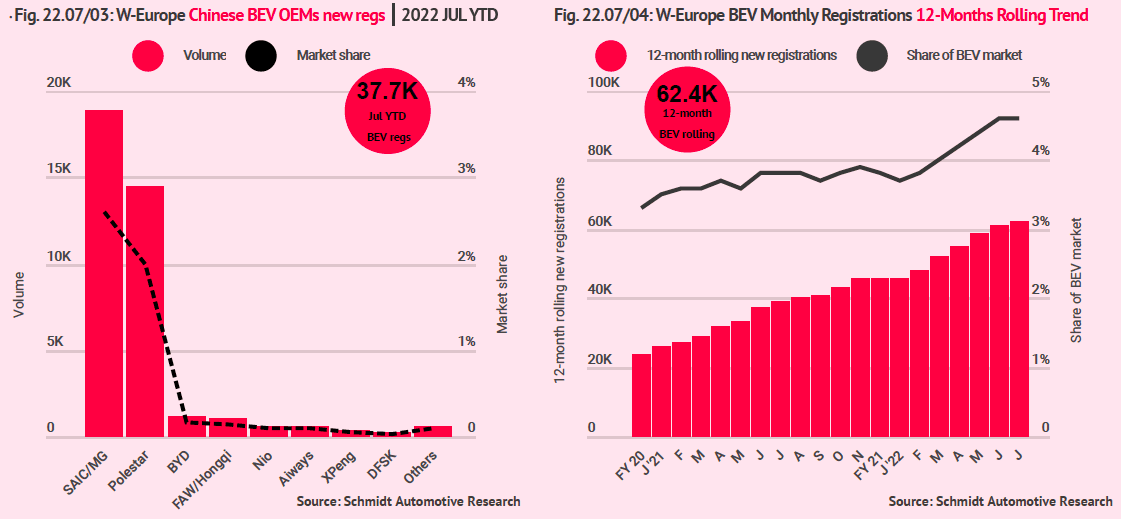
Similarly, over the first seven months of 2022, 5.2% of all new West European BEV passenger car registrations have been from Chinese OEMs, up from the 3.8% seen during the same period in 2021. Moreover, according to Schmidt, Chinese OEMs accounted for just under 5% of the West European new BEV passenger car market on a 12-month rolling basis.
To further highlight the increasing importance of the Chinese automotive sector, another 100,000 BEVs have arrived from China in West Europe over the first seven months of the year, but these are bearing Western badges from companies such as Tesla (its Model Y and 3 EVs), Dacia (Spring), and BMW (iX3).
Almost 20 Chinese automotive brands make up the 94,900 vehicles that have already arrived in West Europe, led by SAIC’s MG and Geely’s Polestar – though the latter can equally be said to be from China or Sweden.

Of the 37,000 Chinese BEV brands delivering into West Europe during the opening seven months of 2020, MG and Polestar accounted for 33,300. Meanwhile, brands such as BYD, Great Wall Motors, and Wey are looking to increase their own presence during the second half of the year.
The second half of the year will also see Chinese OEMs begin to distance themselves from the COVID-19 shutdowns which plagued many local manufacturers earlier this year. According to a spokesperson for SAIC’s MG who spoke to Schmidt Automotive Research, the shutdown headwinds are no longer impacting production and the second half of the year is expected to see much smoother sailing.

And, with a massive scaling cost benefit thanks to its booming domestic BEV market, Chinese BEV manufacturers are likely to find themselves with an initial price advantage over their European peers.
According to Schmidt, though, there will be “two windows of opportunity” for Chinese OEMs to enter the European market, starting with a window “before the 2025 EU CO2 fleet emissions target cut (-15%) leaving traditional OEMs continuing to push ICEs up until then – and likely unable to procure enough EV components even if the market required – to help finance their BEV transition.”
A second window is likely with the “Euro 7 exhaust gas regulations expected in 2027 for new models [which] will spark a switch from high volume traditional OEMs from ICE to BEV almost overnight.”