Home » Electric Cars » Electric cars melt the ICE to dominate World Car of Year awards

Electric cars melt the ICE to dominate World Car of Year awards

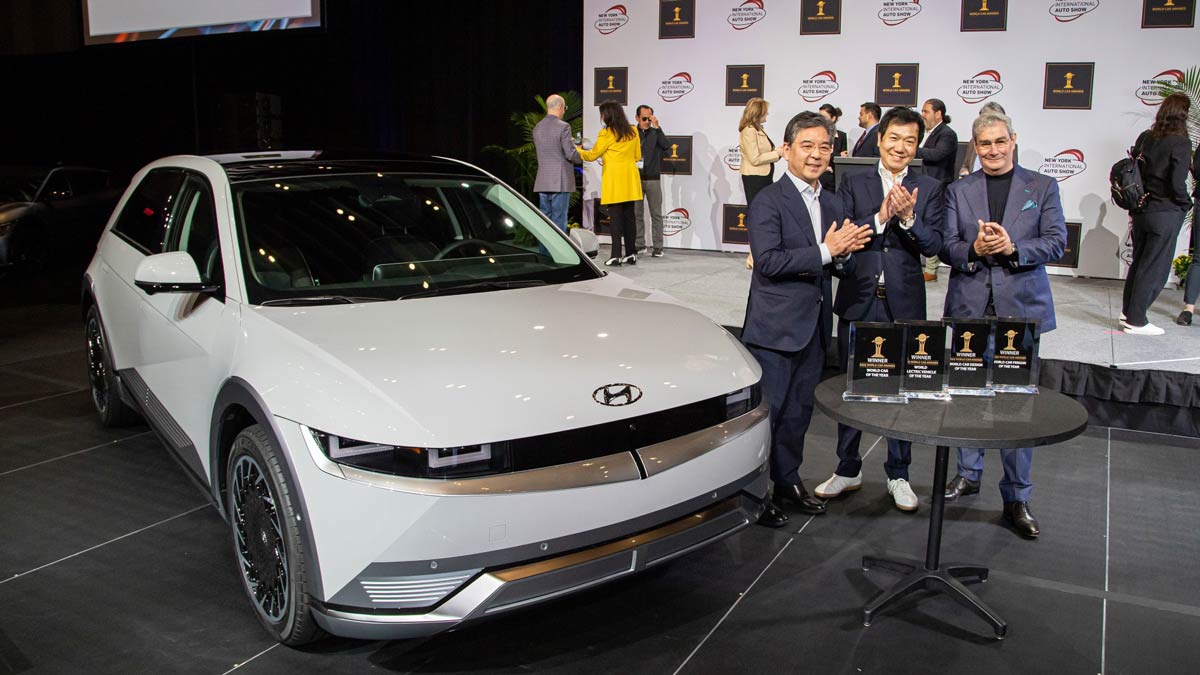
The Hyundai Ioniq 5 wins the 2022 World Car Awards. Source: WCS

A revolution in automotive design, coupled with oodles of luxury features and powerful electrifying performance has seen electric cars sweep away the age of combustion engines in the latest World Car Awards.

And pleasingly, all the winners are, or will be by the end of 2022, available in Australia.

Hyundai Ioniq 5 took the lead, grabbing three titles at the 2022 awards ceremony in New York on Wednesday, where five out of six categories were won by electric cars. The Audi e-tron GT won the World Performance Car title, and the Mercedes-Benz EQS won the World Luxury Car title.

The Ioniq 5 was the first electric model to bring to market vehicle-to-load (V2L) technology which allows owners to charge devices straight from the vehicle’s large lithium-ion battery, and it is innovations like this that are enabled by EV drivetrain that have apparently won the hearts of judges.

The big battery beneath the floor also allows for a new approach to design in EVs, and the interior of the Ioniq 5, which was dubbed an “electric Tardis” by The Driven expert Bryce Gaton.

Ioniq 5 interior. Supplied

Outside, the Ioniq 5 is distinctly different to any car that has come before. It has angular lines and also offers the option of an exterior V2L charge point that makes it simple to plug in an electric bike or other large battery-powered things, such as an electric Harley Livewire. Electric weekend away, anyone?
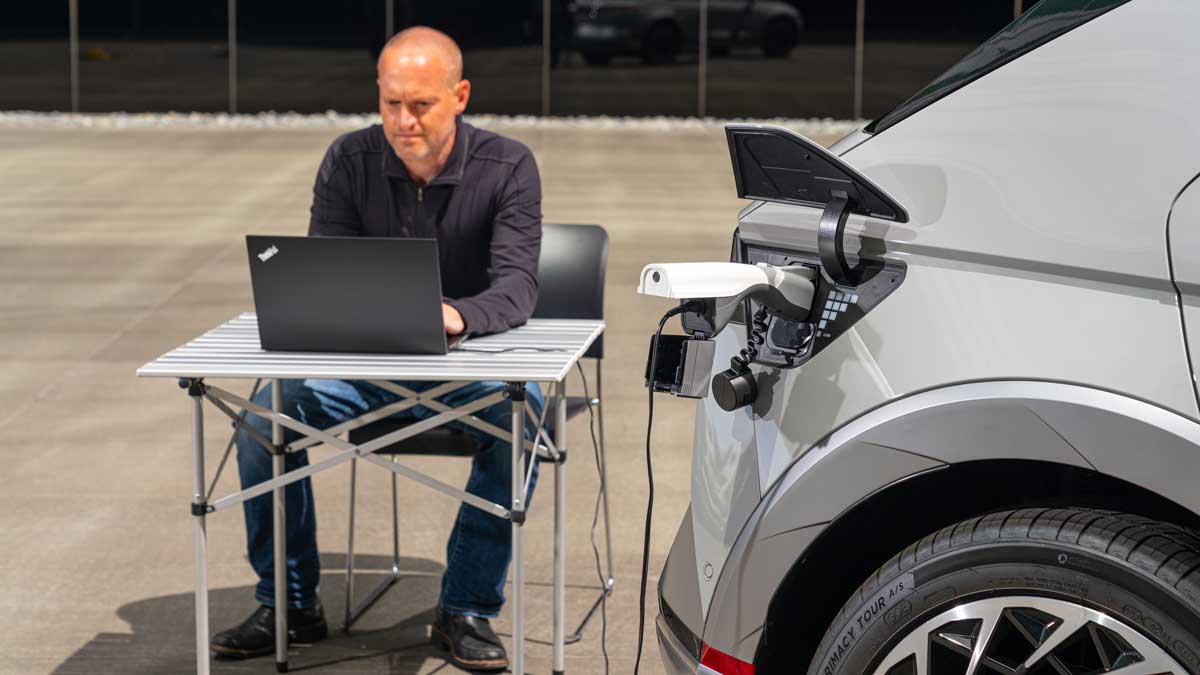
Ioniq 5 V2L capacity. Source: Hyundai

Its win as World Car of the Year was up against some serious contenders, which were also both fully electric: the Ford Mustang Mach-e, which has by all reports proved a popular addition to the US market, and the Kia EV6, which like the Ioniq 5 is available in Australia and shares the same drivetrain platform.

While the EV6 takes a more traditional approach, both internally in terms of design, it remains a fierce competitor against its South Korean cousin, and with its dynamic looks and focus on driving performance aims to appeal to a younger audience.

Beating down the EV6 in the World Car Design of the Year category, the Ioniq 5 also faced off the Audi e-tron GT, which is the German carmaker’s grand tourer take on its electric e-tron series.

Built on the same platform as the Porsche Taycan, the e-tron GT instead nabbed the World Performance Car of the Year title – this time against two combustion contenders, the BMW M3/M4 and the Toyota GR86 which shares its DNA and its entry application with the Subaru BRZ.

And its performance credentials are impressive: The Audi e-tron GT features a dual electric motor setup that produce a massive 630Nm torque and 350kW of power, which can be increased to 390kW for short periods of time.

The RS e-tron GT takes things a step further, with 21-inch alloy wheels and tungsten carbide brake discs with red callipers. It can sprint from 0-100km/hr in 3.3 seconds, with 440kW of power (up to 475kW on boost) and 830Nm torque, while the e-tron GT isn’t far behind, clocking in at 3.6 seconds.

First Audi e-tron GT lands in Australia. Source: Audi

While the Japanese contenders scored best in terms of value and marginally topped the others for market significance, the e-tron GT – which starts at $181,700 for the e-tron GT quattro and $249,700 for the range-topping RS e-tron GT in Australia – scored higher on every other mark. Unsurprisingly for a performance car, its zero-emissions credentials saw it come way out in front on the Environment scorecard.
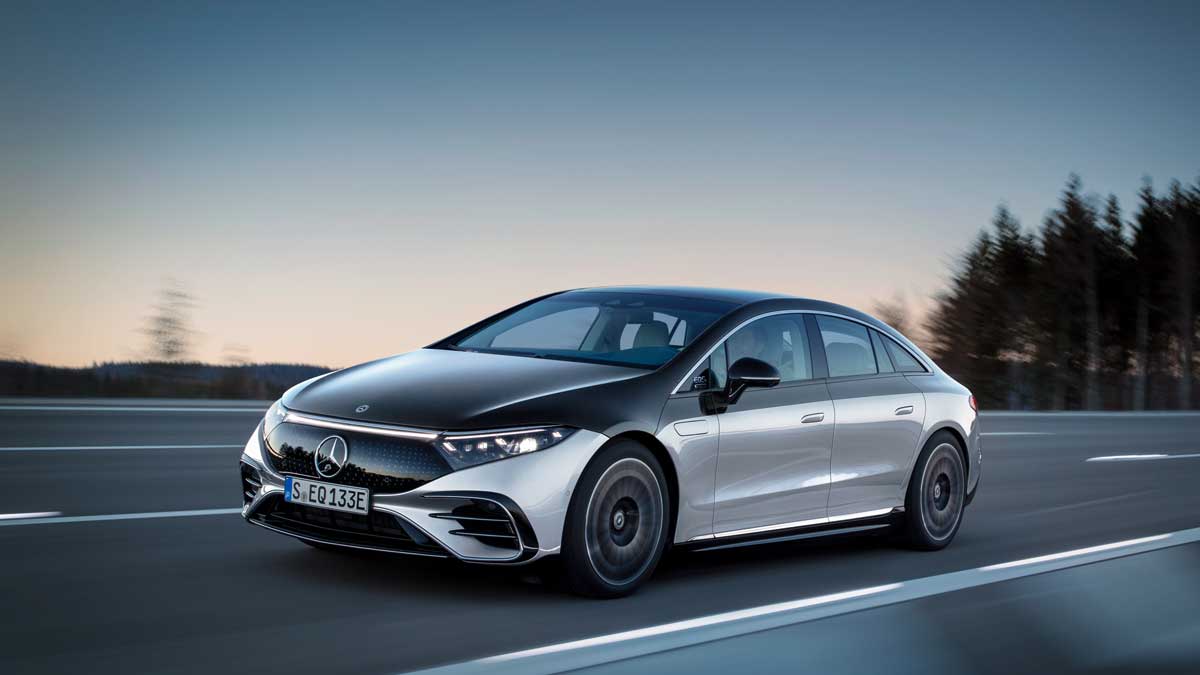
The EQS all-electric luxury sedan. Source: Mercedes-Benz

Mercedes-Benz’ flagship EQS electric sedan, which nabbed the top luxury car award, barely won its title against another electric luxury contender, the BMW iX.

Both veritable zeppelins showcasing peak technology innovation, they headed off the Genesis GV70 by three score points. But it was the EQS that ultimately won out, with innovation as well as safety front and centre for the judges.

With a massive “hyperscreen” and avante garde ambience for those in the cockpit, Mercedes-Benz hopes to seduce those with high-tech innovation that soothes the senses.

Designer “soundscapes” that evoke Daft-Punkesque expeditions into the future and even a new perfume made specifically for its built-in “air-balance” system also seek to encapsulate both driver and passenger in a cocoon of luxury effervescence, if that happens to be your thing.
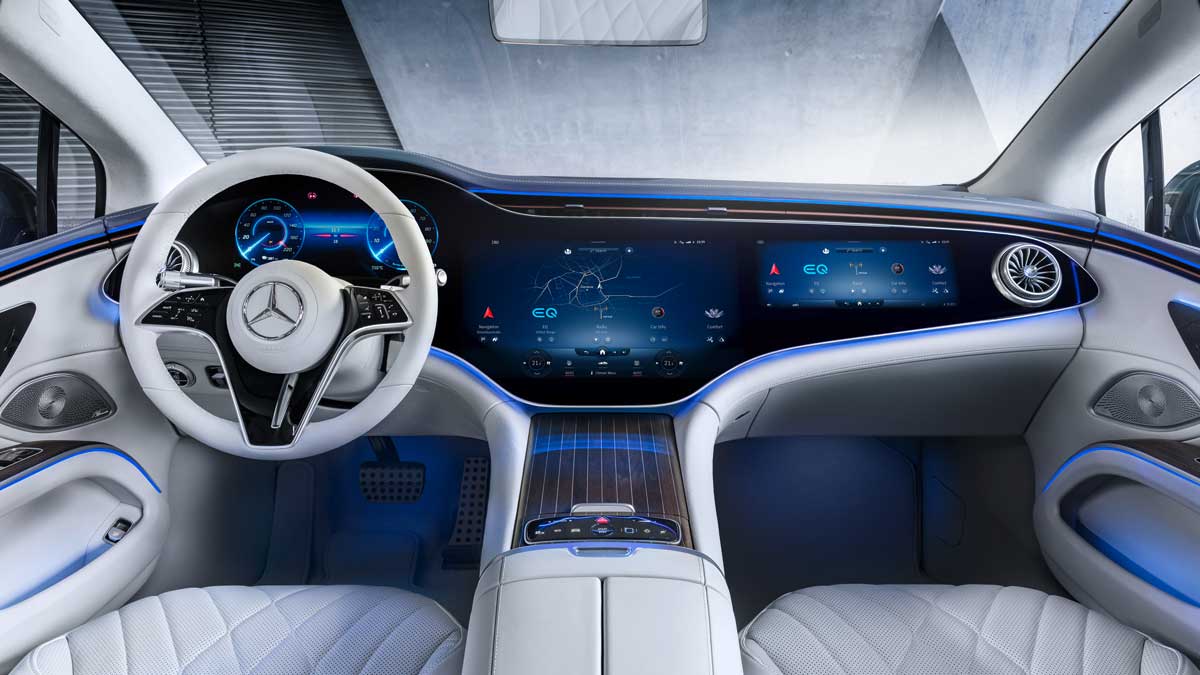
Merced-Benz has finally unveiled its all-electric luxury sedan, the EQS, that promises to challenge not only high-end electric models such as the Tesla Model S, but also its own S-class. The EQS is Daimler’s flagship electric model that sits at the top of its EQ series, and notably it makes several claims to position it also at the top of the entire electric vehicle market. Leading this is the fact it has scored a very impressive 0.20 drag coefficient, a score that was also recorded by the solar-powered Lightyear One in 2019 but which is not yet in production. This makes it a sliver more aerodynamic than the refreshed Tesla Model S, which in January recorded a drag coefficient of 0.208 according to Tesla. Other specifications revealed by Daimler on Thursday (Europe time) include a driving range of 770km (WLTP) and power output of 385kW for the mid-range, all-wheel-drive 580 4Matic, and 245kW for the rear-wheel-drive base level 450+ variant . A high-performance variant with up to 560kW power is also in the pipeline. Significantly, it will be available in Australia from late 2021. In Australia, luxury electric sedans are a bit thin on the ground (well, EVs in general are but that fact of course has been covered widely by The Driven elsewhere). In fact, the addition of the EQS will be the second premium electric sedan to hit Australian roads unless you also count the Porsche Taycan. And going by the reception of the $191,000 (base price) Taycan, 250 or so of which have been sold since its recent introduction, the EQS could see an equally warm welcome in an uncrowded high-end segment. This is partly because car importers have preferred to approach the lagging local market by importing mostly smaller (and thus more affordable) hatches and fastbacks such as the Nissan Leaf and Hyundai Ioniq, or ever-popular SUVs in both compact and luxury segments, such as the MG ZS EV or the Audi e-tron. But there are some caveats. Unlike Porsche and Hyundai, Mercedes-Benz is not going down the 800-volt architecture route. However, while the EQS remains at 400 volts Mercedes-Benz says it can be charged at a rate of up to 200 kW on a DC fast charger which is entirely respectable and means it can be recharged from 10-80% in as little as 31 minutes, or 300km range in 15 minutes. At home, work or an AC destination charger it can charge at up to 11 kW. If you want a faster “slow” charge there is an option of 22 kW as an extra, which seems a little strange in the environment of such a luxurious car. The EQS also represents a new era for Mercedes-Benz which says its battery has a 26% higher energy density than that in the EQC, with the largest pack on offer sitting at 107.8kWh usable energy capacity, and 90kWh usable capacity for its “entry-level” 450+ variant. Interestingly, Mercedes-Benz says that Japanese customers will be able to enjoy bidirectional charging. We’ve reached out to Mercedes Australia to find out if this might be an option in Australia in the future. Mercedes guarantees that within ten years or 250,000km, a remaining capacity of at least 70 percent will be available. The battery management can be updated over-the-air.
Merced-Benz all-electric luxury sedan, the EQS. Source: Daimler.

For more information on local features, specifications and pricing make sure to check out our EV models pages.
Bridie Schmidt is associate editor for The Driven, sister site of Renew Economy. She has been writing about electric vehicles since 2018, and has a keen interest in the role that zero-emissions transport has to play in sustainability. She has participated in podcasts such as Download This Show with Marc Fennell and Shirtloads of Science with Karl Kruszelnicki and is co-organiser of the Northern Rivers Electric Vehicle Forum. Bridie also owns a Tesla Model Y and has it available for hire on evee.com.au.

Related Topics