

Electric vehicles can greatly reduce transport-related carbon emissions, and the introduction of lithium-ion batteries has been powering their adoption – both literally and figuratively.
The key for mass adoption is lowering the price, and that in turn means improvements are needed in materials and energy density. But it has been a long haul.
Early attempts in the 1970s by Exxon to use lithium metal in anodes were thrown out the window because the dendrites that would grow every time a battery was charged and discharged kept causing fires.
Sir John Goodenough worked out that by using cathodes made of cobalt, batteries became safer (less dendrites) and more energy could be stored in them. Moroccan scientist Rachid Yazami discovered that using graphite in the anode batteries would also last longer.
These discoveries enabled Sony to commercialise the lithium -ion battery in the 1990s, but cobalt, the key material needed to enable a high number of charge and discharge cycles was expensive – ok for small rechargeable devices but too expensive for large applications such as electric cars.
Faced with high manufacturing costs (batteries were still more than $US1,000/kWh to make in 2010), car makers only began using lithium-ion batteries less than a decade ago, as researchers found that they could replace the cobalt with other cheaper materials.
Battery prices have been recorded at less than $US100/kWh in some electric buses in China, but are yet to drop to this “magic number” needed for price parity in passenger cars. That is now expected around 2023.
The ultimate mainstream success of electric vehicles will depend on the continued improvement of lithium-ion batteries, as researchers and manufacturers work to bring down the price.
Tied into this is increasing energy density of the batteries, so that less materials are needed to achieve the same amount of range – or to pack the same amount of batteries in and achieve longer range.
Reducing the amount of expensive materials in batteries regardless of a change in energy density is also a goal.
A new series of infographics from Bloomberg Green outlines the developments in batteries over the past decade.
NMC batteries
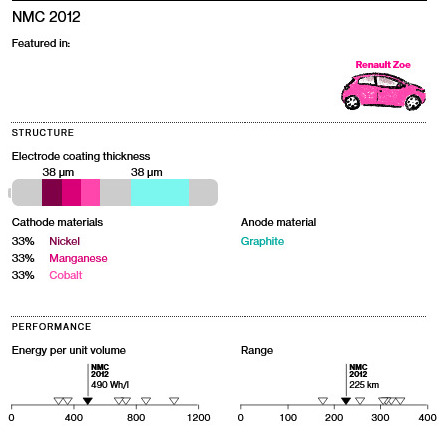
The NMC 2012 battery was used in early electric models such as the Renault Zoe. Cobalt was replaced with manganese and nickel, achieving an energy density of 490Wh/litre according to Bloomberg Green.
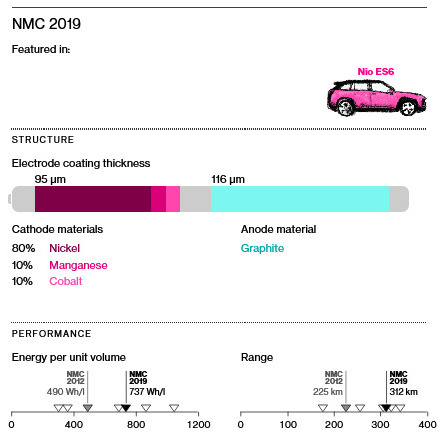
By 2019, the NMC chemistry was adjusted so that anodes and cathodes could be thicker and use less cobalt and more nickel. This chemistry was used in the Nio ES6, and has an energy density of 737Wh/litre.
NCA batteries
Around the same time that NMC 2012 arrived, Tesla and Panasonic began using aluminium instead of manganese. The NCA battery was borne, and according to Bloomberg Green paid off as it was cheaper than manganese, had an energy density of 688Wh/litre.
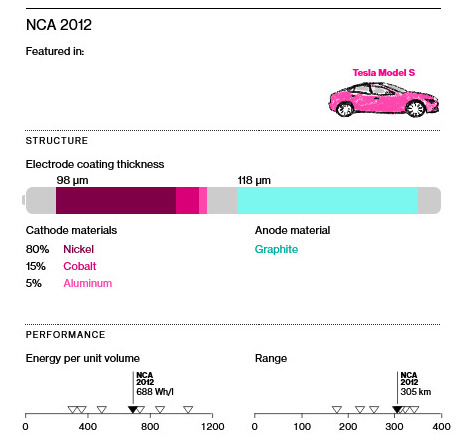
By 2019, Tesla had worked out that the addition of a little silicon oxide would mean less graphite was required. The bonus of this discovery was that it made the batteries lighter, hence also increasing range. This is the chemistry that allowed the Model 3 to become Tesla’s most affordable electric model…until the introduction of the lithium-iron phosphate battery.

LFP batteries
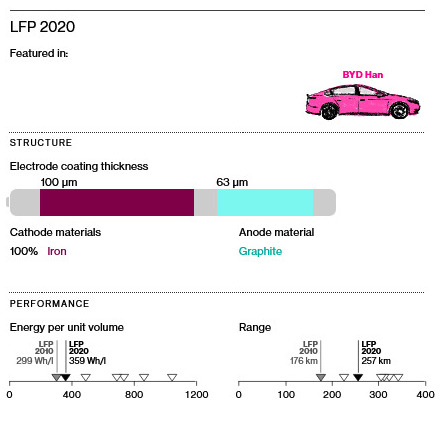
The lithium-iron phosphate (LFP) battery does away with cobalt altogether. It was first introduced in 2010 and while its energy density is comparatively lower than all other options at 299Wh/litre, because it uses cheap iron it became an affordable option for large applications such as buses.

A decade down the track and LFP chemistry has improved to the point, thanks to thicker electrodes, that it is now used in the Shanghai-made Model 3. This LFP battery has an energy density of 359Wh/litres.
What’s next?
Today’s batteries are still subject to dendrite formation, although less so than three decades ago. Solid-state batteries promise a much higher energy density, and also a much safer form of rechargeable battery. By replacing the liquid electrolytes with solid electrolytes, the theory goes that dendrite formation will be suppressed.
Many companies say they’re working towards making a “solid state battery”, such as China’s CATL, Japan’s Toyota, and South Korean company SK Innovation, which is working with Goodenough.
Some say they’ve cracked important puzzles, such as a company called Quantumscape that is backed by Volkswagen, and Samsung.
Bloomberg Green says that by 2025, en energy density of 1044WEh/litre could be achieved, extending range by as much as 50%.