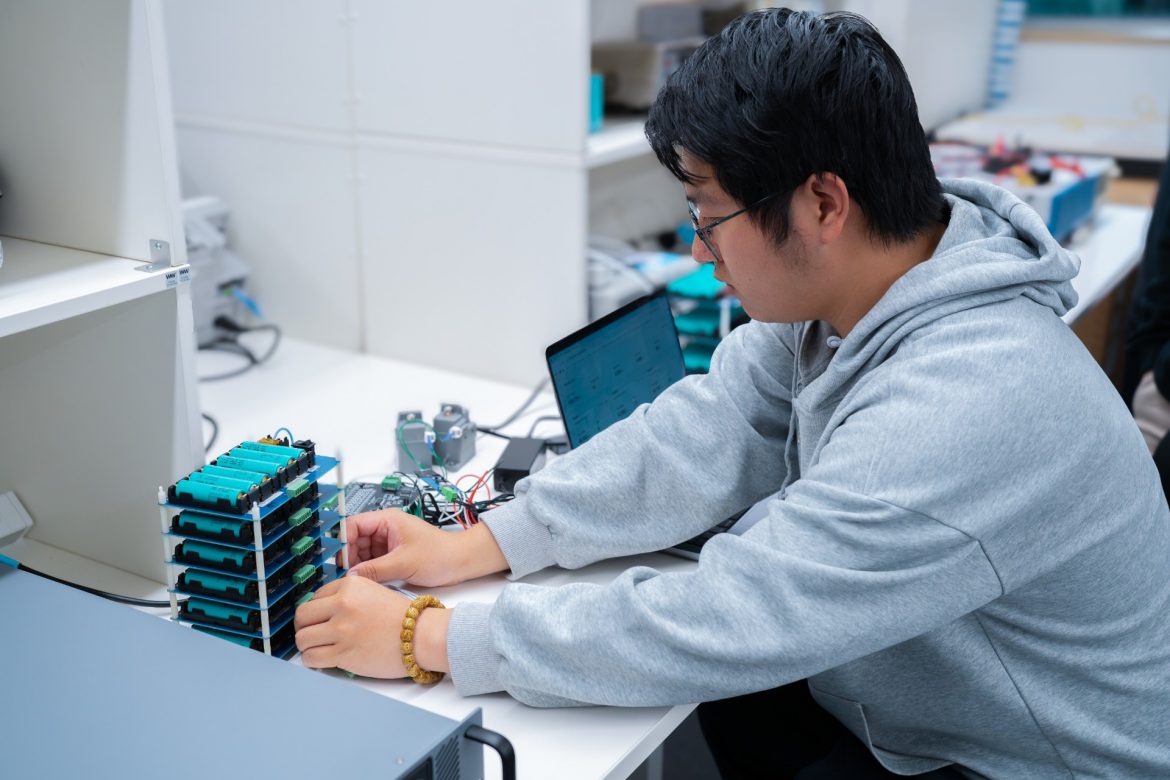
UNSW Sydney researchers have developed a prototype that can estimate the health of individual battery cells in under three minutes. The technology could help recyclers identify which retired electric vehicle (EV) batteries can be reused for energy storage.
Associate Professor Huadong Mo from UNSW Sydney’s School of Systems and Computing co-leads the research with Dr Ziyang Lyu from the School of Mathematics and Statistics.
“Up to 95% of a battery’s components can be recovered, some even to make new batteries. Yet only a small fraction of lithium-ion batteries in Australia are collected for recycling today.”
“As more EVs reach the end of their first life, Australia has a real opportunity to build a local second-life battery industry, with retired batteries supporting grid and community energy storage. Fast, affordable testing is one of the key pieces needed to make that happen, because every battery we can safely give a second life keeps delivering value instead of heading straight to landfill.”
However, current methods to assess an EV battery’s health currently rely on a process called full charge-discharge testing, which takes around 10 hours and costs around $120 per EV battery pack. More concerningly, though, is the fact that a full charge-discharge test puts the battery through hours of high-stress cycling, which can lead to overheating and fire.
That’s why the research team led by Mo and Dr Ziyang Lyu from the School of Mathematics and Statistics have developed their new assessment platform to reduce safety risks while also cutting down the time and cost of assessing EV battery packs.
The prototype assessment platform is designed to measure how battery cells respond to short electrical pulses, with the data fed into statistical models to estimate the battery’s health in under three minutes per cell.
Currently, lab testing has shown that the process yields accuracy greater than 90 per cent and could help to bring battery testing down below $25 per pack.
The project builds on previous research undertaken by Associate Professor Mo through the Australian Economic Accelerator (AEA) Ignite program, which cut battery testing time to five minutes.
The UNSW Sydney researchers has partnered with battery recycling and lifecycle management company DY New Energy on a $1.3 million project to further develop and test the new battery assessment platform, backed by the Australian government through its Trailblazer for Recycling and Clean Energy (TRaCE) Lab to Market Fund.
Specifically, the project will test the new technology across more than 500 batteries in real-world conditions, before moving on to piloting in recycling facilities and second-life battery energy storage systems.
As part of the project, the researchers will also develop and test an AI-powered decision engine that would be capable of recommending whether retired EV batteries should be reused or recycled. This would be combined with an intelligent Battery Management System (iBMS) module that will integrate the decision engine’s findings directly into battery systems for real-time monitoring and decision support.
UNSW will lead the algorithm development, statistical modelling, iBMS, and system integration, while DY New Energy will provide real battery datasets, deployment environments, and access to its industrial workflows.
“Support from the TRaCE Lab to Market Fund lets us take this beyond the lab and into real deployment,” said Dr Lyu.
“Partnering with DY New Energy gives us the data, environments and industry insight we need to build something that works commercially.
“Validating [our technology] across more than 500 batteries in real operating conditions is the critical next step. Lab results are promising, but industry needs to see the technology perform on the factory floor and in working energy storage systems before adopting it.”
The researchers are designing the platform to work with existing management systems already used by recyclers and energy storage operators, and to be able to assess the three main lithium-ion chemistries used in EVs and energy storage: lithium iron phosphate (LFP), nickel cobalt aluminium (NCA) and nickel manganese cobalt (NMC).
“Recyclers rarely receive neatly sorted batches,” said Dr Lyu.
“One day it might be LFP cells, the next a mix of nickel-based chemistries from different manufacturers. We’ve designed our models to handle that variety, so the platform works with the batteries operators actually receive, not just ideal lab samples.”
Lyu said the same technology could also help operators decide when to reuse or recycle batteries from stationary energy storage systems.