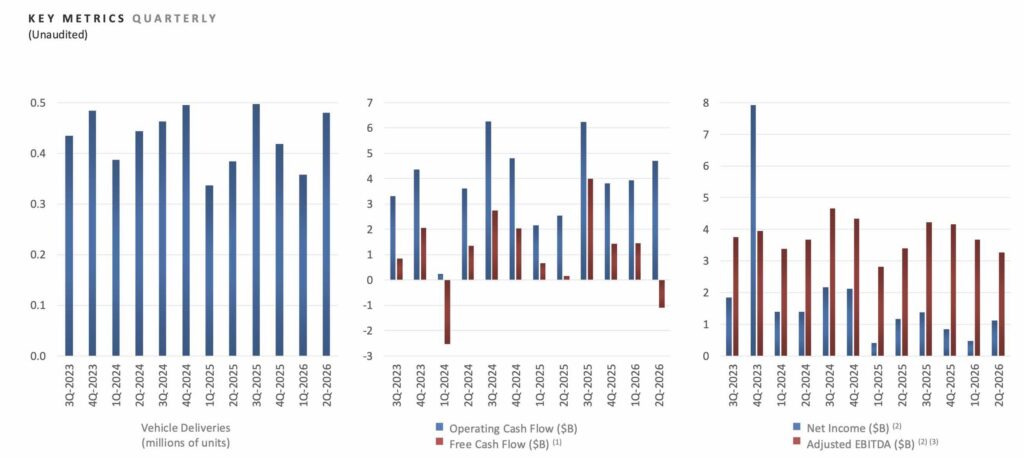
EV giant Tesla has suffered a major profit squeeze, and reported its first negative cash flow for years, as Elon Musk continues his big bet on Ai, including full self-driving, robo-taxis, and humanoid robots, and moves the company further away from its core car business.
The company on Thursday (Australian time) reported strong than expected revenues of $US28.3 billion, but much lower than expected earnings of just 31 cents a share on stock that is currently trading at $US374. This is not a stock driven on a conventional view of price-earnings multiples, but by a belief in the man and his technology.
The results highlight the continuing popularity of Tesla EVs, particularly the best selling Model Y, but lower margins and the huge cash burn on Ai, with Musk planning to spend more than $US25 billion this year, nearly triple what the company spent last year, according to Reuters.
It is a familiar story for Musk and Tesla, given the big spending on the original Model 3 and Model Y, the cash burns and the massive short selling that dominated trading in the country before the outstanding success of the two EVs shut that argument down.
Tesla’s advantage in Ai is less clear – not in the minds of the shareholders and tech-bros who relentless promote the company – but because of the big gains made in China, and because Tesla’s dominant position is protected in its home market by an effective ban on Chinese competition.
“This is a massive capex year, but I’m confident that all the things that we are investing in will yield incredible returns,” Musk told analysts on a post-earnings conference call.
He was asked by one analyst about the potential for synergies between Tesla and the newly floated SpaceX, now with an eye watering valuation that has made Musk a trillionaire, albeit now in $A rather than $US after the share price pulled back.
“Well I mean as you can tell from all the many collaborations on so many fronts with SpaceX, there’s more and more overlap,” Musk replied. “Especially with Terafab, that’s really going to be a gigantic project.”
But, as Electrek pointed out, he then pulled back: “Obviously we can’t talk about combining companies and that kind of thing on a call. It’s got to be done with the appropriate process.”
Tesla, of course, already has a stake in SpaceX, and shared technology, and most of its reported net income came from the surge in SpaceX shares after its listing. They have yet to be marked down since the market pull-back. Tesla’s EV and energy storage business reported combined operating margins of just 1.4 per cent.
A lot of Tesla’s spending is going into FSD, which is still rolling out slower than expected. Musk put this down to an abundance of caution.
“We’re going as fast as humanly possible in scaling Robotaxi, but while trying to ensure that we do not harm anyone at all, and ideally do not even run over a pet,” Musk said.
Still, the company has posted revenues of more than $US100 billion over a 12 month period for the first time, and Tesla insists it is in its largest and most exciting period of investment.
“From here, there remains much hard work as we aim to revolutionize transportation, energy and productivity through our leading real-world AI. Scaling will be non-linear, and we are focused on long-term value creation. We’ve never been more optimistic about the future.”
Tesla said it had record deliveries in Australia, where Model Y was the best selling vehicle of any type in May and June, and in South Korea, Colombia, Japan, Taiwan, Thailand, Portugal, the Philippines, Chile, Slovenia and Lithuania.
It achieved record energy storage deployments in EMEA, supported by record deployments from Megafactory Shanghai, and production of the Megapack 3 and Megablock are expected to begin this year at its new Megafactory Texas.
And you can sign up for The Driven’s free daily newsletter and get the latest EV news and analysis delivered straight to your inbox.