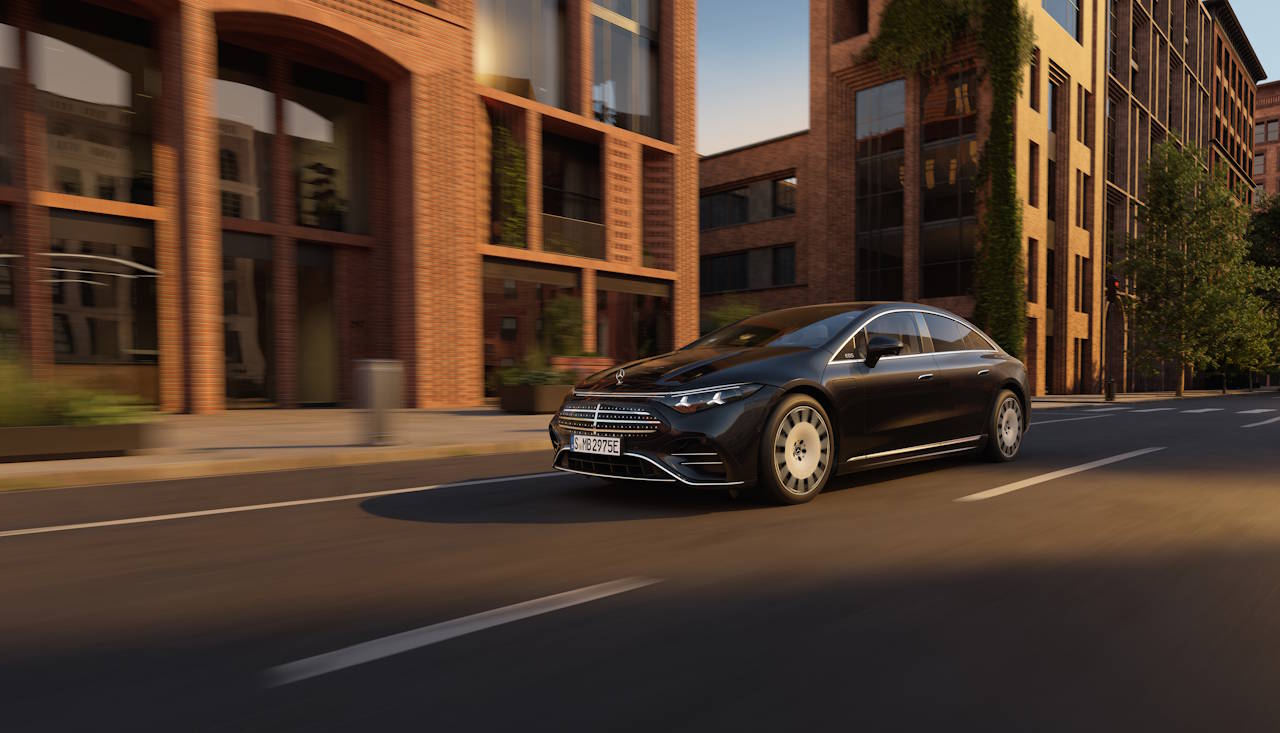
German luxury carmaker Mercedes-Benz is gunning hard to sell the electric vehicle (EV) with the longest range, debuting this week its updated EQS which boasts a WLTP driving range of 925 kilometres (km) – enough to make the 9 hour drive from Sydney to Melbourne with plenty to spare.
The EQS was the first all-electric luxury saloon from Mercedes-Benz when it was released back in 2021, but the newest model has undergone significant upgrades, with the company boasting that a quarter of all the vehicle’s components have been “newly developed, updated, and refined.”
The most important in terms of range is a slightly larger battery, 122 kWh instead of 118 kWh, along with cells that feature anodes in which silicon oxide is blended with graphite. Mercedes-Benz says this allows greater energy density and more energy to be stored per kilogram, and within the same battery installation space.
The EQS boasts driving efficiency of between 19.5-16.2 kWh/100 km and the battery can act as a power storage unit for the grid and the home, with both vehicle-to-grid and vehicle-to-home capability.
To put the claimed 925 km WLTP range into perspective, the route along the Pacific Highway from Sydney to Brisbane is around 917km long, while the journey from Sydney to Melbourne along the Hume Highway is around 878km. However, EVs driven at 110 km/h along a freeway usually have a shorter range, but ultimately that largely depends on drivers and conditions.
The 925km range quoted by Mercedes-Benz does beat the 900km touted by the BMW i3, and is reportedly the highest range currently claimed by any EV under the WLTP testing procedure.
The new EQS will go on sale in Europe later this year, before Australian deliveries are set to begin in the last quarter, though it is unclear at this stage if the 925km range claimed for the EQS 450+ will translate onto Australian roads. The price in Germany, its debut market, is pitched at €94,403 including 19 per cent VAT, and €79,330 euros for business customers.
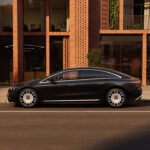
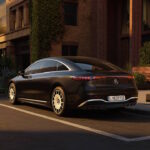
If you want to take the EQS for a longer drive, the 800V system allows for ultra-fast charging up to 350kW which is capable of adding 320km of range in just 10 minutes. Conversely, at 400V charging stations, the battery splits virtually to charge at up to 175kW.
During driving, the EQS boasts regenerative braking up to 385kW, dramatically increasing the car’s efficiency, while the EQS is also the first German car manufacturer to offer a series-production car with steer-by-wire technology, eliminating the need for a physical steering column and vibrations translated from uneven road surfaces to the driver.
Steer-by-wire will be available as an option, with electromechanical steering available as the alternative option.
And for those with doubts about replacing the traditional physical steering column with the digital steer-by-wire, Mercedes-Benz has incorporated a redundant system architecture which means there are basically two signal paths, ensuring steering capabilities are always guaranteed.
Moreover, the company claims that, even in the unlikely event of a complete failure, lateral control is still possible thanks to rear-axle steering and targeted wheel-specific braking interventions via the electronic stability platform (ESP).

The new EQS also boasts Mercedes-Benz’ new Operating System (MB.OS), which integrates and controls every aspect of the vehicle using artificial intelligence (AI) while also connecting to the Mercedes‑Benz Intelligent Cloud.
Driver assistance features rely on up to 27 sensors, MB.OS receives over-the-air (OTA) updates, and the car’s standard MBUX Hyperscreen merges the active zones of the three displays beneath a single, continuous glass surface which measures over 55 inches.
Click here for a full run-down of the extensive features and upgrades.