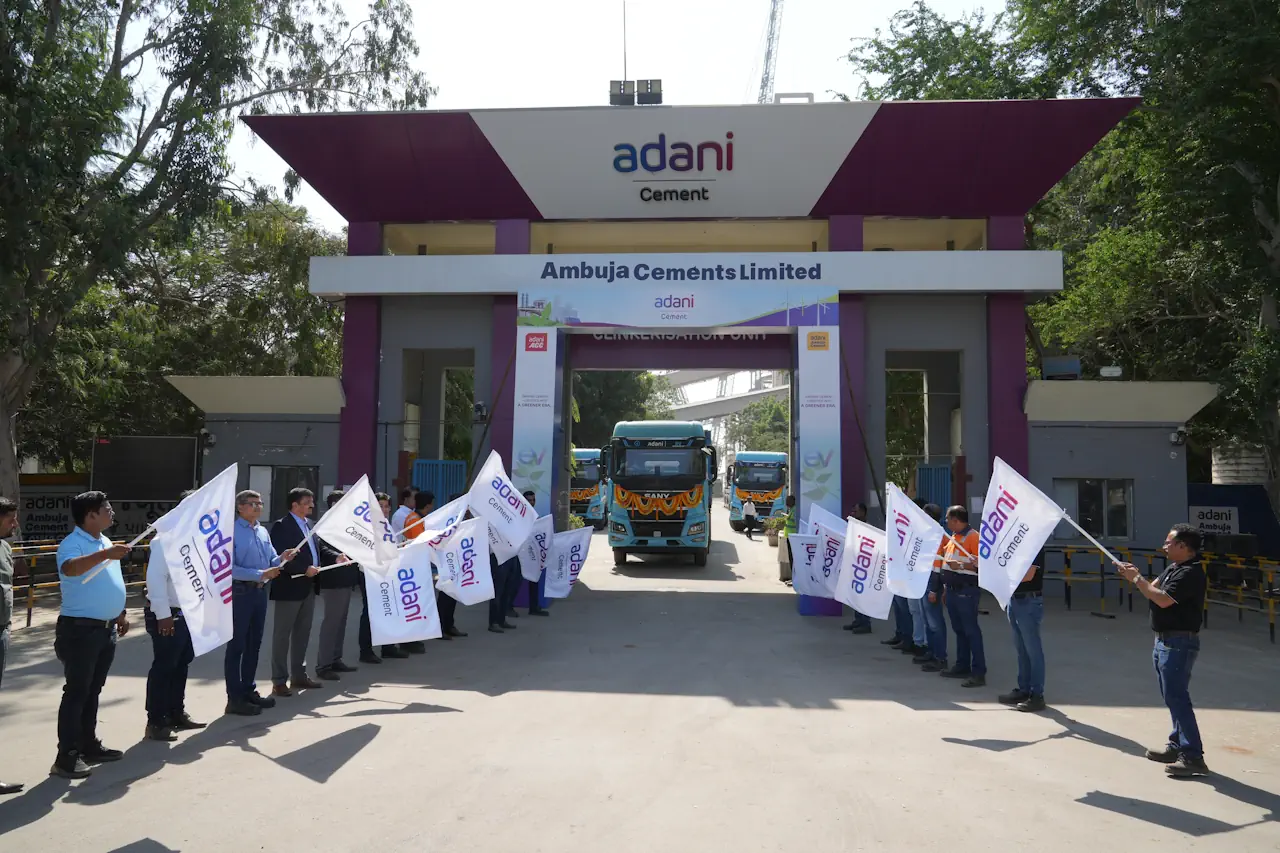
Indian cement manufacturer Adani Cement will deploy 410 battery electric trucks by March of next year, a first for the company and a “defining milestone” in its efforts to increase its sustainability.
Adani Cement, India’s leading cement and building materials producer and a part of the mammoth Adani Group, announced last week the deployment of the first of 410 electric trucks it plans to rollout across its operations through March of 2027 for movement of cement and clinker around the country.
The trucks, which appear to be models from the heavy-duty electric semi-trailer tractor 55-tonne class from Chinese manufacturer Sany, are first being deployed at Adani Cement’s Sanghi Plant in Gujarat.
“The deployment at Sanghi is just the beginning,” said Vinod Bahety, Adani Cement CEO. “We have identified multiple routes across India for EV-based transport of clinker and cement.
“Every truck we electrify reduces our carbon footprint and insulates our logistics cost base from diesel price volatility. This is smart sustainability — it benefits the people, planet and the balance sheet. This is our commitment in action — to build a greener, more competitive cement company that serves India’s growth while protecting its future.”
Adani Cement did not specify in their press release exactly which model trucks were being rolled out, but the handful of press images available match up with Sany’s heavy-duty electric semi-trailer tractor line, including the Sany 5538E and the Sany 5550E, both of which are sold in India.
The Sany 5538E is its short-range option, boasting a 282 kilowatt-hour (kWh) battery capable of 189 kilometres driving range and charging at up to 240 kilowatts (kW), while the 55503 boasts a 376 kWh battery, driving range of 245 kilometres, and charging at up to 360 kW.
And according to Adani, the economic case for heavy-duty electric trucks in India’s cement sector has reached what it described as a “structural tipping point” thanks to rising diesel prices and falling lithium-ion battery costs, as well as a decline in solar tariffs.
Adani’s calculations show that diesel trucks emit approximately 0.7375 kilograms of CO₂ per km. However, electric trucks powered by renewable energy can eliminate up to 100 per cent of these emissions, making the electrification of logistics a powerful lever for Scope 3 decarbonisation.
In fact, Adani predicts that its 410-strong fleet of electric trucks will eventually reduce CO2 emissions by over 25,000 tonnes annually, displacing the equivalent of 11 million litres of diesel per year.
India is currently the world’s second-largest cement producer, and the movement of limestone, clinker, and finished cement across supply chains is an essential but carbon intensive step.