German automaker Volkswagen has secured a Level 3 autonomous driving road test permit in Hefei, China authorising real-world on-road testing and large-scale data collection, while Dutch automotive giant Stellantis last week announced two separate efforts to advance its autonomous driving credentials in France.
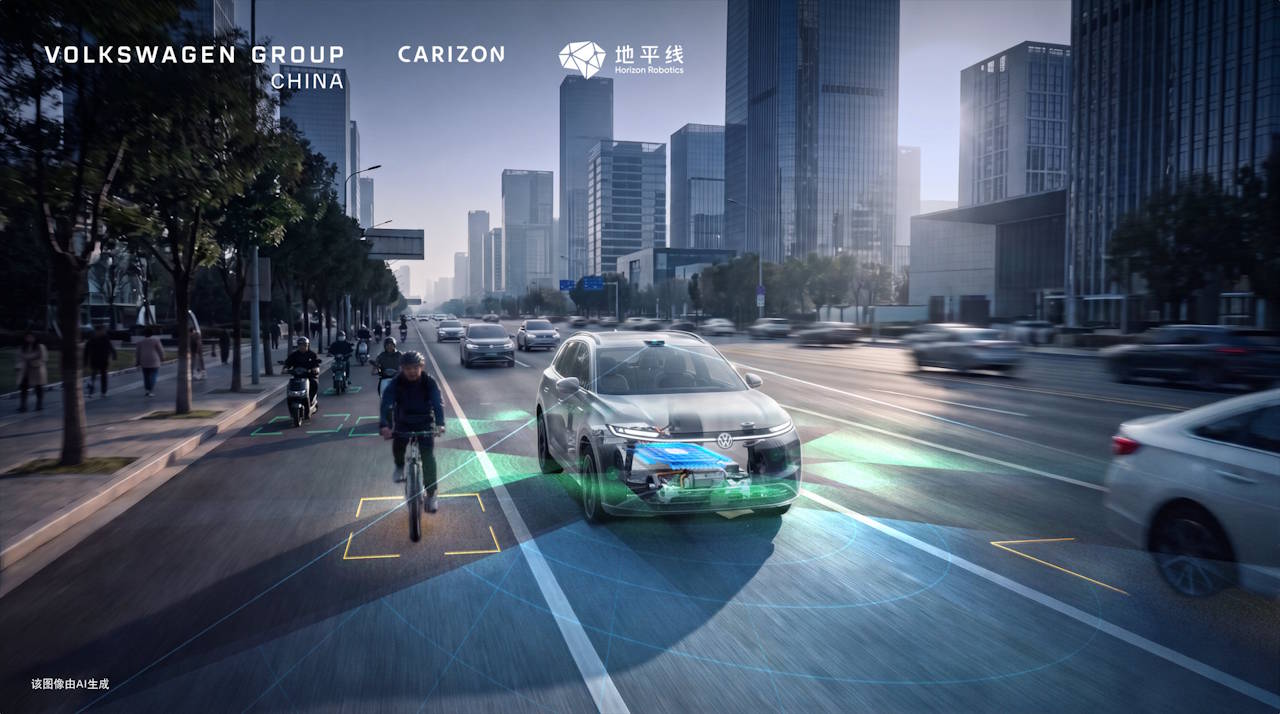
Volkswagen Group China announced last week that it had secured a Level 3 autonomous driving road test permit in Hefei, China. Volkswagen says the permit was granted under the toughest L3 regulatory framework yet, incorporating the latest safety requirements.
Securing the permit is billed as the next step in the company’s efforts to reach Level 3 readiness, which Volkswagen is currently targeting for some time in 2027.
It follows the development of Volkswagen Group China’s first in-house full-scenario L2++ driver assistance system, Hyper Sense 8, through its joint venture with Chinese smart driving company Horizon Robotics.
Volkswagen Group China is also leveraging its own in-house AI world model, GAIA 2.0, which runs advanced driver assistance system (ADAS) safety simulations every day that are equivalent to five million kilometres of driving and based on up to 30 million driving scenario clips. The company is hoping to eventually ramp that up to 10 million kilometres of training data per day for Level 3, “so that rare and unexpected situations are learnt before a customer meets them on the road.”
Volkswagen also confirmed that it continues to develop its own L4-ready system-on-chip, the C7H.
“At Volkswagen, safety and reliability come first in autonomous driving,” said Ralf Brandstätter, CEO of Volkswagen Group China.
“Technological progress must never come at the expense of safety. Our ambition is to combine innovation with the highest safety and quality standards to build trust in new technologies. With this permit, we can test in real traffic in Hefei and collect data at scale. It is the next step on our road to Level 3 readiness.”
Back in Europe, Dutch automotive giant Stellantis – which was formed in January 2021 as a result of the merger between Fiat Chrysler Automobiles (FCA) and the PSA Group – continues its own ambitious autonomous driving plans.
Stellantis announced last Friday two big partnerships designed to advance the deployment of autonomous vehicles in France.
Firstly, the company announced that it would partner with London-based developer Wayve, computing giant Nvidia, and the French government to advance the deployment of autonomous vehicles in France and accelerate the technology’s development across the wider European Union.
Announced at an autonomous vehicle conference in Paris last week, the collaboration will combine Stellantis’ L4-Ready Platforms and vehicle engineering and manufacturing expertise with the Wayve AI Driver, which will integrate Nvidia Halos OS on the Nvidia Hyperion compute and sensor architecture.
The hope of the collaboration is to position France as a base for a massive autonomous vehicle ecosystem spanning the entire value chain, from silicon to vehicles.
“This collaboration will help accelerate the delivery of autonomous driving technologies that make mobility safer and more convenient for customers,” said Anne Laliron, SVP of technology research at Stellantis.
“While its impact is global, France is one of Stellantis’ key centers for engineering and technology development, making it a natural home for advancing the future of AI-powered mobility.”
Stellantis also announced last Friday a partnership with Estonian software developer Bolt and the Métropole du Grand Paris, also known in English as Greater Paris, to introduce autonomous mobility services by experimentation across Greater Paris through a pilot program submitted to the European Commission’s ADACities initiative.
The proposed program is expected to start in 2028 and brings together Métropole du Grand Paris, representing Paris and its 129 surrounding municipalities, Stellantis’ L4-Ready Platforms and vehicle engineering expertise, and Bolt’s expertise in European mobility and deployment.
Together, the three partners aim to explore how autonomous mobility technologies can be integrated into European cities, assessing how autonomous vehicles might complement existing public and private transport services while addressing unmet mobility needs.
The project has been submitted to the European Commission’s Autonomous Drive Ambition Cities (ADACities) initiative, which aims to support the wider deployment of autonomous mobility across European cities.
“For customers, autonomous mobility should mean more choice and easier access to safe and reliable transportation,” said Ned Curic, chief engineering & technology officer at Stellantis.
“By combining Stellantis’ vehicle engineering and deep understanding of European mobility needs with the complementary expertise of our partners and local public authorities, we aim to develop a driverless mobility that complements public transport and makes everyday journeys simpler and more accessible.”