
Cheaper electric vehicles offer protection from oil shocks and independence from service-station queues and prices. But falling values for existing vehicles could disadvantage owners who rely on finance – and monetary policy could compound the damage.
Recently we argued that the Reserve Bank should distinguish imported oil shocks from domestic overheating. Separately, we argued that access to capital and an equitable distribution of benefits must sit at the centre of electrification.
Vehicle markets now bring those arguments together and raise the question: how can we ease the painful losses for existing owners when cheaper electric transport takes over?
Australians are used to seeing rapid declines in the value of their cars, but this transition to EVs is happening so fast the losses on oil-based cars may be even more dramatic.
The danger is not simply that shifting to electric vehicles can cause financial difficulties for some. The wider system of oil dependence faces oil volatility and technological competition from renewables, EVs, and electrified machinery across the economy. Overextended borrowing adds another vulnerability: debts written against assumptions of continuing oil dependence persists for many more decades.
A correction with several speeds
Australia’s September vehicle figures show substitution between drivetrains, not a general market collapse. Overall deliveries rose 1.8% year on year, but battery-electric sales increased 118%, while petrol-only sales fell 36% and diesel declined 18%. Non-plug-in hybrids are a separate category: these figures do not mean every vehicle containing an engine is retreating equally.
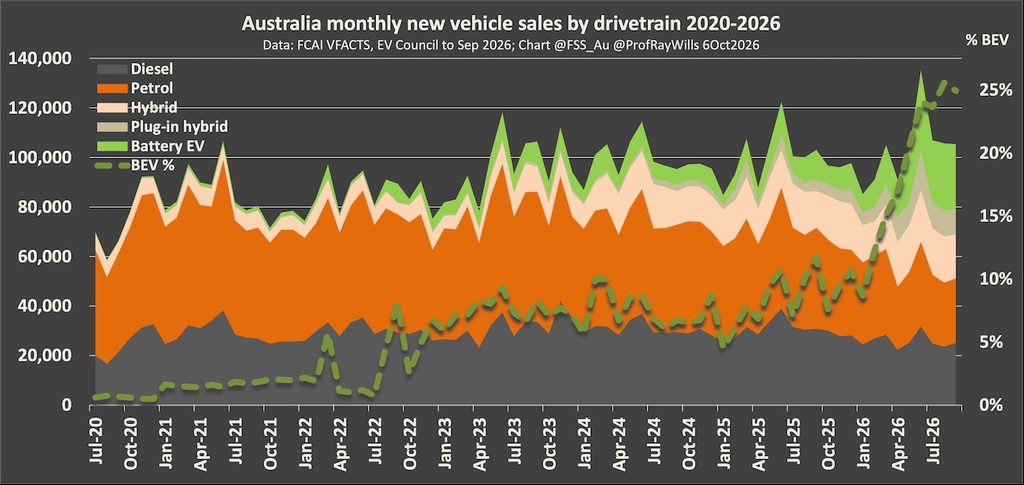
The oil shock strengthens the incentive to switch, while cheaper EVs make switching feasible. BYD’s Atto 1 Essential, advertised under a limited-time offer at A$19,990 drive-away, now competes at Australia’s cheapest-new-car price point.
That is a meaningful threshold and reflects the rapidly shrinking “price premium” across a growing number of segments.
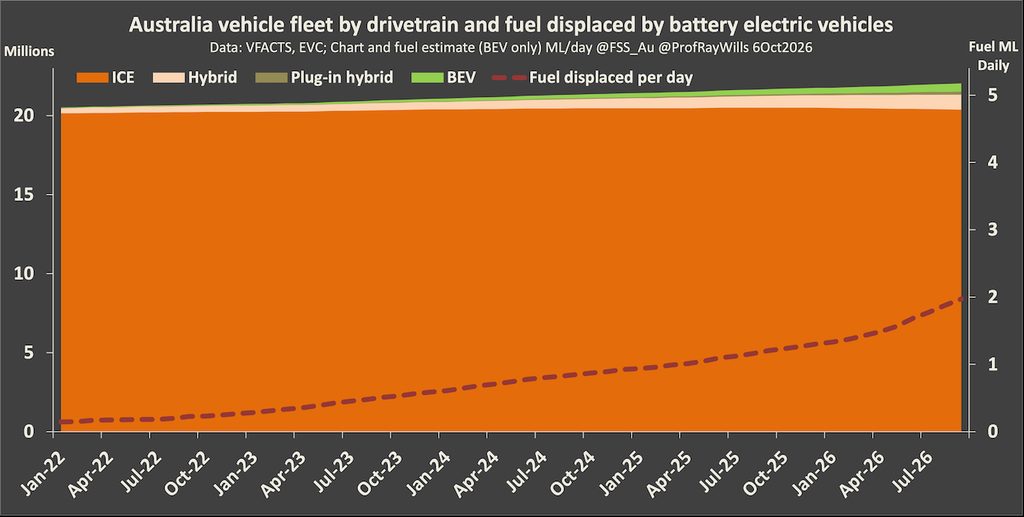
The benefits extend beyond household budgets: Ember estimates that electric cars, including plug-in hybrids, displaced 200 million barrels of crude oil in oil-importing countries during the first six months of the Hormuz energy crisis, worth around A$29 billion, with Australia’s avoided oil imports valued at approximately A$330 million.
But oil prices can fall as well as rise. A supply recovery could relieve household budgets and soften the immediate rush towards EVs. A recession-driven oil-price fall would be less reassuring: cheaper petrol could coincide with unemployment and weaker vehicle demand.
The cause of the price movement matters, not merely its direction. RBA research likewise distinguishes oil-demand shocks from supply disruptions when considering monetary responses. For households, it also isn’t just about the price, but whether the service station has fuel available to sell!
Where “subprime” becomes relevant
The subprime analogy concerns collateral, not a prediction of another 2008.
Imagine a borrower owing A$30,000 on a vehicle now worth A$22,000. Lower running costs make an EV attractive, but selling the existing car leaves an A$8,000 financing gap. Rolling that shortfall into another loan makes the replacement harder to afford.
This mechanism already appears in US lending. Edmunds figures reported by CNBC put average negative equity among ‘underwater’ trade-ins at US$6,884 in the second quarter. Around 43% of buyers rolling negative equity into replacement finance took 84-month loans in the first quarter. These are specific borrower groups, not all motorists.
If collateral values fall while defaults rise, lenders recover less. Tighter lending can then suppress purchases and reinforce price weakness. The scale of Australian exposure needs Australian evidence on outstanding loan balances, vehicle values and borrower distress.
Drivetrain values will reset unevenly
There will be no single percentage markdown for combustion vehicles, nor guaranteed protection for EVs.
Persistently high fuel prices put pressure on inefficient vehicles. Efficient hybrids could retain appeal where charging is difficult. Diesel utilities may behave differently from urban petrol hatchbacks because replacement options and work requirements differ.
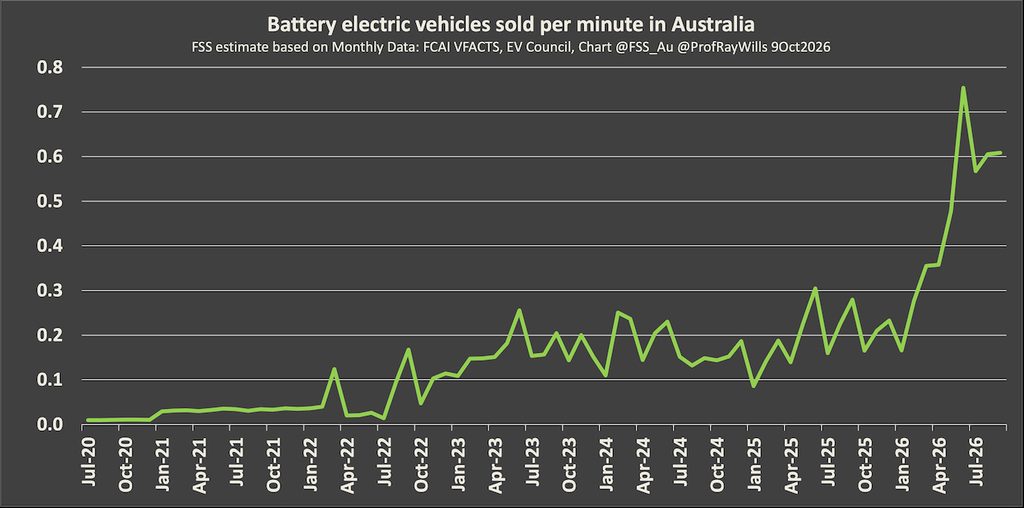
EVs face their own repricing: cheaper new models can reduce what buyers will pay for older ones. Australia’s used-EV sales more than doubled between February and March 2026, while available stock fell 38%. That supports a short-run scarcity story, not permanently rising residuals.
Battery durability adds another dimension to resale values. Pickles, drawing on tests of more than 2,750 used batteries, reports that five-year-old EVs typically retain about 93% of charge capacity, with high-mileage former rideshare vehicles exceeding 230,000km scoring around 89%. That supports confidence in their remaining usefulness, but does not insulate their market prices from cheaper new competitors.
The likely adjustment is differentiated by drivetrain, efficiency, capability, charging access and purchase price – not a simple electric-versus-petrol divide.
Falling asset values are not falling CPI
This distinction matters for the RBA. Losing A$8,000 on an existing car is a household balance-sheet loss, not an A$8,000 reduction in consumer inflation.
Cheaper new vehicles can restrain measured inflation, subject to quality adjustments. Expensive fuel can simultaneously lift CPI. A household can therefore experience rising living costs and falling wealth together.
It’s not simply whether an EV holds its value, but whether the owner’s debt falls fast enough to keep pace with its depreciation.
Policy must not deepen the trap
Higher rates cannot reopen an oil shipping route. They can reduce demand and influence inflation expectations, but also make replacement finance more expensive.
The RBA’s legitimate concern is persistent inflation and second-round effects. RBA analysis recognises that temporary supply shocks may be looked through, but the response depends on inflation persistence, expectations and broader economic conditions.
Government should meanwhile prioritise charging access, credible battery-health information and targeted finance, not indiscriminate subsidies protecting old asset values, nor building new legacy assets that depend on oil.
As we argued in September, equity means access to the hardware and finance that deliver savings. A successful transition makes mobility cheaper without abandoning those whose existing debts prevent them from moving.
Policy should help households access cheaper mobility, not guarantee the resale value of existing vehicles – and should avoid encouraging borrowers to carry unmanageable old debt into a new purchase.