Several legacy car makers have been pushing for a watering down of Australia’s New Vehicle Emissions Scheme (NVES). Designed to over time to bring down Australia’s transport CO2-e emissions, the scheme has been criticised by some (primarily by those who heavily rely on sales of larger diesel and petrol models) as ‘too harsh’ and ‘likely to push up vehicle prices’.
It was also thought that Mazda might be keen to join that chorus, given their reliance on volume sales of large emitters such as the 2.2 to 3 litre diesel BT50 ute range, 7-seater ultra-large SUV mild hybrid diesel/petrol CX80, CX90 and the large SUV mild hybrid diesel/petrol CX70.
In fact, apart from the two new BEVs, Mazda only currently offer one other model with a plug – a PHEV version of the CX80. All-up, under the year-by-year tightening of the NVES rules through to their first review in 2028/29, Mazda could have been looking at hefty penalty bills should their overall model mix remain over-dependent on a range biased towards large, fossil-fuelled models.
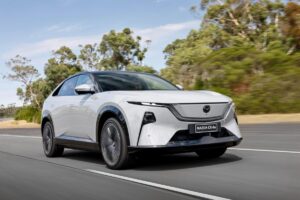
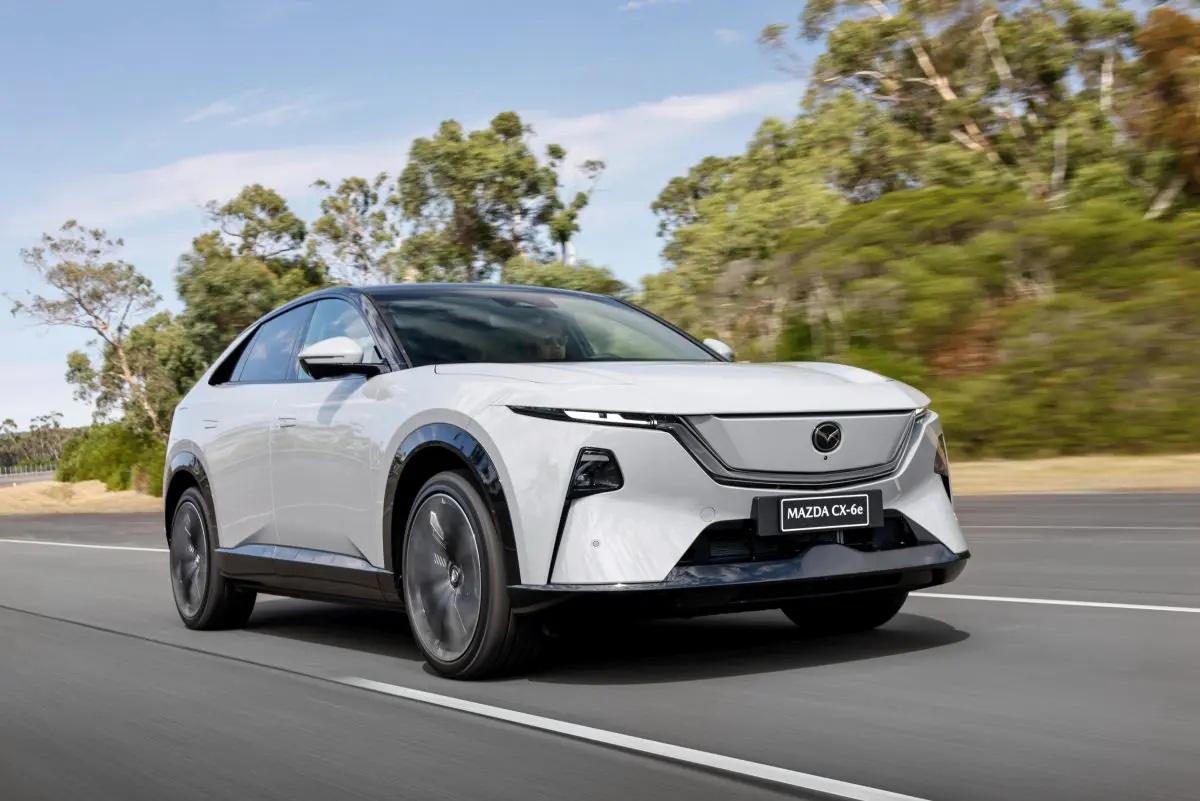
However, in discussions with The Driven during the recent CX-6e launch, Mazda Australia managing director, Vinesh Bhindi, said they are now more comfortable with the current NVES settings, in part due to the recent big uptick in Australian EV sales bringing in significant interest for both the Mazda 6e and CX-6e.
Hiroshi Ozawa (General Manager, Technical Development Centre at Changan Mazda, China) also noted there will likely be a fast-tracking of several more (yet to be identified) Mazda BEVs, meaning increased scope for sales of zero-emission Mazda models capable of balancing the NVES books.
As a result, Vinesh Bhindi said he was now more confident of meeting without penalty the requirements of the NVES over the current regulatory period out to 2029, and as such was not interested in joining the push to weaken (or remove) the current NVES regime.