A new study of millions of vehicles across Great Britain has revealed that electric vehicles (EVs) are much less likely to fail compared to petrol equivalents as the car’s mileage climbs.
The study, which was commissioned by the British Vehicle Rental and Leasing Association (BVRLA) and carried out by independent transport research organisation New AutoMotive, aims to correct misconceptions around the long-term reliability of EVs.
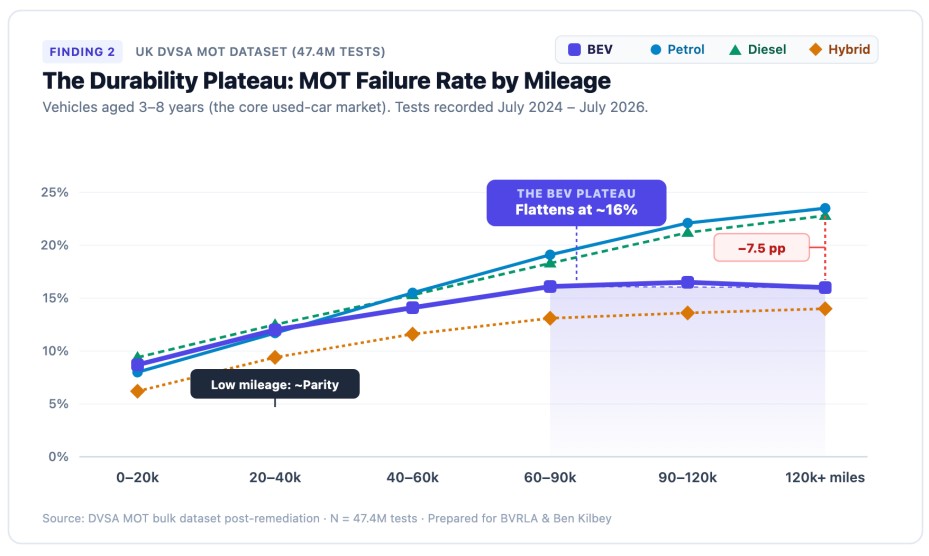
The study analysed 47.4 million statutory Ministry of Transport tests completed across Great Britain between July 2024 and July 2026, and found that battery electric vehicles (BEVs) and petrol cars perform at near parity for the first 40,000 miles.
But as that mileage increases, BEVs consistently outperform petrol vehicles, demonstrating much greater reliability.
Official MOT tests are mandated by the UK Driver and Vehicle Standards Agency (DVSA) and are an annual legal safety and environmental vehicle inspection required for most vehicles over three years old in the UK.
By analysing this massive test database, the study was able to pierce misconceptions on both side of the debate.
Over the first 40,000 miles driven, BEVs and petrol cars exhibit a failure rate at near parity – around 12 per cent for BEVs and 11.7 per cent for petrol cars – but when the mileage starts to climb past 60,000 miles, the BEV failure rate levels off at approximately 16 per cent while petrol and diesel failure rates climb “relentlessly” past 23 per cent.
The discrepancy between BEVs and petrol cars only widens as the mileage increases. Among 3- to 8-year-old vehicles that have covered between 90,000 to 120,000 miles, BEVs fail at around 16.5 per cent, while petrol vehicles fail at around 22 per cent and diesel vehicles at 21 per cent.
And when that milage surpasses the 120,000 mile mark, the durability gap widens to 7.5 percentage points, with BEVs remaining at 16 per cent and petrol vehicles inching up to 23.5 per cent.
The report also found old electric vehicles stay on the road at double the rate of combustion vehicles: at age 15, the road exit rate for BEVs is 5.4 per cent, compared to 11.9 per cent for petrol vehicles.”
Similarly, in twin-model tests that were able to compare identical vehicle bodies that are available in electric and non-electric fuel types – for example, the Hyundai Kona and Nissan NV200 – electric drivetrains win 5 out of 9 comparisons, tie 3, and lose only 1.
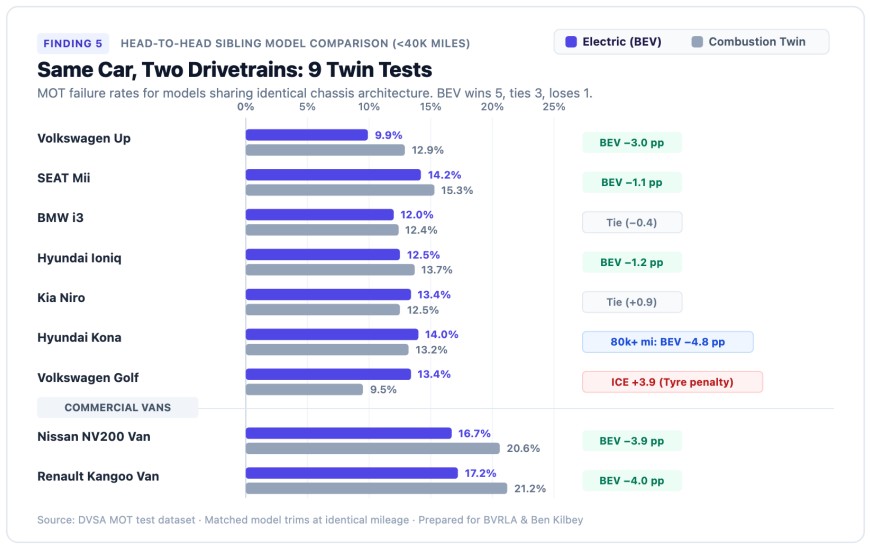
“Mileage has always been one of the first things people look at when buying a used car, and passing 60,000 or 70,000 miles can have a big impact on how a vehicle is perceived,” said Toby Poston, chief executive of the BVRLA.
“This research suggests we need to think differently when it comes to electric vehicles.
“Many of the EVs now entering the used market have had their first life in company and leasing fleets and have already covered substantial mileage. What this data shows is that mileage alone should not put consumers off. A well-maintained, higher-mileage electric car can be an extremely durable used vehicle.
“That matters because the used market is where the transition to electric becomes accessible to millions more motorists. Giving buyers confidence in these cars will be critical to creating a healthy and affordable second-hand EV market.”
The report also debunked the myth that, because of their increased weight from batteries, BEVs suffer greater suspension problems. In fact, the data showed that “electric vehicle suspension defect rates are at or below petrol and diesel rates.”
BEVs were not better at everything, however, with the report finding that EVs recorded approximately 1.8 times as many tyre defects as petrol cars – though the analysis also found that the problem was “particularly pronounced” among some earlier EVs adapted from combustion-engine platforms.
Similarly, regenerative braking complicates the picture for brake durability, with high-mileage BEVs experiencing substantially fewer brake defects, while older and lower-mileage BEVs showing increased friction-brake defects, which the researchers attributed to corrosion associated with the physical brakes being used less frequently.