When it comes to producing cheaper, longer range BEVs, the devil is in the detail. To do so you need to work on one (or preferably more) of aerodynamics, weight and electrical efficiency.
To their credit – VW have just revealed a prototype that has made significant advances in all three, as well as basing the vehicle on their existing MEB+ platform – meaning the car is notionally a ‘near production’ model.
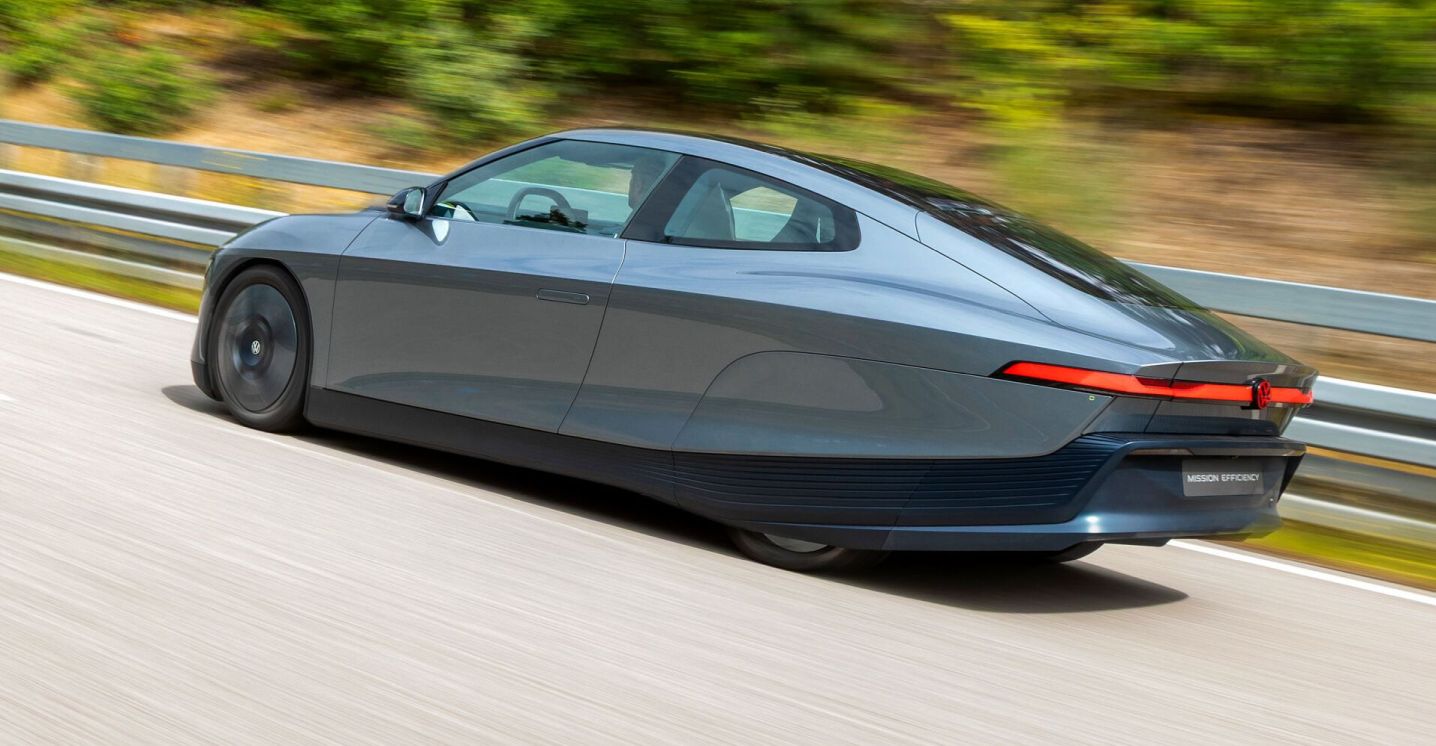
Several records were broken by the ‘Mission Efficiency’ prototype, including the lowest Coefficient of drag (Cd) for a road-approved car at 0.158 and most economical electric car in its class with an efficiency of 6.89 kWh/100km.
In a real-world test, that idealised efficiency was not a lot worse either: on a consumption test drive over a distance of 1,278 km from Volkswagen’s German Development Centre in Wolfsburg via Poznań (Poland) and Olmütz (Czech Republic) to the Austrian capital Vienna, the Mission Efficiency achieved real consumption of 7.51 kWh/100 km including charging losses (6.89 kWh/100 km without charging losses).
The route was completed with an average speed of 67.72 km/h; the top speed was 138 km/h. The 54.9 kWh battery (net) was charged only once during the journey and on arrival in Vienna, still had 164 km of remaining range.
To achieve the ground-breaking low air resistance, VW created a flow-optimised teardrop shape with a small frontal area, active cooling air flaps, clad rear wheels and a fully clad underbody. The doors of the Mission Efficiency feature frameless windows, while the door handles have been integrated into the outer skin for optimum air flow.
As a result, from speeds above 80 km/h, consumption is more than 30 per cent lower than in the standard version of the ID. Polo. At 140 km/h, the Mission Efficiency requires about as much energy as the ID. Polo at 100 km/h.
It is, however, not a small car (unlike the original Honda Insight HEV that the Mission Efficiency mirrors many styling cues in its aerodynamic lines).
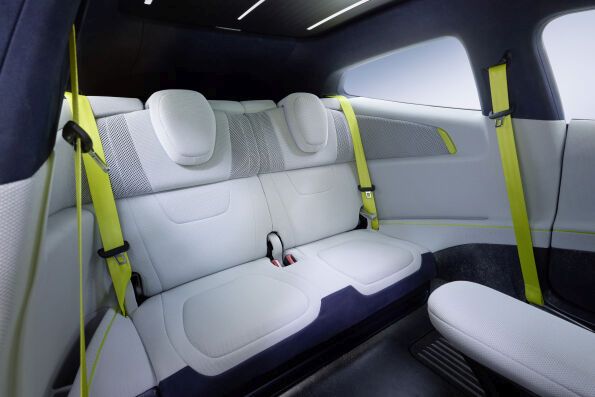
At 4,775 mm long and 1,392 mm tall, the Mission Efficiency coupé offers 2+2 seats and 481 litres of capacity in the luggage compartment. Additional storage compartments under the rear seats and in the sides of the body create space for everyday items and the charging cable.
While the front interior can be used without restriction, the two rear seats are intended for passengers up to a height of only around 1.60 m, meaning the prototype could theoretically be used by a young family of four but is not capable of carrying four full-sized adults.
The body combines components of the ID. Polo with a self-supporting aluminium structure and components made of a high-strength carbon fibre-reinforced polymer (CFRP) and aramid composite.
Another aspect of the prototype is a photovoltaic system with a power output of 370 W integrated into the glass roof and boot lid. This system supplies power to the on-board electrical system, with VW claiming that, depending on the season, region and weather, it can increase the real range by up to 30 kilometres per day.
An interesting move was the choice made for the infotainment system – as in there isn’t one! Instead, it is replaced by mobile Bluetooth box and the “Bring your own device” concept applied with a smartphone or tablet taking the place of the infotainment system display.
“Mission Efficiency is the ideal way to demonstrate what distinguishes Volkswagen in the electric age: technology for the masses – not just for the few,” Volkswagen brand CEO Thomas Schäfer said.
“Rather than using specialist technology, the vehicle set its three world records using affordable production technology from the ID. Polo and ID. Cross, based on the MEB+ platform with front-wheel drive. This shows how much potential efficiency we can add to the latest generation of our electric cars.”
Sign up for The Driven’s free daily newsletter and get the latest EV news and analysis delivered straight to your inbox.