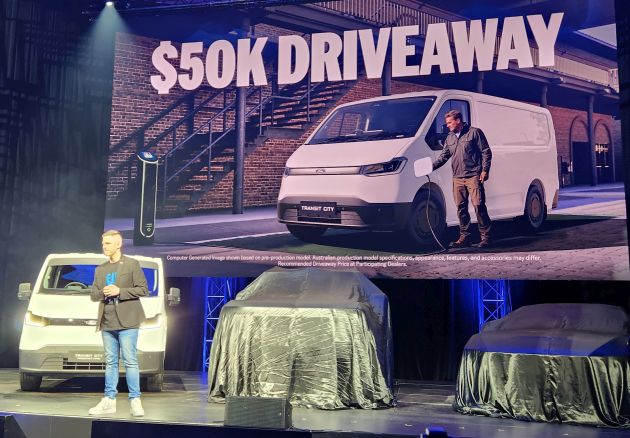
Ford Australia has just announced an addition to their Australian battery-electric van range, and it promises to be a game-changer with a low price and a massive total cost of ownership advantage.
The E-Transit City, as it is named, is a 1 tonne full-battery electric (BEV) van built by Ford’sChinese joint venture partner, Jiangling Motors (JMC). It will arrive in showrooms later next month, and deliveries will commence in November.
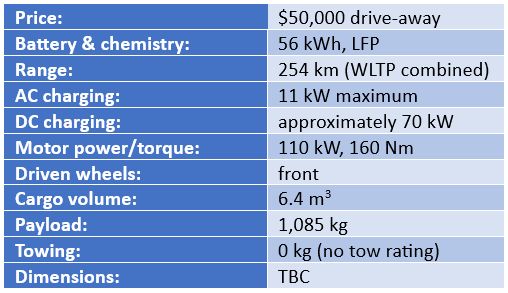
The E-Transit City is fitted with a 56 kWh LFP battery and a 110kW/160Nm motor driving the front wheels. AC charging is up to 11kW AC and around 70kW DC. Quoted DC charging times are 10% to 80% in 33 minutes, or 68 km recharged in 10 minutes.
Driving range under the WLTP test cycle is 254 km (combined). At the launch event, Ford were adamant that they consider this to be plenty of range for a city-oriented van, quoting their research showing that 90% of city-based tradies and delivery couriers do less than 76 km a day. Ford also pointed out that the WLTP city-cycle range for the E-Transit City is up to 380 km.
The E-Transit City van offered here has a 1,085 kg payload and 6.4 cubic metres of load space. (It is not rated for towing).
Also worth noting here that at launch, it will not offer the connectivity of the Ford Pro software ecosystem offered with their other commercial vehicles. Whilst overseas it is offered in low-roof/short-wheelbase and high-roof/long-wheelbase versions, as well as a cab-chassis, only the low-roof/SWB is coming here.
In an admittedly quick inspection at the launch event, I found the driver’s seat to be one of the more comfortable ones I’ve tried in a commercial van. The controls (like all Ford commercial vans) were also straightforward, ergonomically well placed and logical. For commercial fleets where drivers will be jumping in and out of a variety of vehicles, this is an important issue.
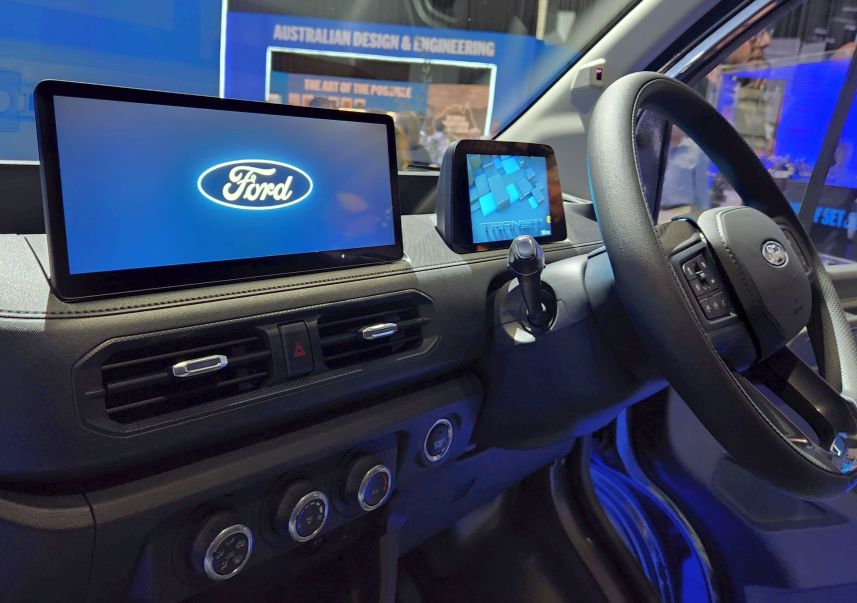
(Control placement by the way is also an issue that many Chinese auto manufacturers need to urgently address, particularly in their passenger cars. Fleet situations are one area where ‘reinventing the wheel’ re placement and use of standard functions is a big black-mark against a model’s inclusion).
The kicker though is the price: $50,000 drive-away. As such it directly competes with internal combustion engined (ICE) vehicles for up-front price.
Given the many cost-savings to be had in fuel and servicing*, let alone avoiding the down-time of refuelling during a trip, for businesses working within the driving range of the E-Transit City or can top-up during breaks, the Total Cost of Ownership (TCO) value proposition for moving electric before your competitors do is all but overwhelming.
Other vans in this segment include the LDV eDeliver 5 (335 km/$48k drive-away offer till Sept 30), Farizon V7E standard range (240 km/$50k drive-away) and Peugeot E-Expert Pro (330 km, currently on a $57k drive-away offer).
I didn’t though include the Kia PV5 Cargo: whilst the Kia has a much greater WLTP range, it has a significantly smaller cargo volume and payload (4.4 cubic metres and 740kg), as well as a noticeably higher price ($56k+ORCs).
All-up, the new E-Transit City is a worthy new entrant to the 1t van field. Furthermore, with its brand-recognition and nationwide dealer network, it is likely to be of great interest to the rusted-on Ford buyer who wanted a full-electric van but until now couldn’t justify the BEV price premium of the E-Transit Custom.
It is also likely to lure a lot of potential buyers away from the lesser-know, smaller service network footprint brands that until now have been the ones proliferating at the value end of the segment.
* Service pricing and intervals for the E-Transit City have yet to be released.
E-Transit City specifications (more details to come at launch):
Sign up for The Driven’s free daily newsletter and get the latest EV news and analysis delivered straight to your inbox.