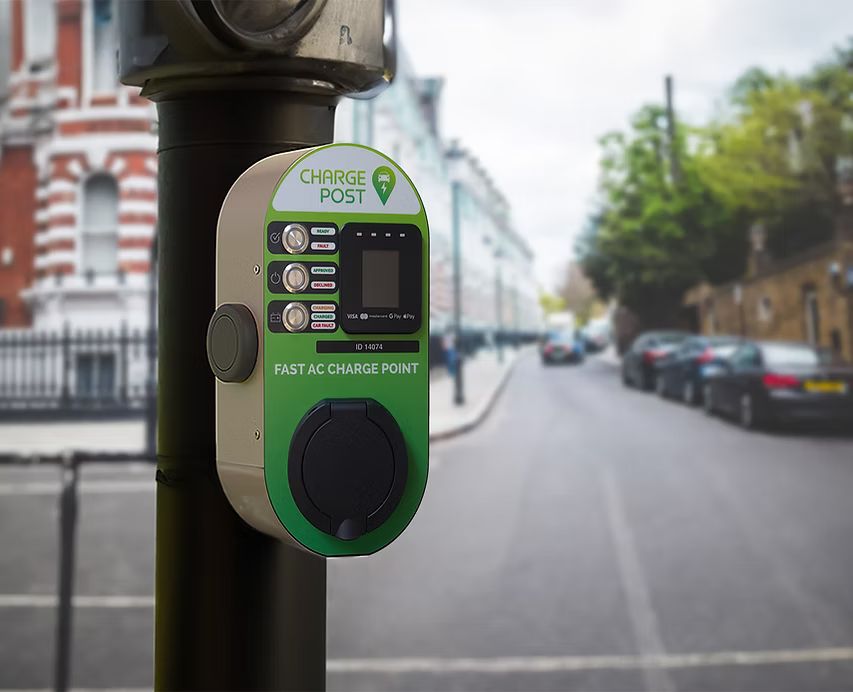
If you’re not in any particular hurry, AC charging offers many advantages. It’s generally cheaper than DC, sometimes even free. Also, as AC charging is slower, it frees you up to spend more time doing your shopping, going the cinema or having dinner without needing to rush back and move the car off the charger.
More and more DC chargers are imposing ‘idle fees’ for cars left at a charger when the charge is finished. For charger hosts, AC chargers are also much cheaper to install and maintain – especially if the owner installs a ‘BYO lead’ AC charger.
If you’re wondering what a BYO lead charger is – well, just like service station air hoses for pumping up your tyres, AC charger leads are prone to damage.
As a result, most public AC chargers are more like a power point and installed with a socket for inserting your own lead. This means you both look after the lead (as it’s yours) and are guaranteed of a working lead when you arrive. However, you do need to rock up with one in the boot … or you won’t be able to use the charger.
So what lead is needed? To start with, many new BEVs come with them supplied as part of the deal. As such it should be the right one for the car. Three phase capable BEVs (i.e. ones with 11 kW or 22 kW AC charge ratings) should come with a three phase lead.
To know what AC charge speed your BEV is rated for, either check the owner’s manual or look up the helpful BEV new and second-hand summary pages found at https://aeva.asn.au/info/ To tell what the lead is rated for, either read the printing on the plug or cable, or check that the plugs have electrical contacts in either five or all seven pins.
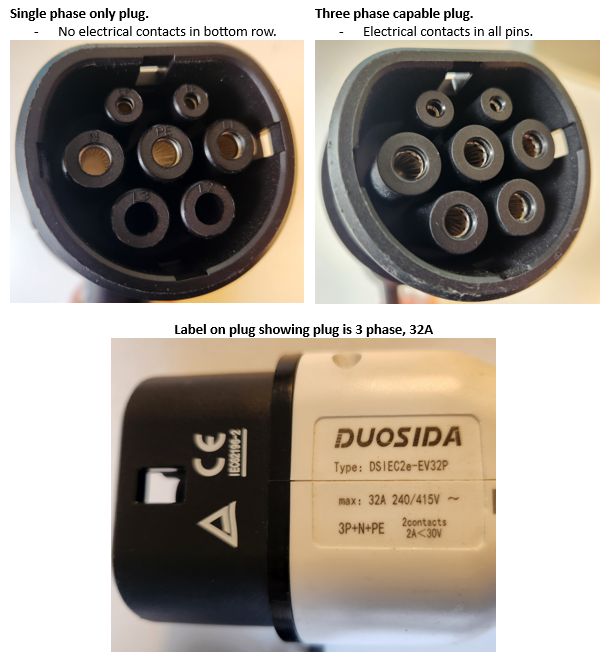
Note that single phase only cars (ones rated as 6.6 kW up to 7.4 kW) may only be supplied with single phase leads. Whilst perfectly useful for a single phase charging BEV, make sure you leave it with the vehicle when you sell it as it is not the best one for most BEVs on the market today.
If the BEV doesn’t come with one, try haggling for it to be thrown into the deal. Mind-you, if asked to pay for it: cross-check the prices from aftermarket suppliers*. Dealer supplied accessories are often more expensive for the same thing bought elsewhere.
However, you do need to know what you are looking for if buying a BYO lead elsewhere. You will need what is called a ‘Type 2 to Type 2 lead’. (Type 1 is the Japanese [and old US] standard that was used by some cars here until around 2017. Unless you have an old Nissan Leaf, Mitsubishi iMiEV or early BMW i3, do not buy a Type 1 lead!).
Also, always buy a three phase, 22 kW capable lead, even if your car is only rated for 7 kW. This will future-proof you for any future car as almost all new BEVs now are three phase capable.
It also needs to be 22 kW rated as it can do both 7 kW single phase as well as up to 22 kW three phase. Some cheapies I’ve seen are 11 kW only, meaning they only do 3.6 kW on one phase. Given some public AC chargers are single phase only, an 11 kW lead will be annoying in the extreme as it gives only half the charge rate the charger could provide.
BYO leads do by the way have one other selection criterion: length. Ranging in length from 3 metres to 10 metres, I would suggest 3 metres is very limiting for a general-purpose lead. 5 metres to 7 metres are the norm. 10 metres can be hard to store in the boot, as well as unnecessary for almost any situation.
Summing up:
If your new BEV comes with a BYO lead, it should be the right one for the car – but check it is using the criteria above. Many dealers are not fully up to speed on BEVs yet and they might grab the wrong one off the shelf.
If buying a lead from an auto shop or charger supplier, make sure the one you order is the right one: except for some old BEVs with Type 1 charge sockets, you should be buying a 22kW rated, Type 2 to Type 2 lead at 5 to 7 metres in length.
* Important note regarding buying electrical goods from overseas suppliers:
EV chargers, leads and adapters should always be sourced from Australian distributors. Buying direct from overseas suppliers may be cheaper, however it creates the potential for significant quality and liability issues – including refusal by insurance companies to pay for damage done by privately imported electrical items.
More information:
https://www.energysafe.vic.gov.au/sites/default/files/2022-12/Buying_Elec_Equip_Online_brochure.pdf
Sign up for The Driven’s free daily newsletter and get the latest EV news and analysis delivered straight to your inbox.
And for a full rundown of all available EV models in Australia, please go to our Compare EVs page here.