As oil prices blow past $100 a barrel amid war in the Middle East, Indonesia’s fast-growing fleet of electric vehicles (EVs) is quietly easing fiscal pressure on the government.
In 2025 alone, EVs saved more than Rp100 billion (~$US5.8 billion) in public spending by substituting millions of liters of imported liquid fuels with domestically produced electricity.
The relief is real, but the current benefits represent only a fraction of what is possible. With policies that expand the supply of EVs in the Indonesian market, the government can multiply these savings while strengthening energy security.
The price of oil dependence
Indonesia imports roughly 60% of its oil, and that dependence puts the economy at risk. To keep fuel affordable for most Indonesians, the government maintains below-market fuel prices for over 60% of fuel consumed nationwide, providing a per-liter fuel subsidy and compensating its state-owned oil company to cover the difference.
The result? A spike in crude prices hits the public purse directly. The fiscal burden is immense: in 2024, the government set aside roughly Rp130 trillion (~$US7.6 billion) to keep fuel prices at affordable levels.
The latest conflict in the Middle East has laid bare the fiscal risk of Indonesia’s oil import dependence. In late February, the price of oil surged nearly 50% within 2 weeks. Prices are now well above the $100-per-barrel assumption built into Indonesia’s 2026 state budget.
The weakness of the rupiah has compounded the problem, breaching Rp17,500 to the dollar as of May 12—well past the budget’s Rp16,500 assumption—making oil imports costlier still. Every $1 increase in the price of a barrel of oil adds an estimated Rp6.8–10.3 trillion ($US400–$610 million) to the deficit.
Plugging the gap
Figure 1. Electric car population and energy consumption, 2025
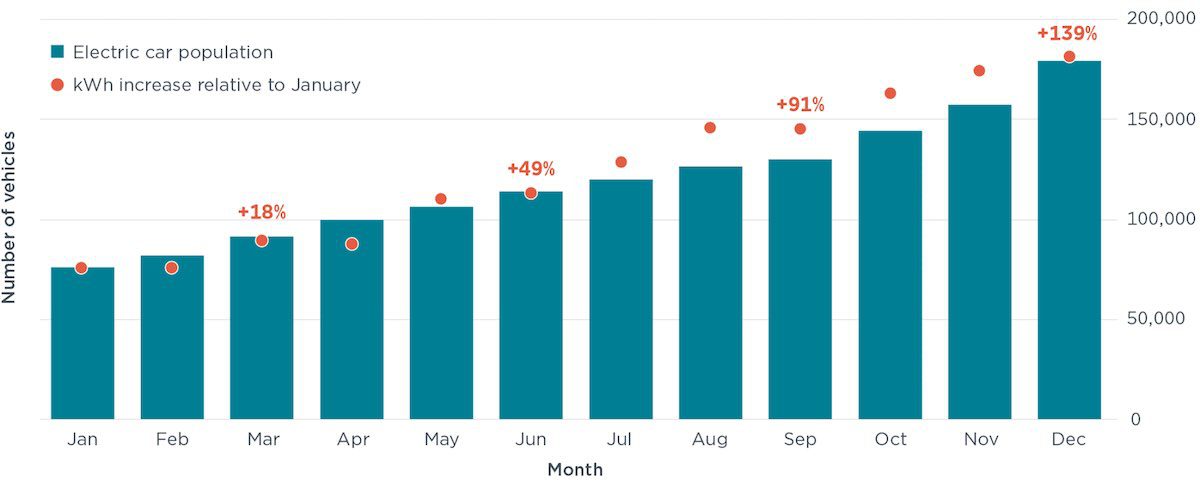
Had those EVs been gasoline or diesel cars, they would have burned through 147 million liters of liquid fuel in 2025. Because roughly 60% of diesel and 80% of gasoline sold nationally is purchased at government-supported prices, most of that avoided fuel would have been burned at the government’s expense.
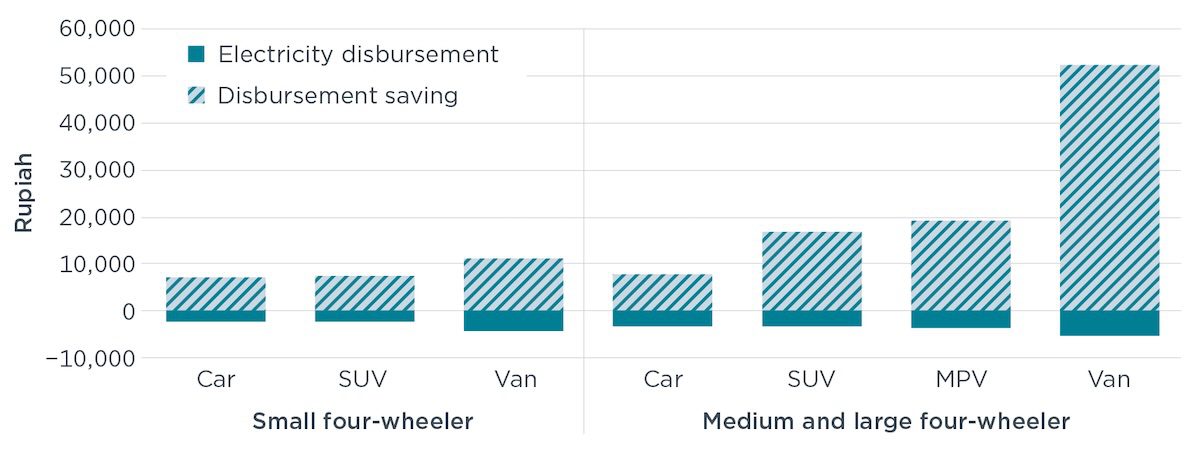
Meanwhile, powering an EV costs the state as little as Rp2,000 ($0.12) per 100 km in electricity compensation, which the government pays to PLN to cover the gap between the regulated electricity price consumers pay and the market price. The equivalent fuel disbursement for a comparable conventional vehicle can run up to 10 times higher.
And the bigger the vehicle, the bigger the savings: commercial vehicles such as trucks and buses consume up to double the fuel per kilometer as passenger cars, meaning their electrification yields outsized fiscal benefits (Figure 2).
Figure 2. EV energy disbursement savings per 100 km
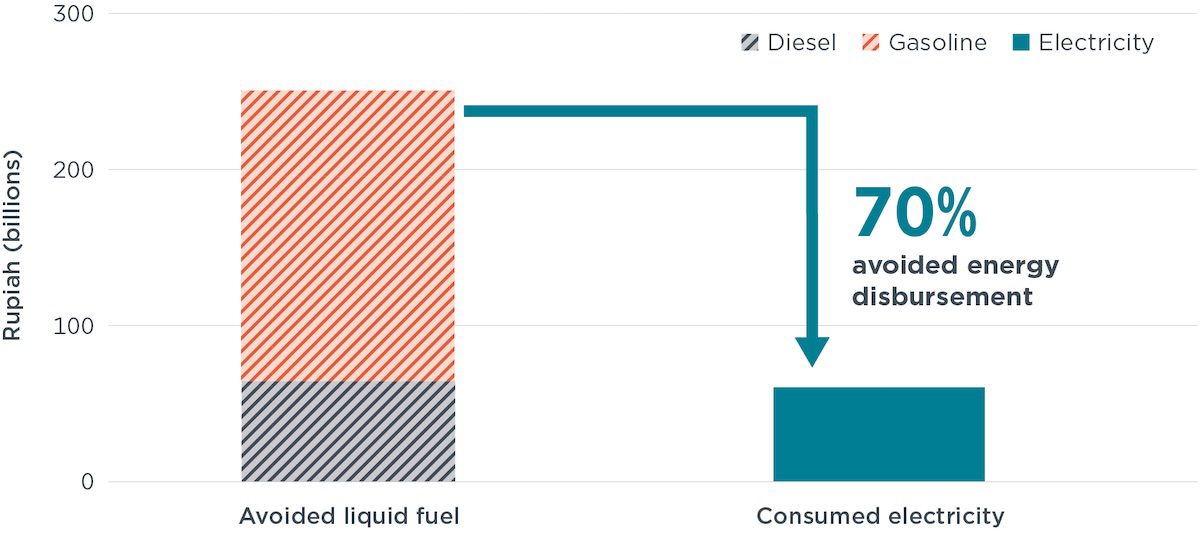
In 2025, the net budget saving across the fleet came to Rp121.7 billion (~$7.2 million), or nearly 70% of the avoided cost of liquid fuels after accounting for the per-liter cost of fuel disbursements and per-kWh electricity compensation owed to PLN (see Figure 3). Put another way, for every rupiah the state spent covering EV electricity, it saved about 3 rupiahs in fuel disbursement.
Figure 3. Annual EV energy disbursement savings
Keep the current running
Every EV sold is a buffer against oil-price shocks. The higher crude prices go, the more each EV saves. But locking in these benefits requires action. Indonesia’s growing EV fleet was built on fiscal incentives that expired in 2025, and without new policies, the fleet’s growth—and its savings—could stall.
To sustain and expand the fiscal buffer, the government can extend incentives to commercial vehicles, which consume far more fuel than passenger cars. And introducing zero-emission supply standards for all road vehicles would ensure more choices and lower prices for consumers and fleets.
The data are clear: domestically produced electricity is steadily replacing imported barrels of oil. Every liter of fuel not burned is money the state can invest in roads, schools, and hospitals. For a country that spends billions on fuel subsidies and is now facing its largest subsidy bill in years, the calculus is straightforward—more EVs make Indonesia stronger.
From the International Council on Clean Transportation. Reproduced with permission.
Please sign up for The Driven’s free daily newsletter and get the latest EV news and analysis delivered straight to your inbox.