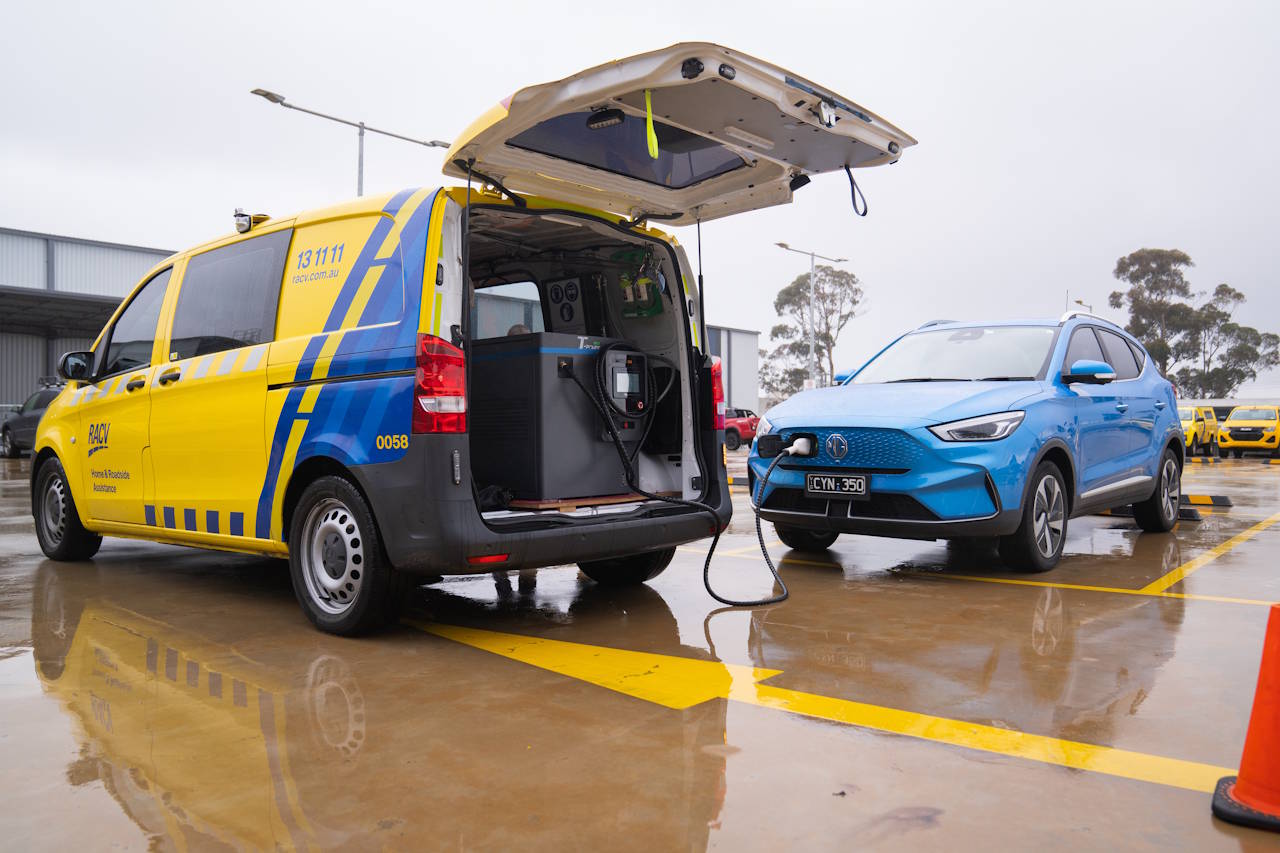
The Royal Automobile Club of Victoria, better known as RACV, says it will begin trialling a mobile DC fast charger as part of its Emergency Roadside Assistance patrol fleet.
RACV has seen roadside assist callouts for out-of-charge electric vehicles (EVs) increase by more than 50 per cent year-on-year since 2023, reflecting Victoria’s rapid uptake of battery EVs.
The state government revealed earlier this year that more than 100,000 Victorians had made the switch to battery electric vehicles (BEVs), helped by month-on-month increases through the first three months of the year and setting a record 15.4 per cent of new light vehicle sales in Victoria in March.
Responding to the increase in out-of-charge callouts and Victoria’s growing fleet of BEVs, RACV will add a single DC fast charger to its Emergency Roadside Assistance patrol fleet.
The 20kW DC on-board charger will be fitted in a single patrol van and will be able to provide around one kilometre of range per minute of charging – meaning a 20-minute roadside visit can deliver enough charge to get an EV up and going enough to get home or to a nearby charging station.
Though RACV is only trialling the mobile DC fast charger in a single patrol van in Melbourne, the organisation is aiming to use the trial to assess demand, performance, and operational fit ahead of a potential broader rollout.

“This trial is about looking ahead to what roadside assistance needs to deliver as more Victorians make the switch to electric vehicles,” said Makarla Cole, RACV general manager for automotive services, adding that the mobile fast charger trial “points to the future of roadside assistance.
“A fast roadside charge can significantly reduce disruption and complements RACV’s broader investment in public charging infrastructure across Victoria, including the Chargefox network.
“While traditional mobile charging solutions provide a small top-up, DC charging allows us to deliver a more meaningful boost in a shorter time, helping drivers get moving again sooner.”
RACV is also planning to trial a BEV roadside patrol vehicle later this year to gauge how an EV performs in real-world conditions including load-capacity, range, and its suitability across the different roadside assist jobs normally undertaken by RACV’s patrol vans.
“We need to understand how an EV patrol vehicle performs operationally, including whether it can carry the equipment required for roadside assistance,” said Cole.
“These trials are about understanding how roadside assistance will evolve as more Victorians move to electric vehicles, and ensuring RACV is ready to support members at every stage of that transition.”
Please sign up for The Driven’s free daily newsletter and get the latest EV news and analysis delivered straight to your inbox.