
Victoria has just finished a year-long parliamentary inquiry into how to “harmonise electric vehicles with electricity supply and demand”.
The central question of the Economy and Infrastructure Committee Parliamentary inquiry was simple: will EVs crash the grid, or can they help keep the lights on while cutting bills and emissions? The answer, from the evidence and the final report, is clear.
EVs are not a threat to the grid – they are the missing piece of a cleaner, cheaper electricity system – if we design for them.
The inquiry ranged well beyond subsidies. MPs examined how to cut peak-time charging, whether public and kerbside chargers are rolling out fast enough, what role network businesses should play, and how to give old EV batteries a second life in homes and communities.
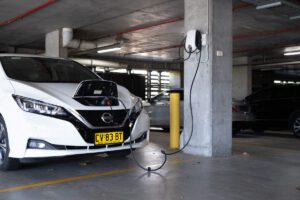
Hearings repeatedly heard that more than 80% of current EV owners charge at home, but renters and apartment dwellers are often locked out, as we reflected in our evidence, and that convenient workplace and daytime charging will be crucial to soak up cheap solar.
All this is happening against a market backdrop that is changing faster than many expected.
In May 2026, battery electric vehicles (BEVs) jumped to 20% of new car sales (updating the figures we provided to the Committee in March 2026), while pure petrol-and-diesel models slid close to half the market.

Australia monthly new vehicle sales by drive train – petrol, diesel, hybrid + PHEV, and BEV
BYD is now clearly ahead of Tesla as Australia’s top EV brand year-to-date, with almost 20,000 battery EVs sold in the first five months of 2026. Tesla still has the country’s single best-selling EV nameplate in the Model Y, and in May was number one spot in all car sales. Meanwhile, Chinese newcomer Zeekr is the fastest-growing brand, while China as a whole has become the largest source of new vehicles sold into Australia.
In total, EV sales are running at more than double last year’s levels – up more than 110% year-on-year in the latest monthly data.

Australian vehicle sales share by country of origin – last data point reports year to date.
In that context, another round of state-by-state inquiries is the last thing we need. What we need now is implementation.
The Victorian Legislative Council Economy and Infrastructure Committee did the hard thinking. Its report accepts the core framing that many of us put forward: EVs are flexible, schedulable loads that can soak up surplus solar and wind, and – with vehicle-to-grid (V2G) or vehicle-to-home (V2H) technology – they can also feed power back in when it is most valuable.
The Committee supports smarter tariffs, better planning, more convenient public and workplace charging, and a clear enabling role for distribution network service providers, rather than turning them into monopoly charging operators.
Where the report is understandably cautious is in how far and how fast to go. It talks a lot about trials, pilots and further investigation. That was reasonable five years ago.
It is less defensible when Chinese-made EVs are pouring into showrooms, some brands coming 5000 at a time in a RoRo car-carrying ship, BEV share hitting one in five car sales, and new brands like Zeekr are scaling from zero to almost a thousand cars a year in a just a few months.
Victoria is now in a position to move from “why” and “what” to “how” and “when”.
Here’s our view of three steps that would make the inquiry’s conclusions bite:
First, mandate smart, network-connected charging for new installations. All new home and workplace chargers above a modest size should be capable of responding to dynamic tariffs or control signals, with default settings that favour off-peak and high-renewables periods and a simple user override.
That does not ban daytime or peak-time charging; it just makes the grid-friendly option the path of least resistance.
Second, fast-track V2G and V2H standards and move beyond perpetual pilots. Victoria is already trialling kerbside V2G and national retailers are experimenting with bidirectional chargers, but the physics are no longer in doubt.
The state can adopt interoperable standards aligned with ISO 15118, require network businesses and retailers to publish clear technical and commercial terms for V2G participation, and shift public funding from scattered pilots to fleet depots, bus yards and neighbourhood-scale roll-outs.
Third, make EV flexibility visible in system planning. AEMO’s Integrated System Plan and Victorian planning documents still tend to treat EVs primarily as additional load.
Planners should be required to publish scenarios in which high utilisation of EV-as-DER – smart charging plus V2G/V2H – reduces the need for some transmission lines and gas peakers, and distribution networks should report how much extra hosting capacity they can unlock with software and targeted upgrades.
Other states can – and should – piggyback on Victoria’s work instead of launching identical inquiries. New South Wales, Queensland and Western Australia all face the same combination of rapidly rising EV sales, booming rooftop solar and emerging minimum-demand issues.
They can adopt Victoria’s analytical frame, coordinate standards and planning assumptions across the NEM, and focus any local processes on their specific constraints rather than revisiting the basics.
The EV market has already moved on from the question of whether Australians want electric cars. The VFACTS data released on 3 June 2026 now shows that the centre of gravity is shifting decisively towards battery vehicles, with Chinese manufacturers in particular scaling up supply at remarkable speed.
The more urgent question is whether our policies, tariffs and planning frameworks will keep up – or whether we will treat this flexible, controllable new load as if it were just another dumb appliance and pay the price in over-built, over-priced infrastructure.
Evidence provide by us to the Economy and Infrastructure Committee Parliamentary inquiry included our submission on behalf of Future Smart Strategies, our appearance before the Committee and our follow-up providing supplementary evidence.