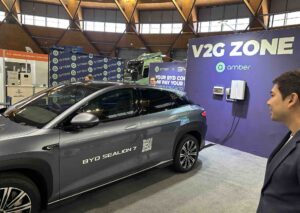
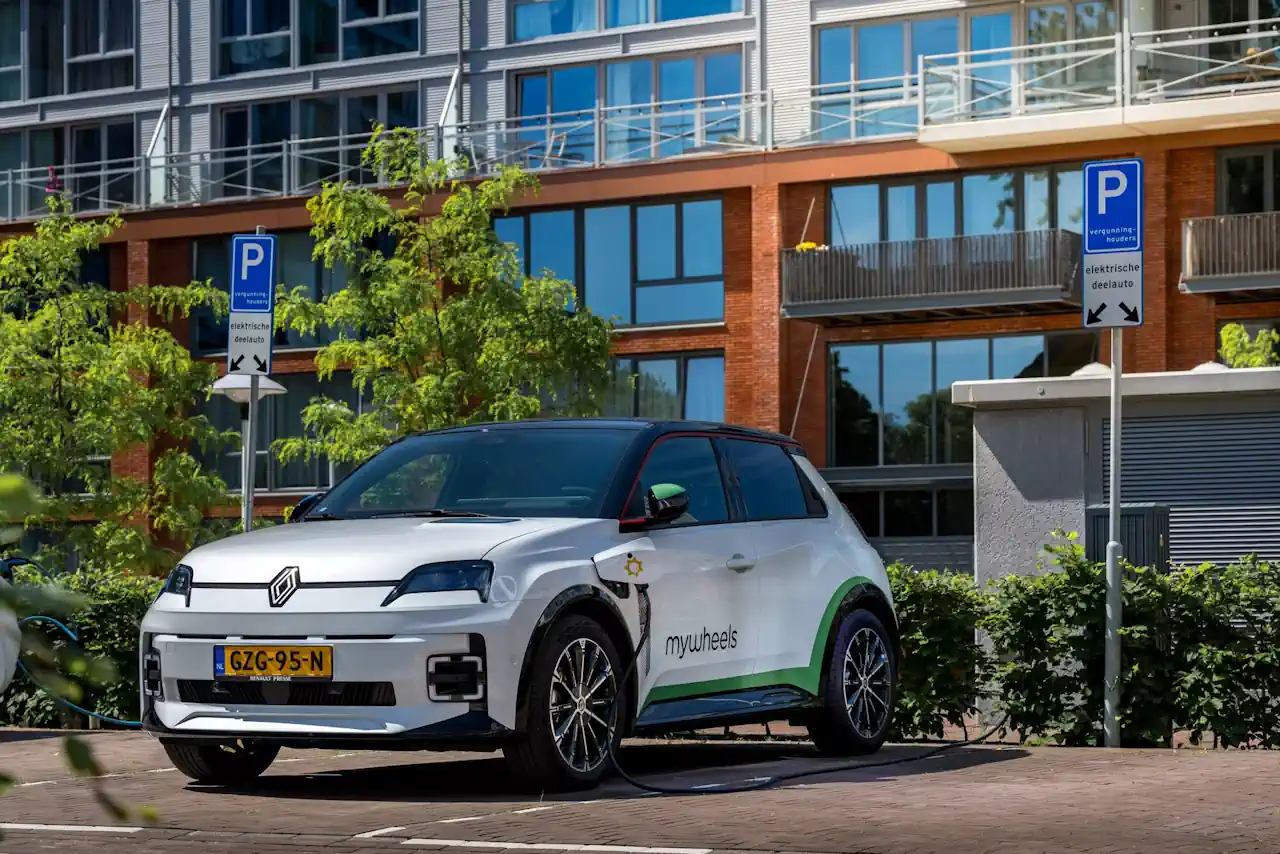
The first large scale vehicle-to-grid system – coupled with an electric car share service and located in the so-called European solar capital – has been deemed a success, and proof that V2G is now ready to roll out at scale.
The scheme, in Utrecht, started out with 50 Renault 5 E-Tech EVs, with plans to add a number of other Renault EVs including the Renault 4 E‑Tech, Renault Megane E‑Tech, and Renault Scenic E‑Tech.
The Utrecht Energized project was designed to stabilise the local grid while also providing Utrecht residents with an affordable and sustainable mobility solution, and at launch it became the first fully operational V2G ecosystem in a European city.
And according to a report published by the Electric Power Innovation for a Carbon-Free Society (EPICS) research program, Utrecht Energized has already provided “real-world evidence that V2G can deliver scalable grid-balancing flexibility using commercially available technology, under operational rather than test conditions.”
“The combination of ACV2G, car-share fleets, and smart charging software has shown that a single initiative can simultaneously address grid congestion, reduce private vehicle ownership, and accelerate EV adoption,” the authors wrote in their report, ‘Charged with potential: Lessons from Utrecht Energized vehicle-to-grid project’.
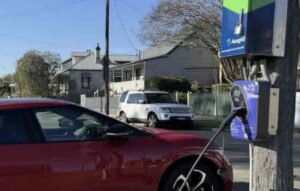
The vehicles operated under the Utrecht Energized scheme can be booked for hourly, daily, or longer rentals via the MyWheels app, and customers are charged according to duration and distance travelled. Each car has its own tethered charging cable and its own dedicated parking bay, which has a 7kW AC V2G-capable charger.
Charging and discharging is managed remotely by We Drive Solar, a Utrecht-based company that developed the V2G charging hardware and software used in the program, and which integrates with the MyWheels booking system.
Delivering the V2G car-sharing program in the Netherlands made a lot of sense, given that the country boasts the highest solar PV capacity per capita in Europe at 1,336W per person – only slightly behind Australia’s own 1,425W per person. So prevalent is solar in the Netherlands that in May 2025, national PV output peaked at 26 gigawatts (GW) at a time when demand was only 15 GW.
Using the fleet of Renault EVs to store surplus solar power during the day and then feeding it back into the local grid during peak demand, therefore, made the Netherlands, and Utrecht in particular, a natural location to demonstrate the increasing reliability of V2G technology.
And according to the Epics report, that’s precisely what Utrecht Energized has done.
“Utrecht Energized offers real-world, operational evidence — beyond trials — that V2G can ease grid congestion, reduce private car ownership, and support renewable energy integration,” said Jess Britton, UKERC Co-Director and Research Fellow at the University of Edinburgh.
According to the report, during the first five months of operation, 50 Utrecht Energized EVs discharged more than 65,000 kilowatt-hours (kWh) of electricity back into the local distribution network – an average of 1,300kWh and 118 hours of discharge per car.
The researchers identified grid congestion as both the primary driver of V2G innovation in Utrecht as well as a growing challenge across the United Kingdom and the rest of Europe.
But as renewable capacity expands and heat and transport continue to electrify, Great Britain’s system operator NESO found that the ability to use EV batteries as flexible storage options could provide around 50 GW of clean flexibility capacity in Great Britain alone by 2050.
The research identified a handful of unresolved challenges, given that the success of Utrecht Energized relied on a range of specific factors – including acute local grid congestion, publicly-funded testing and certification of EV supply equipment and home energy management systems.
It also involved the long-term collaboration between the public, private, and academic sectors, which have been supported by a small group of motivated actors navigating the regulatory and technical challenges.
Cities and regions where grid congestion is less acute, distribution system operators (DSOs) are privately owned, or institutional relationships are less developed, would face what the authors described as “a materially different starting point”.
There also remains two structural uncertainties, in the minds of the researchers, centred around the economics of such an integrated V2G car-sharing platform.
The authors outlined three priorities for governments and network operators, including developing granular and publicly accessible mapping of current and forecast grid constraints.
They also recommended embedding V2G capability requirements in public procurement frameworks before charging infrastructure is locked in; and aligning grid codes internationally to encourage vehicle manufacturers to commit to V2G at scale.
For local authorities, the report also recommended using planning powers to require V2G-compatible charging as a condition of consent for new residential and commercial development, as well as integrating V2G into on-street and public car park infrastructure programmes.
You can hear a discussion of this project, and how it might apply in Australia, in a recent edition of The Driven podcast here: The Driven Podcast: How close is V2G in Australia?