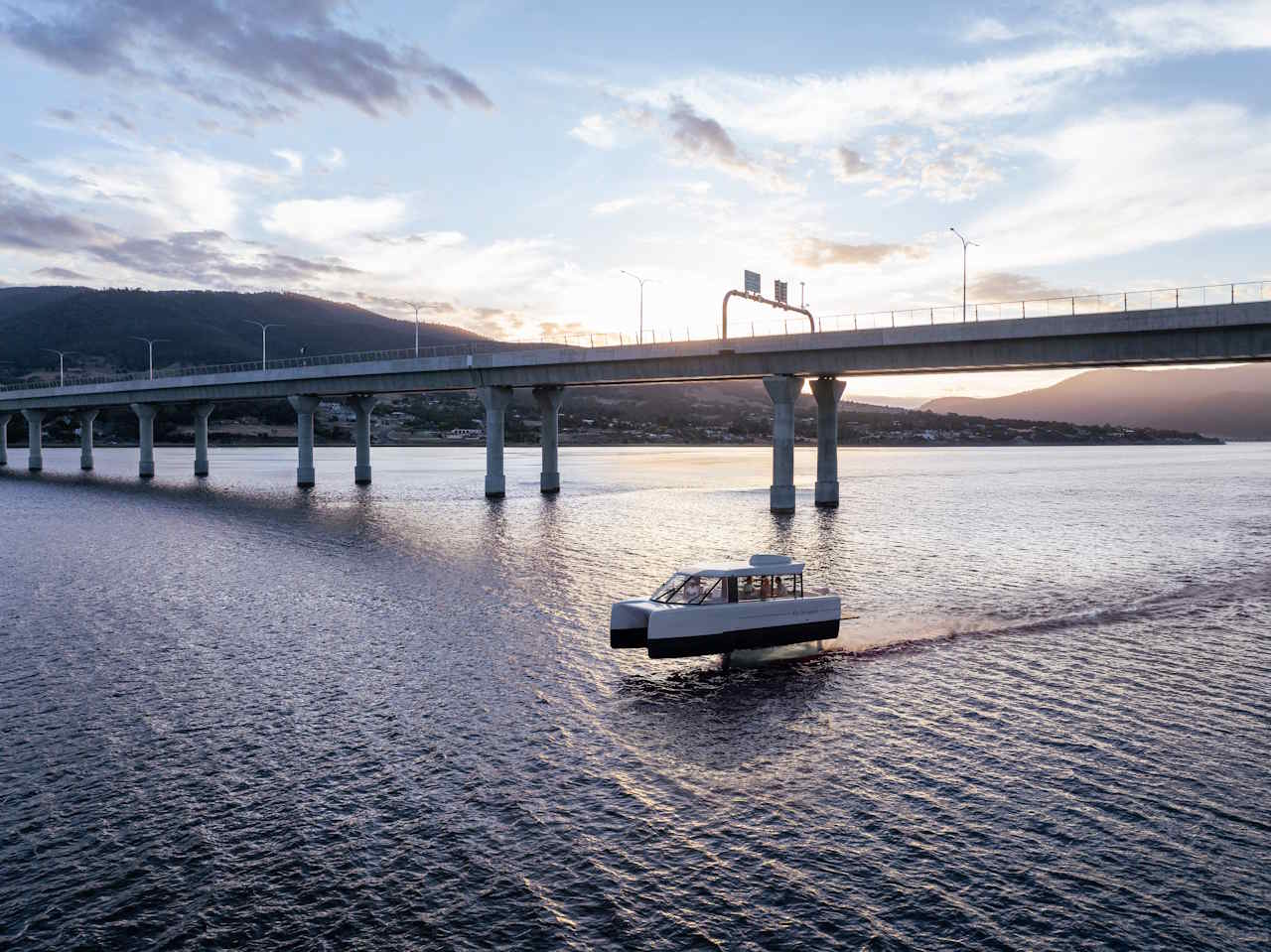
The Derwent River in Tasmania will soon play host to Australia’s first network of electric hydrofoil boats thanks to a partnership between New Zealand marine innovator Vessev and Tasmanian clean energy transport venture Fly Derwent.
The project, announced on Monday, will begin with a single Vessev VS-9 capable of seating 10, which will initially focus on early commuter and premium tourism offerings. Plans are to add bigger 30-seater VS-12 electric hydrofoil boats at a later date.
The VS-9 hydrofoil boats measure nearly 9-metres in length and boast a top speed of 30 knots and a cruising speed of 25 knots, a range of up to 50 nautical miles at cruise speed, and a charge rate of 1 nautical mile per minute.
Fly Derwent says the network will eventually span the full length of the Derwent River, servicing 60 kilometres from New Norfolk to Opossum Bay.

“This world-leading technology unlocks affordable, river-based commuter and tourism transport in Hobart without the need for large-scale infrastructure changes,” said Cameron McCulloch, Fly Derwent principal.
“That’s what excites me most – not just the boats themselves, but everything they make possible in Hobart and beyond.
“It’s an entirely new mode of transport that enables us to use waterways in a way that is more like a metro system than a ferry service.”
Vessev’s hydrofoiling vessels produce virtually no wake thanks to their carbon fibre foils which help lift the boat above the water, minimising friction and water impacts and increasing travel speeds without impacting the environment.

Hydrofoiling technology therefore improves efficiency by up to three times compared to conventional boats, and each boat requires only a modest amount of energy to fully charge.
And considering that Tasmania already operates at close to 100 per cent electricity generation thanks to mostly its hydropower, along with wind and growing solar capacity, charging the vessels will also be zero emissions.
McCulloch is exploring the possibility of installing on-site battery storage, vehicle-to-grid integration, and mobile charging infrastructure that could help support additional routes.
The first vessel, the Vessev VS-9, is expected to arrive in Hobart early next year and Vessev has also confirmed it will work closely with Fly Derwent to accelerate deployment of the VS-12s.

“Electric hydrofoiling enables an entirely new category of water transport,” said Eric Laakmann, Vessev CEO.
“Tasmania is a standout environment to demonstrate this at scale, where abundant renewable energy and strong local ambition come together to show what zero-emissions marine transport can look like in the real world.”
Sign up for The Driven’s free daily newsletter by going to the button on the bottom right of the website’s home page at www.thedriven.io