The global fleet of EVs avoided the consumption of 1.7 million barrels per day of oil globally in 2025, equivalent to 70 per cent of Iran’s exports in the same year, according to a new report released this week.
As the war in Iran and across the Middle East drags through its third week, and the Strait of Hormuz remains closed to all those considered “enemies” of Iran, global oil prices continue to rise, triggering panic buying that has left petrol pumps empty in parts of regional Australia.
The Strait of Hormuz provides 29 per cent of global oil supply and is being used by Iran to make America and Israel’s war against it as economically painful and expensive as possible.

But the closure of the Strait of Hormuz has also revealed the potential of electric vehicles.
According to a new report from global energy think tank Ember, the global electric vehicle fleet avoided the consumption of 1.7 million barrels per day of oil globally in 2025, compared to the 2.4 million barrels of oil exported by Iran through the Strait of Hormuz.
“Oil is the Achilles’ heel of the global economy,” said Daan Walter, a principal at global energy think tank Ember.
“In particular, Asia’s oil vulnerability has been exposed by the current crisis.”
With 79 per cent of the global population living in oil-importing countries, Iran is succeeding in its efforts to make America and Israel’s war as unpalatable and as costly as possible.
Global net importers of oil spent $US1.7 trillion in 2024, and with every $10 increase per barrel of oil, global net import costs will rise by around $160 billion per year, according to Ember.
Even countries with their own source of oil are feeling the pinch, including the United States. In Texas, for example, one of the world’s largest oil-exporting regions, gasoline prices have risen by more than 25 per cent in the three weeks of the war – a larger increase than in oil-importing countries such as the UK and France.
Were countries able to more rapidly replace imported oil used in transport with electric vehicles, Ember believes global fossil fuel imports would decrease by a third, saving around $US600 billion per year.
And given that electrification technologies already exist for more than three-quarters of global energy demand, and every country has sufficient renewable resources of their own to meet that demand using only wind and solar, the crisis in the Middle East may be the last straw that pushes countries headlong into greater electrification.
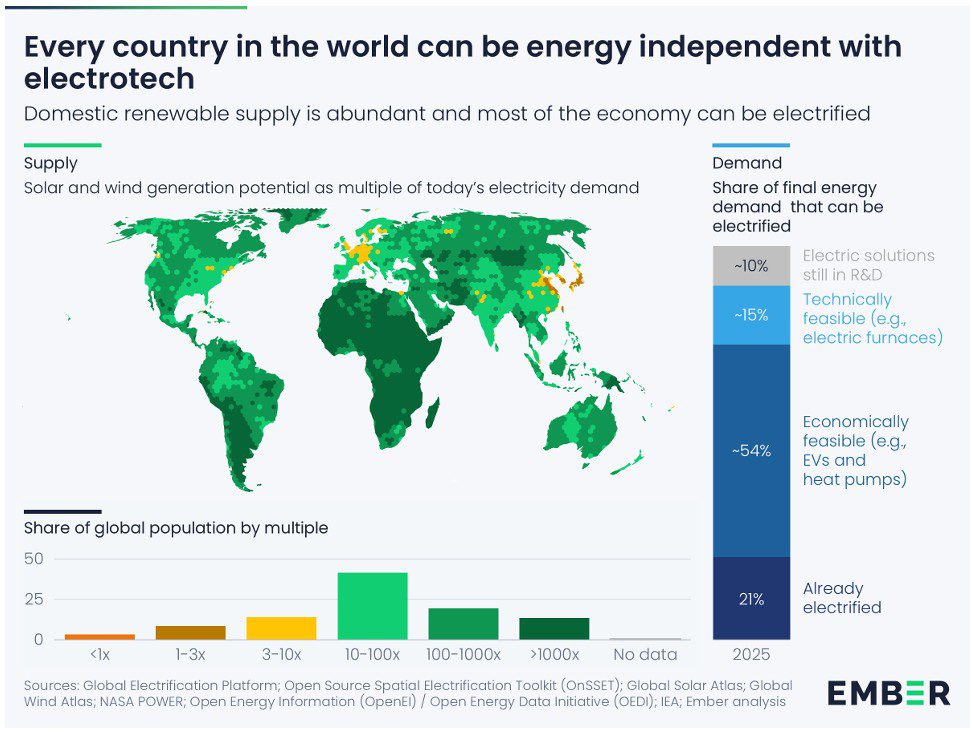
“Unlike the oil crises of the 1970s, there is now a better alternative,” said Walter.
“Electric vehicles are increasingly cost-competitive with gasoline cars. Oil volatility means EVs are a common-sense choice for countries wishing to insulate themselves from future shocks.”
According to Ember’s analysis, electric technologies such as EVs are already cushioning oil shocks. This is particularly the case in Asia, where rapid EV deployment has already slowed the growth of oil demand.
According to Ember, 39 countries now boast an EV sales share above 10 percent – up from just 4 per cent in 2019. Countries like Viet Nam, Thailand, and Indonesia have ramped up shares to 38 per cent, 21 per cent, and 15 per cent respectively. In comparison, the share of EV sales in the EU sits at 26 per cent and 10 per cent in the United States.
And, of course, China is leading the way with an EV sales share over 50 per cent in 2025.
Ember’s analysis found that, with oil at $US80 per barrel, the cost savings are already significant, with China saving over $US28 billion per year in avoided oil imports, and Europe saving about $US8 billion.
And with Asia importing 40 per cent of its oil through the Strait of Hormuz, Ember expects EV adoption across the region to accelerate.