
BYD’s 1 megawatt (MW) charging technology is set to reach Europe this year, with plans to deploy more than 3,000 ultra-fast charging stations by the end of 2026.
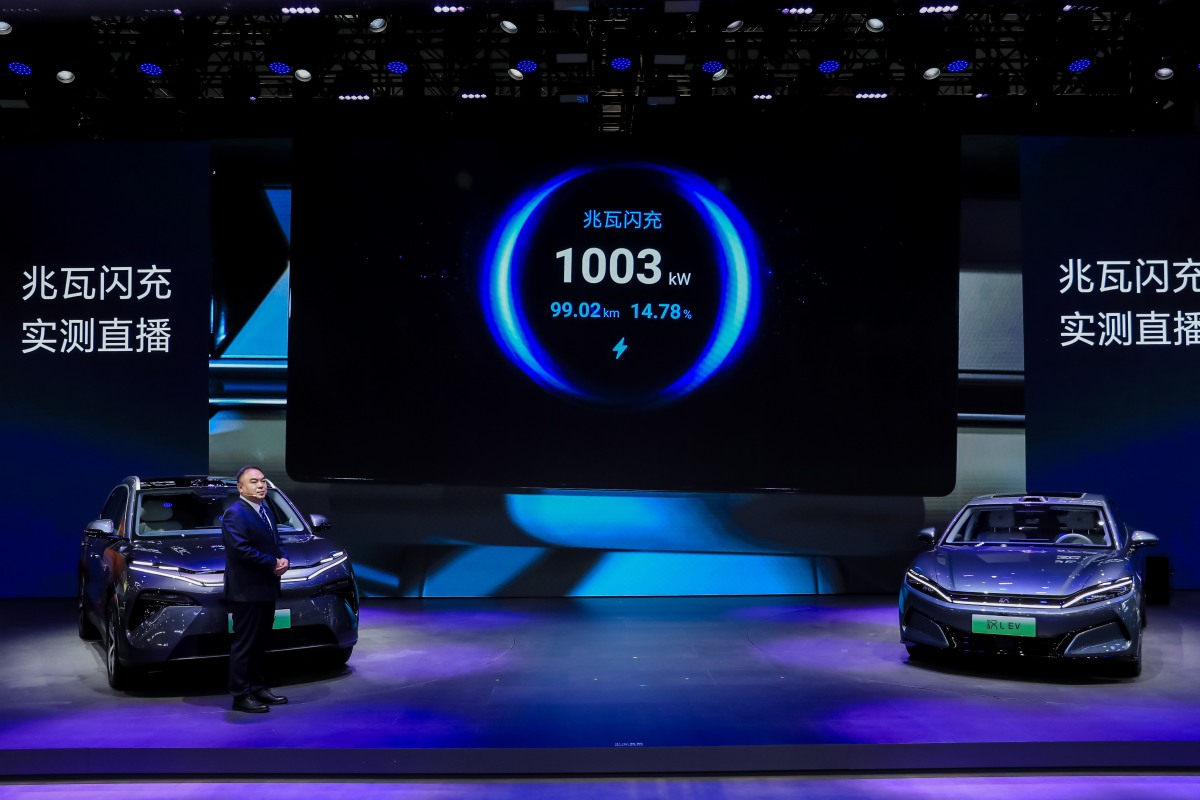
Details of the rollout were outlined in a recent presentation in Poland, shared on X by Norbert C, showing dozens of initial sites capable of delivering up to 1,000 kW of charging power, far beyond the 350–400 kW output typical of today’s fastest European chargers.
BYD first unveiled the 1,000-volt “Super e-Platform” last year, claiming compatible vehicles could add up to 400 km of range in just five minutes. Delivering that level of power consistently, however, will require substantial grid capacity and carefully engineered sites, signalling a significant step-up in charging infrastructure.
Byłem dziś na bardzo ciekawym spotkaniu w BYD Polska. Było trochę o nowych autach ale i o sieci ładowania.
BYD zainwestuje w tym roku kasę w kilkadziesiąt stacji ładowania w Polsce o mocy 1000kW. W Europie ponad tysiąc
I uwaga oni zainwestują kasę ale nie będą CPO (Charge… pic.twitter.com/aOLmVqHqgH
— Norbert Cała ⚡ (@norbertcala) February 26, 2026
The only 1 MW charging-capable vehicle from the brand confirmed to be heading over to Europe is the Denza Z9, which is expected to launch there in the first half of 2026. Denza, as a brand, has also launched in Australia late last year.
Built on BYD’s new “Super e-Platform” can be found in the lates versions of BYD’s Han L sedan and Tang L SUV models. The 1,000-volt architecture supports up to 1,000 amps of charging current, theoretically adding around 400 km of range in just five minutes. This would place them among the fastest-charging mass-market EVs currently available.
A large new BYD electric SUV has recently been spotted testing in China, likely the forthcoming Da Tang, expected to serve as the Dynasty range’s flagship.
The rollout is supported by BYD’s next-generation blade batteries, designed to handle higher charging rates without compromising durability.
The technology is designed to reduce charging times to near-refuelling levels, a key psychological barrier for some prospective EV buyers.
Such ultra-high-power infrastructure will require substantial grid capacity and careful site planning, potentially reshaping competition among European charge point operators.
Future sites may need to be larger and designed to handle significantly higher power levels, as faster-charging models from BYD, Zeekr, Xpeng and others expand into Europe and Australia.
No Australian rollout has been confirmed, but Denza’s recent local launch suggests a megawatt-capable network cannot be ruled out over the longer term.