Home » EV News » Portable battery storage system made from second-hand electric Range Rover batteries

Portable battery storage system made from second-hand electric Range Rover batteries

Image Credit: JLR

British automaker Jaguar Land Rover has unveiled a new portable battery energy storage system that is made from second-life Range Rover and Range Rover Sport PHEV batteries.

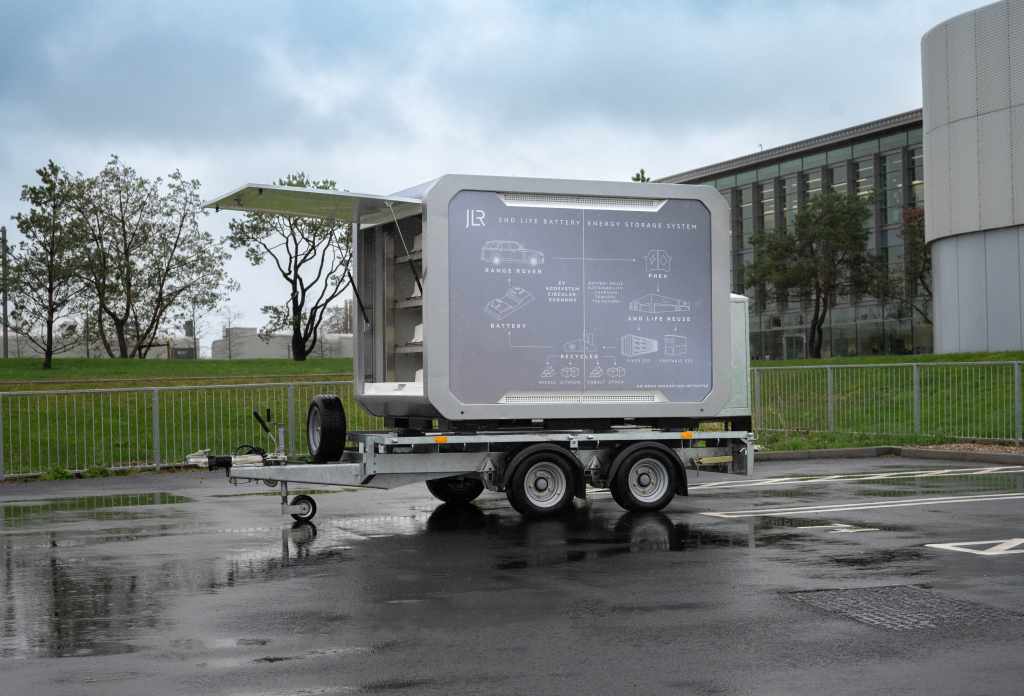
JLR, as the company has been known since 2023, partnered with energy storage start-up Allye Energy to create the Allye Max battery energy storage system (BESS) which contains seven second-life Range Rover battery packs.

Each Allye Max BESS can store 270kWh of energy at full capacity and needs no additional processing to incorporate the seven Range Rover battery packs – meaning they can be taken straight from the car and slotted into the customised racks.

Weighing 3.5 tonnes, the Allye Max BESS is capable of being fully portable or stationary, and will be used to provide energy storage for retailers or JLR sites – helping the company’s network of retailers better make use of renewable energy sources like solar.

Image Credit: JLR
Image Credit: JLR

While there are hopefully more use cases on offer, JLR says each BESS is capable of charging up to nine Range Rover PHEVs at any one time while also being easily charged by plugging it into any CCS-capable vehicle charger using the same input as JLR’s existing PHEV and BEV product portfolio.

Multi-input connectivity made available by powerlock connections also enables the BESS to connect to renewable power at fixed or off-grid sites, meaning that it could be used to replace diesel generators used in various off-grid situations

JLR is looking to use the new battery systems to power off-grid vehicle launches, events, and vehicle testing in remote areas.

“Developing second-life battery projects like this is crucial if we want to make sustainability real in JLR and drive us towards achieving our carbon net zero target by 2039,” said Reuben Chorley, sustainable industrial operations director at JLR.


 

Joshua S. Hill is a Melbourne-based journalist who has been writing about climate change, clean technology, and electric vehicles for over 15 years. He has been reporting on electric vehicles and clean technologies for Renew Economy and The Driven since 2012. His preferred mode of transport is his feet.

Related Topics

Latest posts

France and Germany cut deal to delay phase out of internal combustion cars, reports say

France and Germany cut deal to delay phase out of internal combustion cars, reports say

France and Germany have agreed to push for a further weakening of the EU’s planned phaseout of new combustion engine cars, a deal that could break a months-long deadlock among member states, business daily Handelsblatt and newspaper Frankfurter Allgemeine Zeitung reported. In exchange for French support on cars, Germany will back France’s demands for strict “Buy […]
The Driven Podcast: EVs outsell petrol again as Hyundai scraps Ioniq 3 Australian launch

The Driven Podcast: EVs outsell petrol again as Hyundai scraps Ioniq 3 Australian launch

EVs outsell petrol cars again as we unpack September’s sales figures, Hyundai scraps its Australian launch plans for the Ioniq 3, and we share our first impressions of Honda’s new Super-One electric car. Plus, all the other big EV news of the week.
A seven-fold boost in low-cost EV sales has transformed the new car market in Europe, new report finds

A seven-fold boost in low-cost EV sales has transformed the new car market in Europe, new report finds

EV sales in Europe have jumped 45 per cent in 2026, driven by a seven-fold increase in sales of low cost electric cars – with Scandinavia leading the charge.
Reader’s Question: Should I choose the unfashionable tyre option for my EV?

Reader’s Question: Should I choose the unfashionable tyre option for my EV?

Going for smaller/wheel higher profile tyre options may not be fashionable – but they offer advantages on less-than-perfect road surfaces, add more range, and cost less.