A new analysis from BloombergNEF (BNEF) has raised concerns over an unchecked industry-wide increase in electric vehicle (EV) range that could lead to even earlier battery supply issues.
In BNEF’s recent Electric Vehicle Outlook, the globally respected energy analysts examined the impact on battery demand under different EV range scenarios.
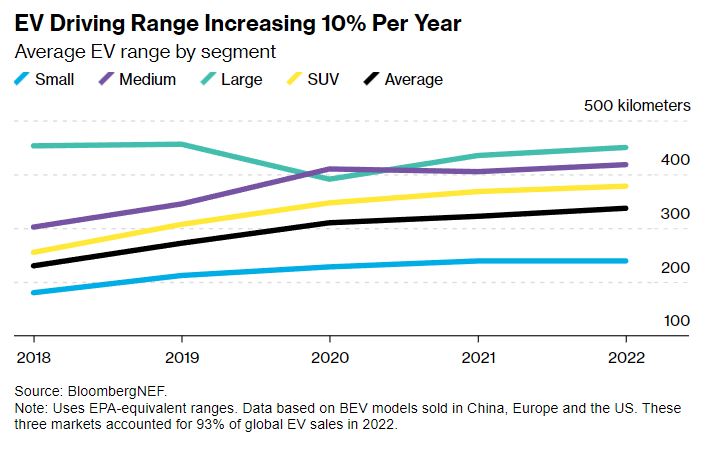
Currently, according to BNEF, the average range of fully electric vehicles across the globe jumped from 230 kilometres to 337 kilometres between 2018 and 2022.
This number is even higher in the United States, where the dominance of Tesla’s longer-range models push the average EV range even higher, but is worsened by the push for larger and heavier vehicles, and even longer driving distances.
To deliver an increase in range, average lithium-ion battery pack sizes have had to increase, growing 10% annually over the same five-year period from 40kWh to 60kWh.
But they are getting bigger and bigger, and many large and luxury EVs and large electric utes now come with battery packs of 100kWh or more, increasing the distance needed to be travelled before the extra emissions of the battery are “paid back.”
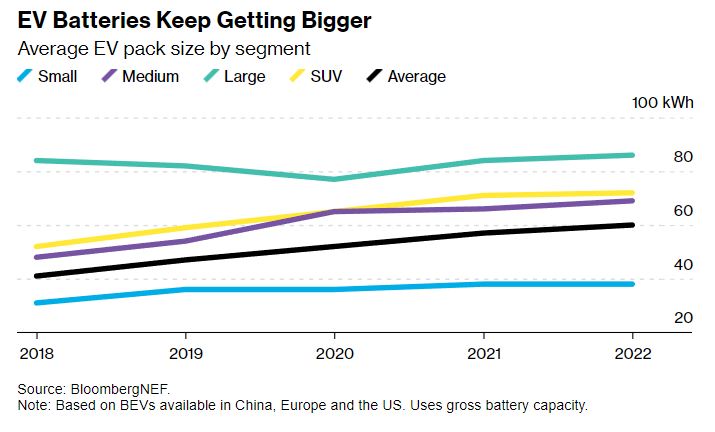
As BNEF highlight, the recent wave of electric pickups/utes are only serving to exacerbate the demand for higher-capacity battery packs and increased EV range.
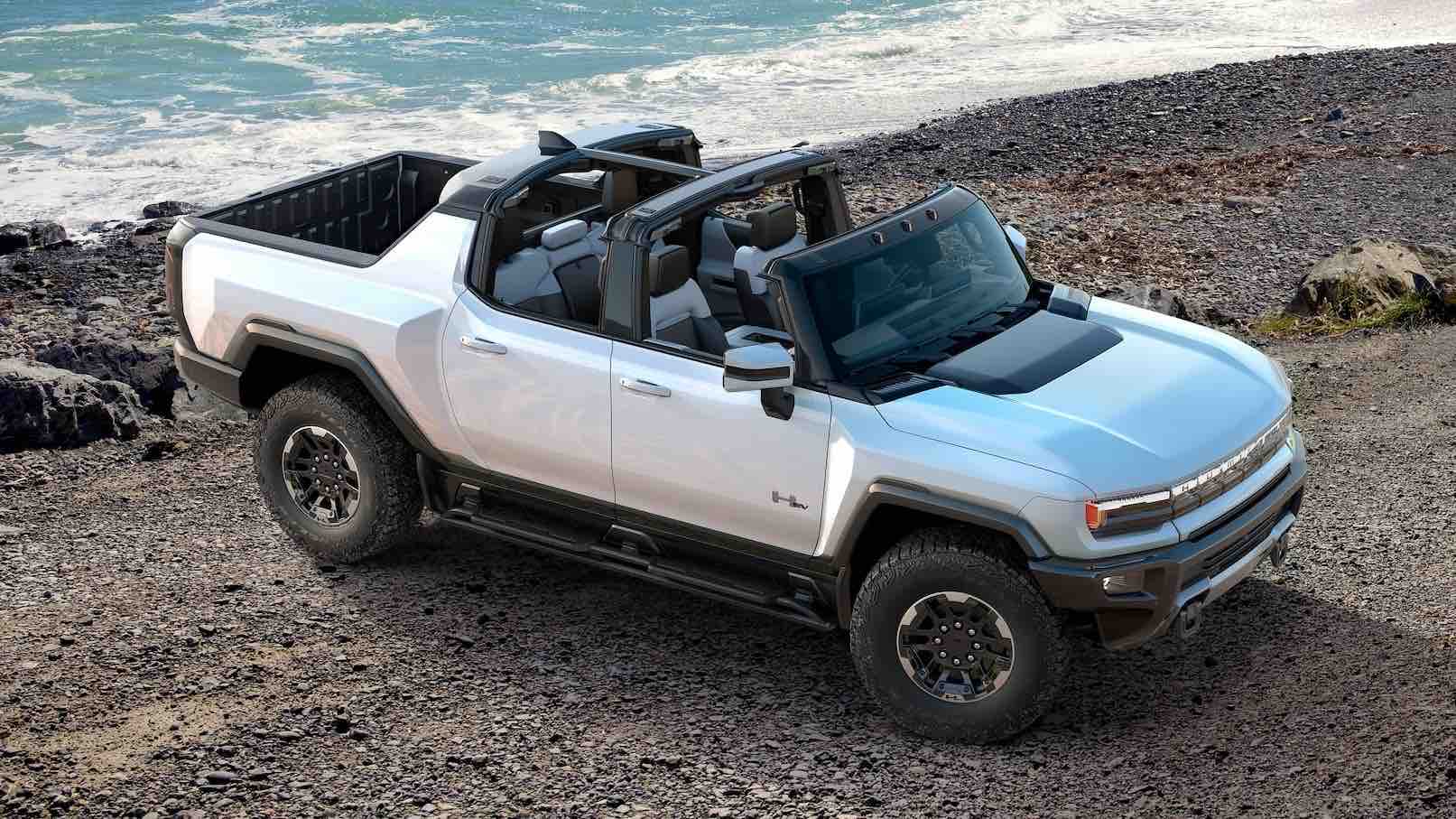
Already the market is anticipating and relishing in the launch of the Ford F-150 Lightning, the Chevy Silverado EV, the RAM 1500 REV, the Hummer and Tesla’s Cybertruck.
BNEF does say that the consequences of this increase in range and battery pack size will lead to supply chain issues if left unchecked. And while increased range makes sense – drivers want to be able to drive further and pack more power in their cars – the lack of public charging has definitely had an undue impact on driver’s concerns over EV range.
BNEF analysed three EV range scenarios and, in the base case, saw EV ranges plateau in the next few years between 400km to 500km, depending on the segment: For example, small city cars in markets like China, Japan, and India have not followed the trend for ever-increasing EV range.
However, in BNEF’s growth scenario, EV ranges in each segment continue to grow at around 5% each year out to 2030. And while BNEF admits that’s “slower than the last few years”, it nevertheless remains “a significant increase.”
Naturally, with these predicted increases, battery demand in 2030 is almost 50% higher in the growth scenario compared with the base case scenario.
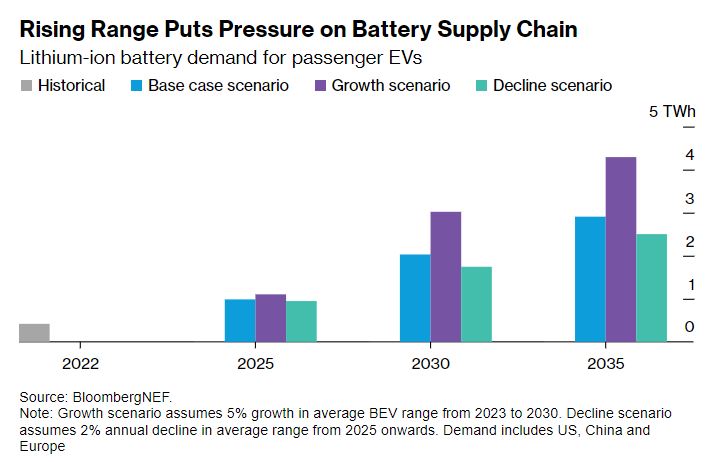
In turn, demand for materials like lithium increase, “which are already set to rocket in the years ahead” and which inevitably “pushes the lithium market quite sharply into deficit by 2030 and could lead to a dramatic price spike similar to what happened in 2021 and 2022.”
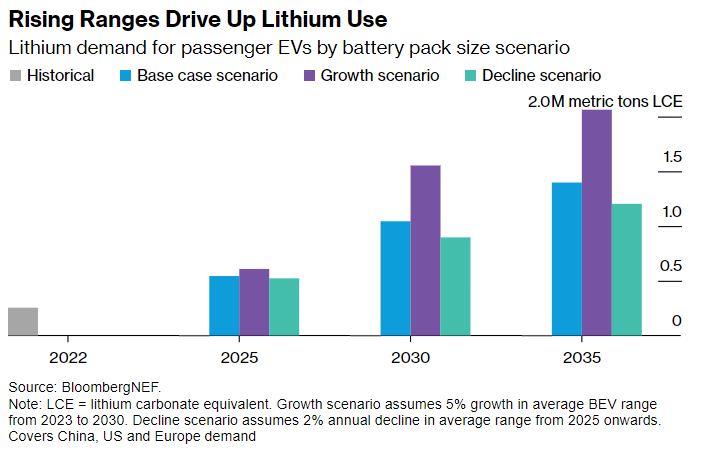
Under the higher-range scenario, nickel supply also looks “very challenging” according to BNEF, though the “affect on materials like cobalt is less significant because its use is already being pushed out by lithium-ion phosphate batteries and other formulations using lower amounts of the metal.”
“So, what can policymakers do to get a handle on this?” BNEF asked.
“The first step is to focus purchase incentives on smaller, lower-price vehicles. Purchase incentives should come with a price cap, ideally one referenced at or below the average transaction cost of a vehicle in a given market.
“More importantly, governments should be supporting large investments in public charging infrastructure.
“The best way to convince consumers that they don’t need excessive range and giant batteries is to show them that public charging options are plentiful, reliable, and convenient. Each individual consumer over-buying the range they need is hugely inefficient by comparison.”
And even if policymakers fail in reigning in this trend, the economics will eventually force a change.