
Claims that the price of petrol would need to hit $3.85 before battery-powered electric vehicles become cost-competitive to cars with an internal combustion engine (ICE) have been called out by a Youtuber and EV owner, who says that the sums don’t stack up.
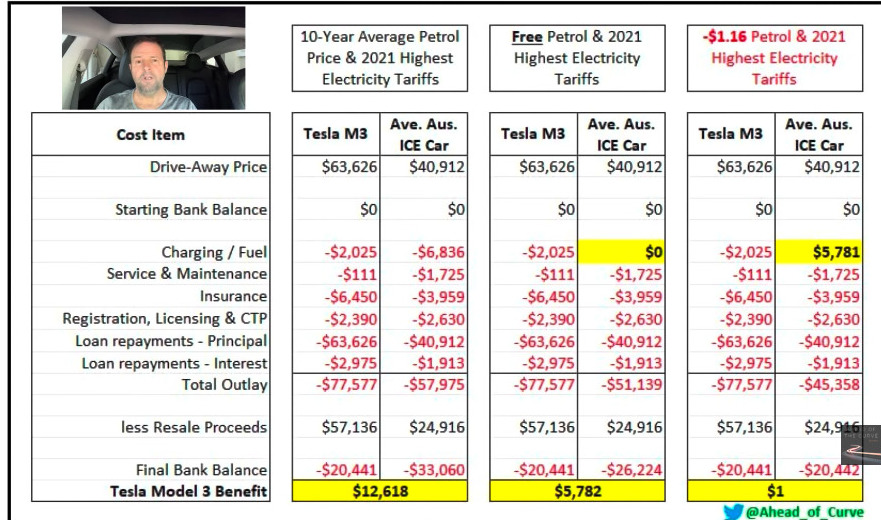
In fact, he says that buying an ICE car today would leave the owner up to $12,000 out of pocket, and to break even with an EV owner the petrol companies would have to pay ICE owners $1.16 a litre.
The wildly different numbers have emerged as petrol prices top $2.00 in Australia and – as some consumers begin to look to alternatively-powered vehicles to escape the bowser – the Australasian Convenience and Petroleum Marketers Association (ACAPMA) released a report seeking to convince drivers to stick with ICE cars for the time being.
But the equations that form the basis of the report are rubbish, says Pete Petrovsky, who owns a Tesla and put together comprehensive sums in November to underline how much less EVs cost to own compared to ICE cars.
The ACAPMA report, as reported by the ABC’s Daniel Mercer, claims that “analysis was based on an average price premium of $25,000 for an EV compared with an internal combustion engine model.”
“I call BS on this,” says Petrovsky in a video he released countering the claims (see the bottom of this article).
The figures used in the ABC article were sourced from a piece titled “EVs – ‘Zeal’ versus ‘Real’” published on a news website run by the ACAPMA, which argues that rising petrol prices are not driving consumers to buy electric cars, because petrol is not expensive enough yet.
In response to an enquiry from The Driven, APACMA CEO Mark Mackenzie confirmed this article formed the basis of the ABC article and there was “no fancy analysis.” He also said: “We are agnostic on mobility energy (we will put fairy floss in peoples’ cars if that is their mobility energy source of choice).”
The report looks at a five-year cost of ownership, and says that the average fuel consumption of new cars sold today is 8 litres per 100km, and therefore an average annual fuel cost is $2,420 if about 1,210 litres are burned per year driving 15,000km.
It assumes that the price premium of an average EV over an ICE car is $20,000, and that charging the EV is free from solar.
It says that over five years of ownership, the depreciation of that average ICE vehicle would be $8,000, and seems to assume that the depreciation of the EV would be the same.
“In order for the first owner of an EV to break even, the average petrol price would need to be at least $3.50 per litre, which makes a complete mockery of current claims that the high price of petrol is driving people to consider EVs”, ACAPMA CEO Mark McKenzie said in the article.
ACAPMA takes the $20,000 price premium and divides it by 6,050 litres, producing $3.30 a litre as the basis of its argument.
Petrovsky, however goes further than this, including charging costs of the EV based on electricity prices, and takes an average fuel cost over the past 10 years.
He includes sundry costs such as servicing, maintenance, finance, insurance and registration fees. Importantly, he also includes a different resale value for the VE and the ICE – a sum that is somewhat speculative but not unreasonable given that ICE cars are likely to become less desirable as petrol prices continue to soar.
The answer using these assumptions is that the Model 3 owner would come out $12,000 ahead.
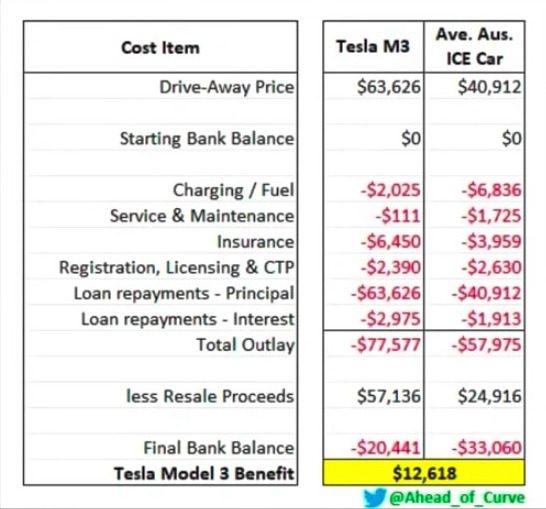
In fact, extrapolating a bit further, Petrovksy concludes that even if petrol were free, the Model 3 owner would be some $7,000 head, and ICE owners would not break even until petrol companies were paying them $1.16 a litre to take it away.
“It’s not surprising to see a fossil fuel lobby self-servingly spread misinformation and cast doubt over the viability of EVs in an attempt to slow down the transition away from fossil fuels, currently their life blood, but the interests of their members would be better served by providing objective information and useful education,” Petrovsky said in a note to The Driven.
“Petrol station owners have a choice to either cling to a dying business model targeting a shrinking customer base or invest in serving an increasingly growing market. If they don’t, others will.”
To hear Petrovsky’s full break down of his EV vs ICE ownership sums, you can view his video here: